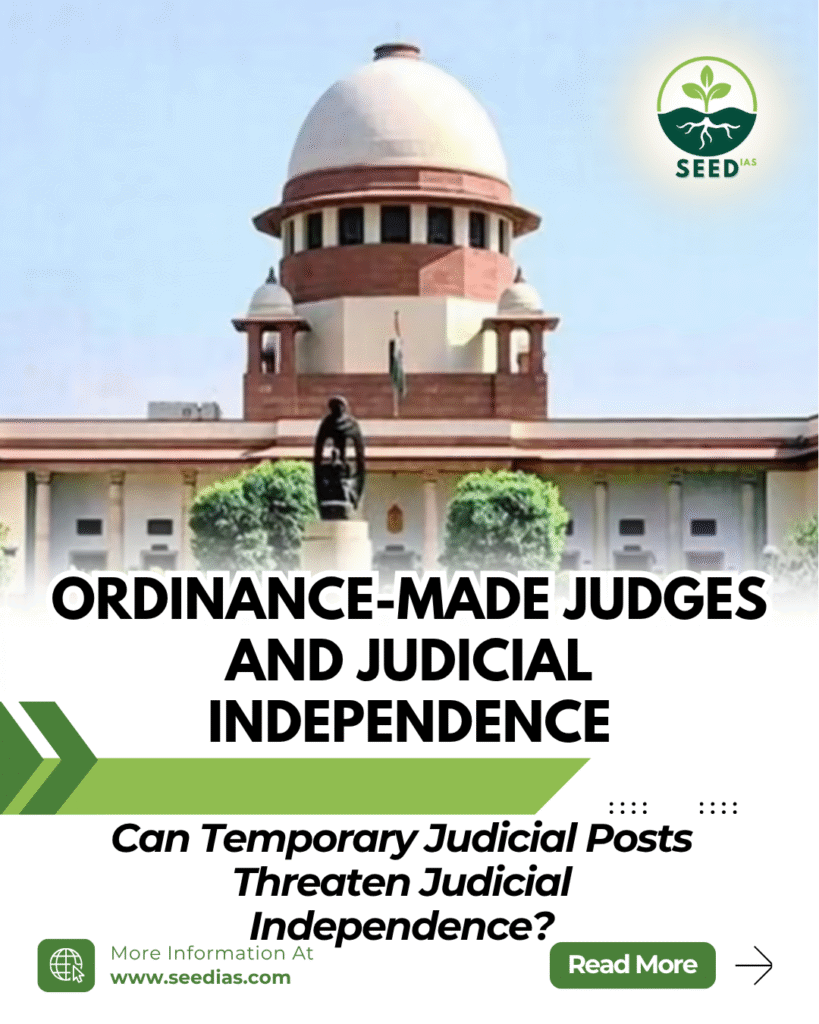
CONTEXT OF THE NEWS
The appointment of five new Supreme Court judges has sparked a constitutional debate because three judges were appointed to posts created through the Supreme Court (Number of Judges) Amendment Ordinance, 2026, instead of a regular Act passed by Parliament.
The controversy has raised concerns regarding judicial independence, security of tenure, separation of powers, and the limits of the Ordinance-making power.
BACKGROUND
Strength of the Supreme Court: Constitutional Framework
Article 124(1)
The Constitution originally provided for:
- Chief Justice of India (CJI)
- Not more than seven other judges
However, Parliament may by law increase the number of judges.
Thus, the power to determine the strength of the Supreme Court rests with Parliament, not the Executive.
Evolution of Supreme Court Strength
| Year | Sanctioned Strength |
|---|---|
| 1950 | CJI + 7 Judges |
| 2009 | 31 Judges |
| 2019 | 34 Judges |
| 2026 (Ordinance) | 37 Judges |
Normal Procedure for Increasing Supreme Court Strength
- Chief Justice of India recommends additional judges.
- Proposal sent to the Ministry of Law and Justice.
- Consultation with relevant ministries.
- Union Cabinet approves amendment proposal.
- Bill introduced in Parliament.
- Passed by both Houses through simple majority.
- Receives Presidential assent.
- New judges appointed through the Collegium System.
NEWS BREAKDOWN
What is the Constitutional Issue?
The Supreme Court’s sanctioned strength was increased through the:
Supreme Court (Number of Judges) Amendment Ordinance, 2026
Instead of:
- Parliamentary debate
- Passage of an Amendment Bill
The Executive used the President’s Ordinance-making power.
This has led to questions regarding constitutional propriety.
What is an Ordinance?
Article 123
Article 123 empowers the President to promulgate Ordinances when:
- Parliament is not in session.
- Immediate legislative action is necessary.
Key Features
| Feature | Ordinance |
| Issued by | President |
| Based on | Advice of Council of Ministers |
| Force | Same as an Act of Parliament |
| Nature | Temporary |
| Validity | Six weeks after Parliament reassembles unless approved |
Why Was This Power Created?
The Ordinance-making power was intended for:
- Emergencies
- Urgent situations
- Legislative gaps when Parliament is not sitting
It was never meant to become an alternative route for ordinary legislation.
SUPREME COURT’S VIEW ON ORDINANCES
R.C. Cooper v. Union of India (1970)
Key Principle
The President’s satisfaction under Article 123 is not beyond judicial review.
An Ordinance can be challenged if:
- Issued in bad faith (Mala Fide)
- Represents a Colourable Exercise of Power
Definition: Colourable Exercise of Power
When a constitutional authority appears to act within its powers but actually pursues an impermissible objective.
D.C. Wadhwa v. State of Bihar (1986)
Key Principle
Repeated re-promulgation of Ordinances is a:
“Fraud on the Constitution.”
The Court held that executive legislation cannot replace legislative scrutiny.
Gokaraju Rangaraju v. State of Andhra Pradesh (1981)
The De Facto Doctrine
Judicial decisions remain valid even if the appointment of the judge is later found defective.
Purpose
To prevent:
- Legal chaos
- Endless litigation
- Invalidity of judgments
Krishna Kumar Singh v. State of Bihar (2017)
A Seven-Judge Constitution Bench ruled:
- Ordinance power is exceptional.
- It is not a parallel source of legislation.
- Executive convenience cannot replace parliamentary deliberation.
WHY ARE ORDINANCE-CREATED JUDICIAL POSTS CONTROVERSIAL?
1. Threat to Judicial Independence
Definition
Judicial Independence means judges must function free from:
- Political influence
- Executive pressure
- Legislative interference
The judiciary forms part of the Basic Structure Doctrine.
Concern
An Ordinance:
- Can lapse
- Can be withdrawn
- Requires later legislative approval
Thus, judges appointed to such posts may appear dependent on executive action.
2. Security of Tenure Concerns
Definition
Security of Tenure means judges should enjoy a stable position protected from political uncertainty.
If the Ordinance lapses:
- The additional posts may disappear.
- Questions may arise regarding the status of judges occupying those posts.
3. Optics of Conflict of Interest
Important Fact
The Union Government is the largest litigant before the Supreme Court.
Critics argue that:
- The Executive created the posts.
- The same Executive appears before the Court.
This creates concerns about institutional neutrality.
4. Contradiction with NJAC Judgment (2015)
What was NJAC?
National Judicial Appointments Commission (NJAC) was created to replace the Collegium System.
The Supreme Court struck it down in 2015.
Court’s Reasoning
The Executive should not gain influence over judicial appointments.
Current Criticism
Critics argue that accepting Ordinance-created posts indirectly makes judicial positions dependent on Executive action.
5. Legal Uncertainty if Ordinance Lapses
Possible Scenario
If Parliament:
- Rejects the Bill, or
- Fails to pass the Bill,
the sanctioned strength may revert from 37 to 34 judges.
This creates a constitutional anomaly:
Key Question
What happens to sitting judges occupying posts that no longer legally exist?
The Constitution provides no explicit answer.
6. Institutional Uncertainty for Junior Judges
The Collegium appears to expect that:
- Retirements will create permanent vacancies.
- Ordinance-appointed judges will shift into those vacancies.
However, if the Ordinance expires before such vacancies arise, legal ambiguity remains.
7. Pendency Argument Under Scrutiny
Government’s Justification
Additional judges are needed to tackle approximately 93,000 pending cases.
Counter Argument
Previous expansions in:
- 2008
- 2019
did not significantly reduce pendency.
Root Cause
Experts point to excessive admission of:
Special Leave Petitions (SLPs)
Article 136
Allows the Supreme Court to grant special leave to appeal against judgments of lower courts.
Many scholars argue that expanding the Court without reforming SLP admissions merely increases workload.
HOW CAN JUDICIAL INDEPENDENCE BE PROTECTED?
Clarifying the De Facto Doctrine
The Supreme Court should clarify that:
- The doctrine protects past judgments.
- It does not permanently validate defective institutional arrangements.
Prudent Swearing-In Protocol
The Collegium may consider an institutional convention:
- Judges appointed to newly created posts should assume office only after Parliament approves the legislation.
This would strengthen public confidence.
Recusal in Sensitive Cases
Recusal
A judge voluntarily abstains from hearing a case.
Judges occupying Ordinance-created seats may avoid hearing:
- Constitutional disputes
- Cases involving the Union Government
until the posts receive statutory backing.
Strengthening Parliamentary Oversight
Major institutional changes affecting constitutional bodies should ordinarily occur through:
- Parliamentary debate
- Legislative scrutiny
- Democratic accountability
rather than emergency executive powers.
PRELIMS FOCUS
Important Constitutional Provisions
| Provision | Subject |
| Article 123 | Ordinance-making power of President |
| Article 124 | Supreme Court |
| Article 136 | Special Leave Petition |
| Article 141 | Law declared by Supreme Court binding on all courts |
| Article 368 | Constitutional Amendment |
Important Judgments
| Case | Principle |
| R.C. Cooper (1970) | Ordinance subject to judicial review |
| D.C. Wadhwa (1986) | Re-promulgation is fraud on Constitution |
| Gokaraju Rangaraju (1981) | De Facto Doctrine |
| NJAC Case (2015) | Judicial primacy in appointments |
| Krishna Kumar Singh (2017) | Ordinance power is exceptional |
Key Terms
- Judicial Independence
- Security of Tenure
- Basic Structure Doctrine
- Separation of Powers
- De Facto Doctrine
- Special Leave Petition (SLP)
CONCLUSION
Judicial independence requires that Supreme Court posts be created through parliamentary legislation, ensuring judges remain insulated from executive uncertainty and political contingencies.
PRELIMS CHECK
Question 1
With reference to Article 123 of the Constitution, consider the following statements:
- An Ordinance has the same force and effect as an Act of Parliament.
- An Ordinance automatically becomes a permanent law if Parliament does not reject it.
- An Ordinance ceases to operate six weeks after Parliament reassembles unless approved.
Which of the statements given above is/are correct?
(a) 1 and 2 only
(b) 1 and 3 only
(c) 2 and 3 only
(d) 1, 2 and 3
Question 2
Consider the following judgments:
- R.C. Cooper v. Union of India
- D.C. Wadhwa v. State of Bihar
- Krishna Kumar Singh v. State of Bihar
Which of the above judgments dealt substantially with the constitutional limits of Ordinance-making power?
(a) 1 and 2 only
(b) 2 and 3 only
(c) 1, 2 and 3
(d) 3 only
Question 3
Consider the following statements:
Statement-I:
Judicial independence forms part of the Basic Structure of the Constitution.
Statement-II:
The Supreme Court in the NJAC judgment held that executive influence over judicial appointments may undermine judicial independence.
Which one of the following is correct?
(a) Both Statement-I and Statement-II are correct and Statement-II explains Statement-I
(b) Both Statement-I and Statement-II are correct but Statement-II does not explain Statement-I
(c) Statement-I is correct but Statement-II is incorrect
(d) Statement-I is incorrect but Statement-II is correct
ANSWERS
Answer 1: (b)
Explanation:
- Ordinances have the same force as Acts of Parliament.
- They do not become permanent automatically.
- Parliamentary approval is mandatory for continuation.
Answer 2: (c)
Explanation:
- R.C. Cooper allowed judicial review of Ordinances.
- D.C. Wadhwa condemned repeated re-promulgation.
- Krishna Kumar Singh emphasized that Ordinance power is exceptional.
Answer 3: (a)
Explanation:
- Judicial independence is part of the Basic Structure Doctrine.
- The NJAC judgment protected judicial primacy in appointments.
- Executive influence was considered a potential threat to independence.
“Constitutional institutions remain strongest when their legitimacy rests on law, not convenience, and on principles, not expediency.”