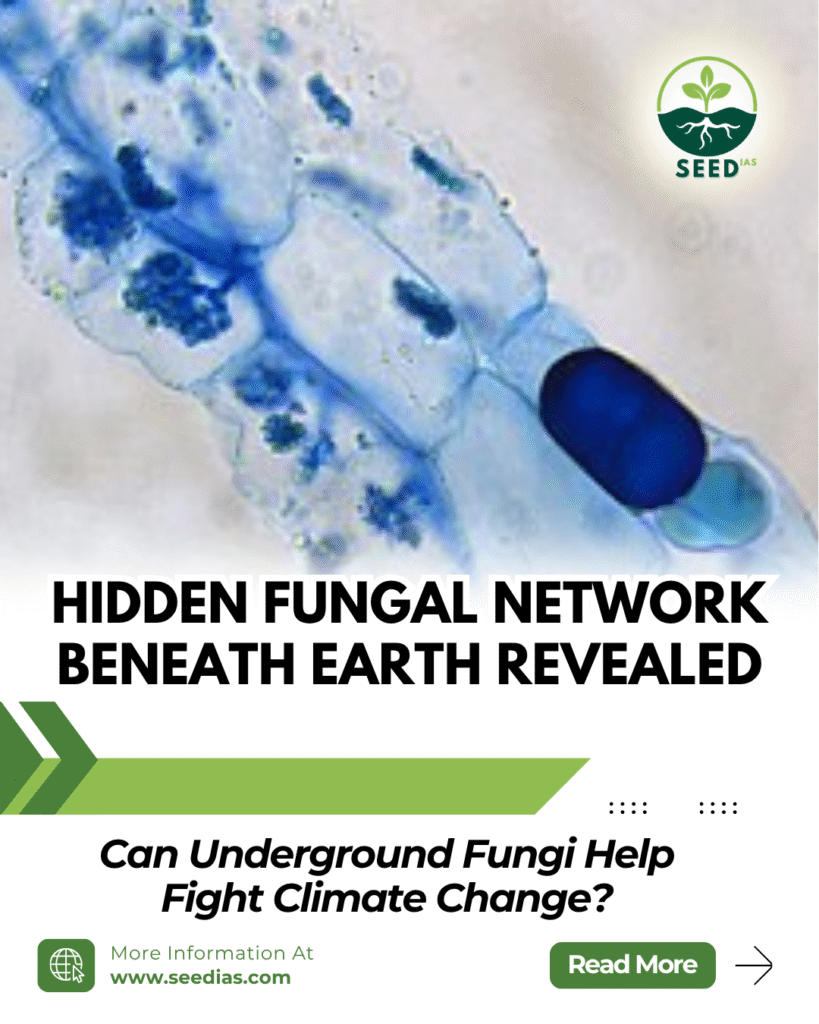
Context of the News
A recent study published in the journal Science has, for the first time, mapped the global underground network of Arbuscular Mycorrhizal (AM) Fungi. Using Machine Learning and data from over 16,000 soil cores, researchers estimated that these fungal networks extend across approximately 110 quadrillion kilometres, highlighting their immense ecological and climate significance.
Background
What is Mycorrhiza?
Mycorrhiza refers to a mutually beneficial association between fungi and plant roots.
The term originates from:
- Mykes = Fungus
- Rhiza = Root
In this relationship:
- Plants provide carbon-rich food to fungi.
- Fungi supply water and nutrients to plants.
This partnership is among the oldest biological relationships on Earth.
Evolutionary Importance
Scientists believe that fungi played a critical role in helping plants colonize land around 450 million years ago.
Arbuscular Mycorrhizal Fungi (AMF) are considered among the earliest fungal partners of terrestrial plants.
News Breakdown
What are Arbuscular Mycorrhizal (AM) Fungi?
Definition
Arbuscular Mycorrhizal Fungi (AMF) are fungi belonging to the Phylum Glomeromycota that form symbiotic associations with plant roots.
Key Facts
- Found in association with 70–90% of all land plant species.
- Represent one of the most widespread terrestrial symbiotic relationships.
- Present across forests, grasslands, agricultural lands, and deserts.
Why are AM Fungi Called “Living Fossils”?
Living Fossils
A Living Fossil is an organism that has remained relatively unchanged over millions of years.
Ancient Asexuals
AM fungi are often called Ancient Asexuals because:
- They have existed since the earliest land plants.
- No confirmed sexual reproductive stage has been observed.
- They have survived major extinction events.
Significance
Their long evolutionary history offers insights into:
- Early terrestrial ecosystems.
- Evolution of plant-fungal interactions.
- Long-term ecological stability.
Structure of AM Fungal Networks
What are Hyphae?
Hyphae are thin, thread-like fungal filaments that collectively form a fungal network.
How Do They Function?
The fungal network acts as a biological transportation system.
| Movement from Soil to Plant | Movement from Plant to Fungus |
|---|---|
| Water | Carbon compounds |
| Phosphorus | Sugars |
| Nitrogen | Photosynthetic products |
| Micronutrients | Organic carbon |
Why is this Important?
The network increases the root system’s effective reach, allowing plants to access nutrients from larger soil volumes.
Major Findings of the Study
Scale of the Underground Network
Researchers estimated that fungal hyphae collectively span:
110 Quadrillion Kilometres. This is one of the largest biological networks ever documented.
Methodology
The study utilized:
- More than 16,000 soil cores
- Advanced Machine Learning models
- Global ecological datasets
Ecological Importance of AM Fungi
Natural Biofertilizers
What is a Biofertilizer?
A Biofertilizer is a living organism that improves nutrient availability and soil fertility naturally.
Functions of AM Fungi
- Enhance nutrient absorption.
- Improve water uptake.
- Promote plant growth.
- Increase drought resistance.
- Protect plants from pathogens.
Agricultural Importance
AM fungi can reduce dependence on:
- Chemical fertilizers
- Excessive irrigation
- Synthetic soil amendments
Role in Soil Health
AM fungi are among the most important biological components of soil ecosystems.
Their Contributions
- Improve soil structure.
- Increase soil aggregation.
- Enhance nutrient cycling.
- Support microbial diversity.
- Improve ecosystem productivity.
Impact of Decline
Reduced fungal populations can lead to:
- Lower soil fertility.
- Reduced agricultural productivity.
- Declining ecosystem resilience.
Biodiversity Hotspots of AM Fungi
What is a Biodiversity Hotspot?
A Biodiversity Hotspot is a region with exceptionally high biological diversity and ecological significance.
Key Regions Identified
Approximately 40% of global AM fungal networks are concentrated in grassland ecosystems.
Important hotspots include:
- South Sudan Grasslands
- Tibetan Plateau
- Banni Grasslands (India)
About Banni Grasslands
Location
- Situated in Kachchh District, Gujarat.
- Located near the Great Rann of Kutch.
Importance
- Asia’s largest tropical grassland ecosystem.
- Rich in biodiversity.
- Supports pastoral communities.
- Acts as an important carbon sink.
Climate Change and Carbon Storage
Carbon Sequestration
What is Carbon Sequestration?
Carbon Sequestration is the process of capturing and storing atmospheric carbon dioxide to reduce climate change.
Key Findings
AM fungal networks store approximately:
300 Million Tonnes of Carbon
This is about:
4–6 times the total weight of the global human population.
Contribution to Climate Mitigation
Annual Carbon Capture
AM fungi help sequester approximately:
4 Billion Tonnes of CO₂-equivalent annually
Why is this Significant?
This contribution:
- Reduces atmospheric carbon dioxide.
- Supports climate stabilization.
- Enhances ecosystem resilience.
- Complements nature-based climate solutions.
Threats to AM Fungal Networks
Agricultural Intensification
Key Finding
Cropland ecosystems contain approximately:
50% lower fungal density than natural ecosystems.
Reasons
- Intensive tillage.
- Excessive fertilizer use.
- Monoculture farming.
- Soil degradation.
Grassland Conversion
Conversion of natural grasslands into:
- Urban settlements
- Industrial zones
- Intensive agriculture
can destroy fungal networks that have taken centuries to develop.
Policy Implications
The study highlights the need to:
- Protect natural grasslands.
- Promote sustainable agriculture.
- Restore degraded soils.
- Integrate soil biodiversity into climate policies.
- Recognize fungal ecosystems in conservation planning.
Why is this Important for UPSC?
Environment
- Soil biodiversity.
- Ecosystem functioning.
- Grassland conservation.
Agriculture
- Sustainable farming.
- Biofertilizers.
- Soil health management.
Climate Change
- Carbon sinks.
- Nature-based solutions.
- Climate mitigation strategies.
Science & Technology
- Application of Machine Learning in ecological research.
- Biological networks and ecosystem mapping.
Prelims Focus
High-Value Facts
- Arbuscular Mycorrhizal Fungi (AMF) belong to Phylum Glomeromycota.
- AM fungi form associations with 70–90% of land plants.
- AM fungi are often called Living Fossils and Ancient Asexuals.
- Hyphae are thread-like fungal structures responsible for nutrient transport.
- Banni Grasslands are located in Gujarat.
- AM fungi improve absorption of Phosphorus, Nitrogen, and water.
- AM fungi are classified as mutualistic symbionts.
- Grasslands are among the world’s most important carbon storage ecosystems.
- Soil biodiversity is increasingly recognized under global climate and ecosystem restoration frameworks.
Conclusion / Way Forward
Protecting underground fungal networks is essential for sustainable agriculture, biodiversity conservation, and long-term climate resilience through nature-based solutions.
Prelims Check
Question 1
With reference to Arbuscular Mycorrhizal (AM) fungi, consider the following statements:
- They belong to the phylum Glomeromycota.
- They form symbiotic associations with the roots of most land plants.
- They primarily obtain nutrients from plants without providing any ecological benefit.
Which of the statements given above are correct?
(a) 1 and 2 only
(b) 2 and 3 only
(c) 1 and 3 only
(d) 1, 2 and 3
Question 2
Consider the following statements:
- Hyphae are thread-like structures of fungi.
- Arbuscular mycorrhizal fungi enhance phosphorus uptake in plants.
- Cropland ecosystems generally have higher AM fungal density than natural grasslands.
Which of the statements given above are correct?
(a) 1 and 2 only
(b) 2 and 3 only
(c) 1 and 3 only
(d) 1, 2 and 3
Question 3
Consider the following pairs:
| Region | Feature |
| 1. Banni Grasslands | Gujarat |
| 2. Tibetan Plateau | AM fungal hotspot |
| 3. Great Rann of Kutch | Tropical rainforest ecosystem |
How many of the above pairs are correctly matched?
(a) Only one
(b) Only two
(c) All three
(d) None
Answers
Q1 Answer: (a)
Explanation:
- AM fungi belong to Glomeromycota.
- They associate with 70–90% of land plants.
- They provide nutrient and water uptake benefits; hence Statement 3 is incorrect.
Q2 Answer: (a)
Explanation:
- Hyphae are fungal filaments that transport nutrients.
- AM fungi significantly improve phosphorus absorption.
- Croplands typically have lower fungal density than natural ecosystems.
Q3 Answer: (b)
Explanation:
- Banni Grasslands are located in Gujarat.
- The Tibetan Plateau is identified as an important AM fungal hotspot.
- The Great Rann of Kutch is a salt marsh ecosystem, not a tropical rainforest.
“Nature’s greatest strengths often remain unseen. Like roots beneath the soil, your consistent efforts today will support extraordinary growth tomorrow.”