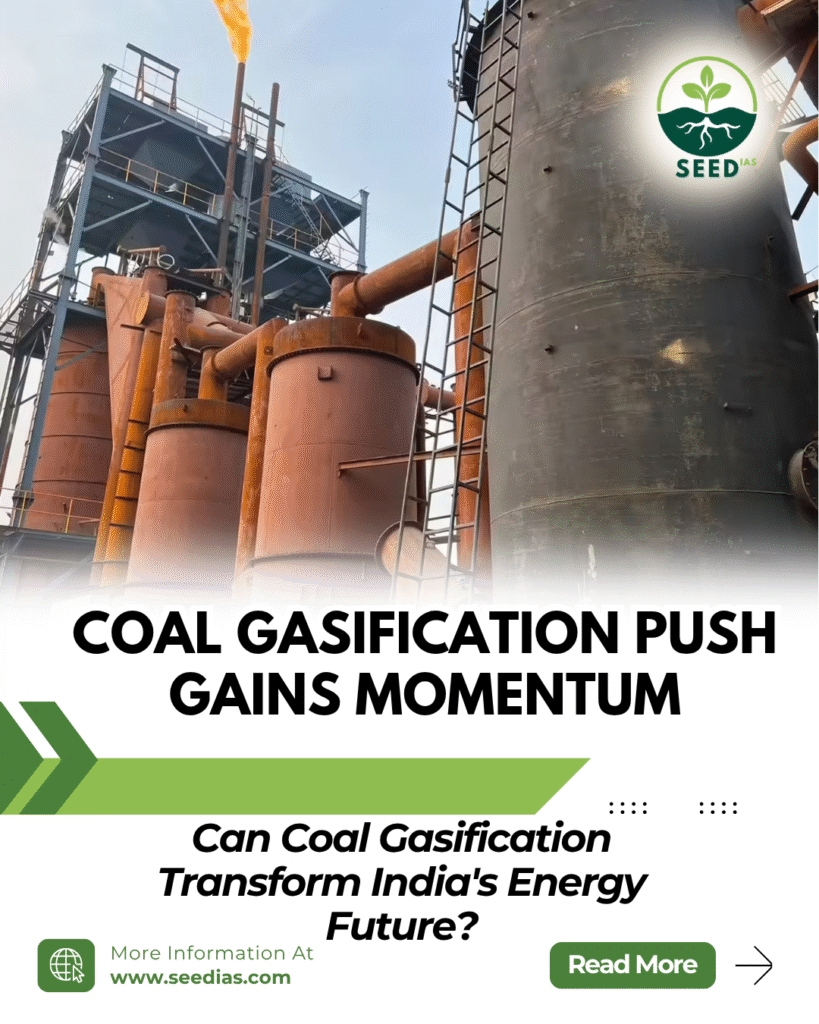
CONTEXT OF THE NEWS
The Ministry of Coal is organizing a major Roadshow on Coal and Lignite Gasification Projects in Hyderabad on 11 June 2026, following the strong response received during the earlier roadshow in New Delhi.
The event aims to accelerate investments, technology adoption, and project implementation in India’s emerging coal gasification sector.
BACKGROUND
India’s Energy Challenge
India possesses the world’s fifth-largest coal reserves and coal remains the backbone of the country’s energy sector.
However, excessive dependence on imported:
- Natural Gas
- Crude Oil
- Fertilizers
- Petrochemicals
creates strategic and economic vulnerabilities.
To reduce import dependence and improve energy security, the Government is promoting Coal Gasification as an alternative pathway for utilizing domestic coal resources.
National Coal Gasification Mission
The Government has set an ambitious target of achieving:
100 Million Tonnes (MT) of Coal Gasification by 2030
The initiative was announced to:
- Diversify coal utilization.
- Reduce imports.
- Promote clean coal technologies.
- Support industrial growth.
NEWS BREAKDOWN
What is Coal Gasification?
Definition
Coal Gasification is a process in which coal is converted into a combustible gas mixture called Synthesis Gas (Syngas) by reacting coal with controlled amounts of oxygen, steam, and heat.
What is Syngas?
Definition
Synthesis Gas (Syngas) is a fuel gas primarily composed of:
- Carbon Monoxide (CO)
- Hydrogen (H₂)
- Small quantities of Carbon Dioxide (CO₂)
It serves as an important industrial feedstock.
How Does Coal Gasification Work?
Step 1: Coal Processing
Coal is heated under controlled conditions.
Step 2: Partial Oxidation
Limited oxygen prevents complete combustion.
Step 3: Syngas Production
The process generates a mixture of:
- Hydrogen
- Carbon Monoxide
Step 4: Value Addition
Syngas is converted into various industrial products.
Products Obtained Through Coal Gasification
| Product | Major Use |
|---|---|
| Methanol | Fuel and chemicals |
| Ammonia | Fertilizer production |
| Ammonium Nitrate | Explosives and fertilizers |
| Synthetic Natural Gas (SNG) | Energy generation |
| Hydrogen | Clean energy applications |
| Industrial Chemicals | Manufacturing sector |
Why is Coal Gasification Important for India?
1. Energy Security
Definition
Energy Security refers to uninterrupted availability of energy at affordable prices.
Benefits:
- Better utilization of domestic coal.
- Reduced dependence on imported fuels.
- Improved strategic autonomy.
2. Import Substitution**
India imports significant quantities of:
- Natural Gas
- Methanol
- Fertilizer Feedstock
Coal gasification can reduce import bills by producing these products domestically.
3. Value Addition to Coal**
Instead of simply burning coal for power generation, gasification allows conversion into:
- Chemicals
- Fertilizers
- Clean fuels
This generates higher economic value.
4. Support for Aatmanirbhar Bharat**
Coal gasification aligns with the vision of:
Aatmanirbhar Bharat
through:
- Domestic manufacturing
- Industrial growth
- Reduced import dependency
Why is the Hyderabad Roadshow Important?
The roadshow will provide a platform for:
Policy Discussions
Stakeholders will discuss:
- Government incentives
- Regulatory support
- Investment facilitation
Technology Partnerships
Participation from:
- Technology providers
- Research institutions
- Industrial players
can accelerate project deployment.
Investment Opportunities
The event aims to attract:
- Domestic investors
- Foreign investors
- Public sector enterprises
- Private sector companies
into the coal gasification ecosystem.
Stakeholder Collaboration
Participants include:
- Ministry of Coal
- State Governments
- Coal companies
- Lignite companies
- Industry Associations
- Investors
Such collaboration is essential for large-scale implementation.
GOVERNMENT INITIATIVES FOR COAL GASIFICATION
Financial Incentive Scheme
The Government has approved financial assistance for coal gasification projects to promote:
- Commercial viability
- Technology adoption
- Industrial participation
Coal Gasification Projects
Major Public Sector Enterprises involved include:
- Coal India Limited (CIL)
- NLC India Limited
- Singareni Collieries Company Limited (SCCL)
National Green Hydrogen Mission Linkage
Coal gasification can contribute to:
- Hydrogen production
- Industrial decarbonization pathways
- Transition technologies
especially in hard-to-abate sectors.
CHALLENGES ASSOCIATED WITH COAL GASIFICATION
High Capital Cost
Gasification plants require:
- Advanced technology
- Large infrastructure investments
making projects capital-intensive.
Carbon Emissions
Although cleaner than conventional coal burning in some applications, gasification still produces:
- Carbon Dioxide (CO₂)
requiring Carbon Capture and Storage (CCS) technologies for long-term sustainability.
Water Requirement
Coal gasification consumes significant quantities of water.
This creates challenges in:
- Water-scarce regions
- Drought-prone areas
Technology Dependence
India continues to depend on foreign technologies in several advanced gasification processes.
WAY FORWARD
Technology Development
Promote indigenous research through:
- CSIR
- IITs
- Public Sector Enterprises
Carbon Capture Integration
Combine gasification projects with:
Carbon Capture, Utilization and Storage (CCUS)
to reduce environmental impact.
Public-Private Partnerships
Encourage greater participation of:
- Industry
- Investors
- Technology providers
for faster commercialization.
Integrated Energy Planning
Coal gasification should complement:
- Renewable Energy
- Green Hydrogen
- Energy Efficiency measures
to ensure a balanced energy transition.
PRELIMS FOCUS
Important Facts
- Coal Gasification converts coal into Syngas.
- Syngas mainly contains Carbon Monoxide (CO) and Hydrogen (H₂).
- Coal Gasification is a non-combustion process.
- Methanol can be produced from Syngas.
- Ammonia production uses Syngas as feedstock.
- India aims to achieve 100 Million Tonnes of Coal Gasification by 2030.
- Coal India Limited (CIL) is the largest coal producer in India.
- Synthetic Natural Gas (SNG) can be produced through gasification.
- Carbon Capture, Utilization and Storage (CCUS) can reduce emissions from gasification projects.
CONCLUSION
Coal gasification can strengthen India’s energy security, reduce import dependence, and support industrial growth, provided environmental concerns are addressed through cleaner technologies.
PRELIMS CHECK
Question 1
With reference to Coal Gasification, consider the following statements:
- It converts coal into synthesis gas.
- Syngas mainly consists of Hydrogen and Carbon Monoxide.
- Coal gasification involves complete combustion of coal.
Which of the statements given above are correct?
(a) 1 and 2 only
(b) 2 and 3 only
(c) 1 and 3 only
(d) 1, 2 and 3
Question 2
Consider the following products:
- Methanol
- Ammonia
- Synthetic Natural Gas
- Hydrogen
Which of the above can be produced directly or indirectly through coal gasification?
(a) 1 and 2 only
(b) 2, 3 and 4 only
(c) 1, 2 and 4 only
(d) 1, 2, 3 and 4
Question 3
Consider the following statements:
Statement-I:
Coal gasification can contribute to reducing India’s dependence on imported fuels and chemical feedstocks.
Statement-II:
Syngas produced during coal gasification can be converted into methanol, ammonia, and other industrial chemicals.
Which one of the following is correct?
(a) Both Statement-I and Statement-II are correct and Statement-II explains Statement-I
(b) Both Statement-I and Statement-II are correct but Statement-II does not explain Statement-I
(c) Statement-I is correct but Statement-II is incorrect
(d) Statement-I is incorrect but Statement-II is correct
ANSWERS
Answer 1: (a)
Explanation:
- Coal gasification converts coal into synthesis gas.
- Syngas primarily contains Hydrogen and Carbon Monoxide.
- Gasification involves partial oxidation, not complete combustion.
Answer 2: (d)
Explanation:
- Syngas can be converted into methanol.
- Ammonia production uses hydrogen-rich syngas.
- Synthetic Natural Gas and Hydrogen are important gasification products.
Answer 3: (a)
Explanation:
- Coal gasification enables domestic production of several imported products.
- Syngas serves as a feedstock for chemicals and fuels.
- This capability directly supports import substitution and energy security.
“Nations become self-reliant not merely by possessing resources, but by innovating ways to transform those resources into lasting prosperity.”