Context of the News
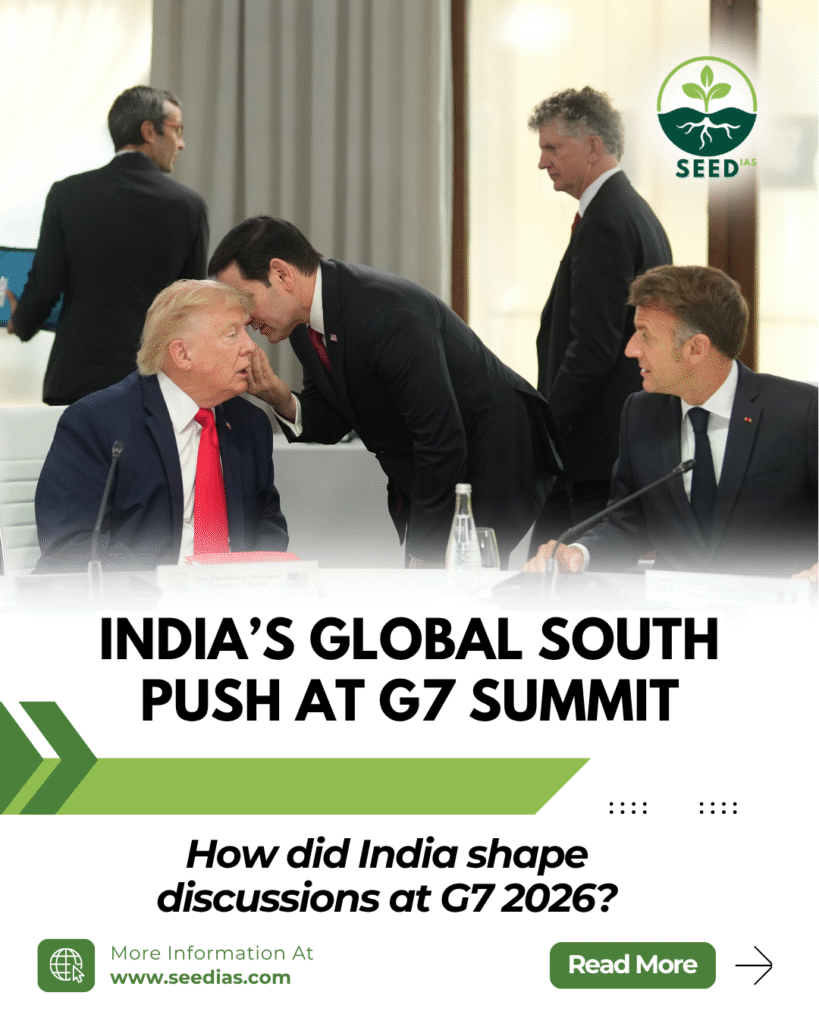
The Prime Minister of India participated in the 52nd G7 Summit Outreach Session 2026 held at Évian, France.
The summit was organized under the theme “Forging New Partnerships and Rebuilding International Solidarity.”
The event provided India an important platform to:
- Represent the interests of the Global South.
- Address the growing global trust deficit.
- Strengthen bilateral relations with Canada, the United Kingdom, and the United Arab Emirates (UAE).
- Promote reforms in global governance and development cooperation.
Background
The Group of Seven (G7) is an informal grouping of major advanced economies that discuss issues related to:
- Global economic governance
- International security
- Trade
- Energy
- Climate change
- Development cooperation
Although India is not a member of the G7, it has frequently been invited to Outreach Sessions due to its growing economic and geopolitical significance.
India has increasingly used such platforms to project itself as a leading voice of the Global South and advocate for more inclusive global governance.
News Breakdown
What Was India’s Core Message at the G7 Outreach Session?
India’s intervention focused on rebuilding trust and creating more equitable global partnerships.
Addressing the Global Trust Deficit
What is Global Trust Deficit?
A Global Trust Deficit refers to the growing lack of confidence among countries regarding international cooperation, commitments, and institutions.
India argued that:
- The world suffers more from a shortage of trust than resources.
- Sustainable solutions require stronger international confidence and cooperation.
- Mutual trust is the most important strategic asset in the modern world.
Reforming the Development Paradigm
India called for a shift away from the traditional:
Donor–Recipient Model
Under this model:
- Developed countries provide assistance.
- Developing countries remain aid recipients.
India advocated replacing this approach with:
- Equality
- Mutual respect
- Shared responsibility
- Collaborative development partnerships
Amplifying the Voice of the Global South
What is the Global South?
The Global South broadly refers to developing and emerging economies across:
- Asia
- Africa
- Latin America
- Oceania
India emphasized that developing countries seek:
- Equal participation in global governance.
- Fair representation in international institutions.
- Greater influence in decision-making processes.
The demand is not merely for financial assistance but for meaningful inclusion.
India–Africa Development Partnership
India highlighted its growing engagement with African countries through:
- Capacity-building initiatives
- Infrastructure projects
- Skill development programs
- Digital public infrastructure support
These initiatives are based on:
South-South Cooperation
South-South Cooperation refers to collaboration among developing countries for mutual development and capacity enhancement.
Key Principles:
- Partnership-based approach
- Respect for sovereignty
- Demand-driven development assistance
- Mutual benefit
Major Outcomes of India’s Bilateral Diplomatic Outreach
India–Canada Relations
The summit witnessed significant progress in India-Canada ties.
Comprehensive Economic Partnership Agreement (CEPA)
What is CEPA?
Comprehensive Economic Partnership Agreement (CEPA) is a broad trade agreement aimed at reducing barriers to trade and investment.
Key Development:
- Both countries aim to conclude CEPA negotiations by the end of 2026.
- Target: Double bilateral trade by 2030.
Trade Snapshot
| Indicator | Details |
|---|---|
| India’s Rank among Canada’s Trading Partners (2024) | 7th |
| Bilateral Trade (2024) | USD 30.9 Billion |
General Security of Information Agreement (GSOIA)
What is GSOIA?
A General Security of Information Agreement (GSOIA) provides a framework for protecting classified information exchanged between countries.
Expected Benefits:
- Enhanced intelligence sharing
- Stronger defense cooperation
- Improved security collaboration
Raisina Americas Initiative
India and Canada announced the establishment of:
Raisina Americas
Purpose:
- Promote geopolitical dialogue.
- Facilitate Track-1.5 diplomacy.
What is Track-1.5 Diplomacy?
It combines:
- Official government representatives
- Non-government experts and policy specialists
This creates informal yet influential policy discussions.
Support for Canada’s IORA Membership
India formally supported Canada’s bid to become a:
Dialogue Partner of IORA
What is IORA?
Indian Ocean Rim Association (IORA) is an intergovernmental organization promoting cooperation among countries bordering the Indian Ocean.
Nuclear Energy Partnership
A major breakthrough occurred in energy cooperation.
Key Agreement
| Component | Details |
| Company | Cameco (Canada) |
| Indian Partner | Department of Atomic Energy |
| Value | CAD 2.6 Billion |
| Period | 2027–2035 |
| Purpose | Long-term Uranium Supply |
Importance
- Supports India’s clean energy goals.
- Strengthens nuclear fuel security.
- Diversifies energy supply chains.
India–United Kingdom Relations
Vision 2035
Leaders reviewed progress under the:
India–UK Vision 2035 Framework
Areas of cooperation include:
- Technology
- Defense
- Education
- Innovation
- Green growth
Comprehensive Economic and Trade Agreement (CETA)
What is CETA?
A comprehensive trade agreement aimed at increasing:
- Trade flows
- Investment opportunities
- Economic cooperation
Both countries reaffirmed commitment toward its early implementation.
India–UAE Relations
Maritime Security Cooperation
Both countries expressed concern over disruptions in international trade routes.
Special focus was placed on:
Strait of Hormuz
Why is it Important?
The Strait of Hormuz is one of the world’s most critical energy chokepoints.
A substantial share of global oil exports passes through this narrow waterway.
India and UAE emphasized:
- Freedom of navigation
- Uninterrupted trade flows
- Maritime security cooperation
BRICS Summit 2026
India formally invited the UAE President to attend the:
18th BRICS Summit
India will host the summit later in 2026.
Understanding the G7
Genesis of the G7
The G7 emerged in response to the:
1973 Oil Crisis
Evolution
| Year | Development |
| 1975 | Formation of G6 |
| 1976 | Canada joined; G7 formed |
| 1998 | Russia joined; became G8 |
| 2014 | Russia suspended after Crimea annexation |
| Present | G7 + European Union participation |
Current G7 Members
- Canada
- France
- Germany
- Italy
- Japan
- United Kingdom
- United States
Additional Participant
- European Union (EU)
The EU participates through:
- President of the European Council
- President of the European Commission
Key Features of the G7
Institutional Structure
Unlike the UN, WTO, or NATO:
- No treaty basis
- No permanent secretariat
- No formal headquarters
It functions as an informal consultative grouping.
Rotating Presidency
The presidency changes every year.
Responsibilities include:
- Setting the agenda
- Organizing meetings
- Hosting the annual summit
Economic Significance
Although G7 countries account for only around:
- 10% of global population
They contribute approximately:
- 43% of global nominal GDP
This gives the grouping significant economic influence.
What Are Outreach Sessions?
Outreach Sessions are special meetings where guest countries and international organizations participate.
Purpose:
- Improve inclusiveness.
- Engage emerging economies.
- Discuss global challenges.
Countries frequently invited include:
- India
- Brazil
- South Africa
Prelims Focus
Important Facts
- G7 was established in 1975 as the G6.
- Canada joined in 1976, creating the G7.
- Russia joined in 1998, forming G8.
- Russia was suspended in 2014 after the annexation of Crimea.
- The European Union participates but is not an enumerated member.
- G7 has no permanent secretariat.
- IORA stands for Indian Ocean Rim Association.
- Strait of Hormuz connects the Persian Gulf with the Gulf of Oman and Arabian Sea.
- South-South Cooperation refers to cooperation among developing countries.
- BRICS currently includes Brazil, Russia, India, China, South Africa, Egypt, Ethiopia, Iran, UAE, and Indonesia.
Conclusion / Way Forward
India’s G7 outreach highlighted its role as a bridge between developed and developing nations while promoting inclusive growth, strategic partnerships, and reform of global governance.
Prelims Check
Question 1
With reference to the G7, consider the following statements:
- The G7 was originally established as the G6.
- The G7 has a permanent secretariat headquartered in Brussels.
- The European Union participates in G7 meetings.
Which of the statements given above are correct?
(a) 1 and 2 only
(b) 1 and 3 only
(c) 2 and 3 only
(d) 1, 2 and 3
Question 2
Consider the following pairs:
| Organization/Initiative | Description |
| 1. IORA | Cooperation among Indian Ocean littoral states |
| 2. GSOIA | Framework for protection of classified information |
| 3. CEPA | Security alliance among Indo-Pacific countries |
How many of the above pairs are correctly matched?
(a) Only one
(b) Only two
(c) All three
(d) None
Question 3
Consider the following statements:
- The Strait of Hormuz connects the Persian Gulf with the Gulf of Oman.
- South-South Cooperation refers to development cooperation among developing countries.
- Russia continues to be a member of the G7.
Which of the statements given above are correct?
(a) 1 and 2 only
(b) 2 and 3 only
(c) 1 and 3 only
(d) 1, 2 and 3
Answers and Explanations
Answer 1: (b)
Explanation:
- The G7 originated as the G6 in 1975.
- It has no permanent secretariat or headquarters.
- The European Union participates through its institutional leaders.
Answer 2: (b)
Explanation:
- IORA promotes cooperation among Indian Ocean Rim countries.
- GSOIA facilitates secure exchange of classified information.
- CEPA is a trade agreement, not a security alliance.
Answer 3: (a)
Explanation:
- The Strait of Hormuz is a key maritime chokepoint connecting the Persian Gulf and Gulf of Oman.
- South-South Cooperation involves partnerships among developing countries.
- Russia was suspended from the G8 in 2014 and is not part of the current G7.
“Nations rise through cooperation, and individuals rise through preparation. Every day of learning brings you closer to your goal.”