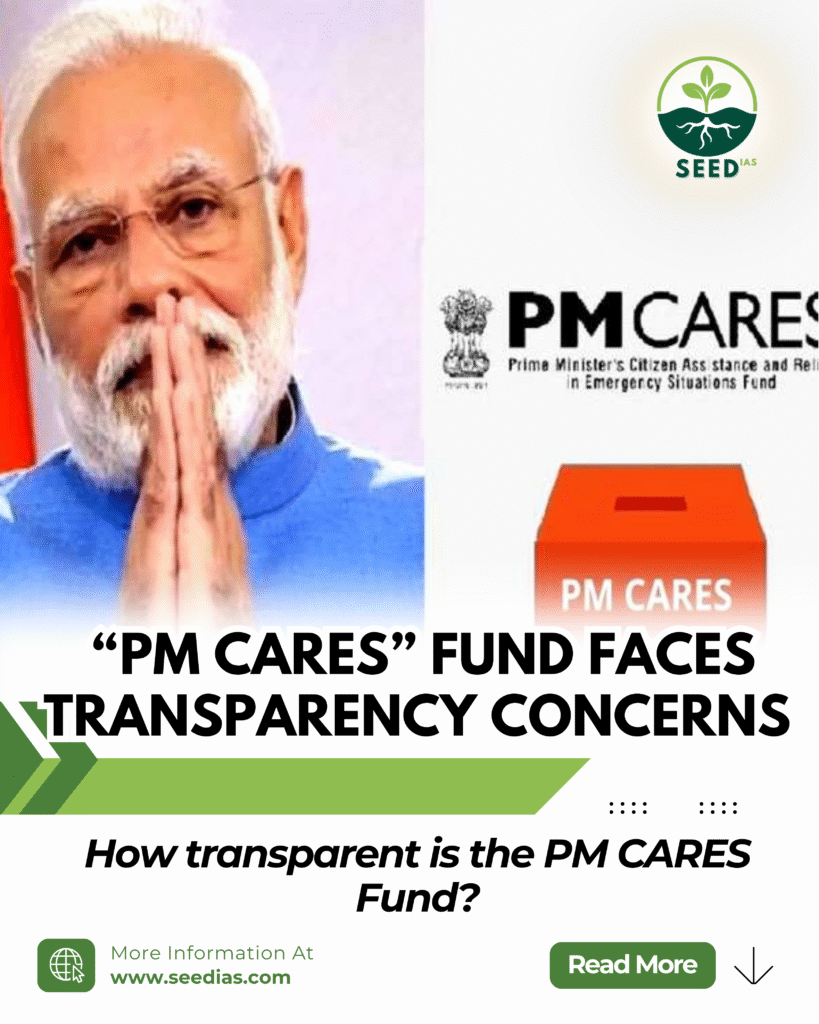
Context of the News
Concerns have emerged over the transparency of the PM CARES Fund, as publicly available audited financial statements have reportedly not been made available after FY 2022-23.
The issue has renewed debate over public accountability, audit, RTI coverage and parliamentary scrutiny of the Fund.
Background
The Prime Minister’s Citizen Assistance and Relief in Emergency Situations (PM CARES) Fund was established in March 2020, during the COVID-19 pandemic.
It was created to provide financial assistance during public-health emergencies, disasters and other distress situations.
Unlike a government budgetary fund, PM CARES is constituted as a Public Charitable Trust.
What is the PM CARES Fund?
The PM CARES Fund is a public charitable trust designed to mobilise voluntary contributions for emergency relief and related activities.
Its broad objectives include:
- Providing assistance during public-health emergencies.
- Supporting relief during natural and man-made disasters.
- Creating or upgrading healthcare facilities.
- Supporting pharmaceutical infrastructure.
- Funding relevant research.
- Providing other forms of assistance during emergency situations.
Who Manages the PM CARES Fund?
The Fund is administered through a Board of Trustees.
| Position | Role |
|---|---|
| Prime Minister | Ex-officio Chairperson |
| Union Minister of Defence | Ex-officio Trustee |
| Union Minister of Home Affairs | Ex-officio Trustee |
| Union Minister of Finance | Ex-officio Trustee |
| Other nominated Trustees | May be nominated by the Prime Minister |
Nominated trustees serve in a pro bono, or unpaid, capacity.
How is the PM CARES Fund Financed?
The Fund is based on voluntary contributions.
It does not receive direct budgetary support from the Government of India.
However, companies and Public Sector Undertakings (PSUs) can contribute through their Corporate Social Responsibility (CSR) expenditure.
The Fund can also receive eligible foreign contributions through its designated foreign-contribution account.
Tax and CSR Benefits
Contributions to PM CARES receive significant statutory benefits.
Income-Tax Deduction
Donations qualify for 100% deduction under the applicable income-tax provisions.
CSR Contribution
Companies can count eligible contributions to PM CARES as Corporate Social Responsibility (CSR) expenditure under the Companies Act, 2013.
Foreign Contributions
The Fund has been granted exemption from the Foreign Contribution (Regulation) Act, 2010 (FCRA) provisions, enabling it to receive eligible foreign donations.
Financial Position of PM CARES
According to the audited accounts for FY 2022-23:
| Financial indicator | Amount |
|---|---|
| Total receipts | About ₹6,723 crore |
| Payments | About ₹439 crore |
| Closing balance | About ₹6,284 crore |
The availability of publicly accessible audited statements after FY 2022-23 has become a major point of concern.
Why is the PM CARES Fund Facing Transparency Concerns?
1. Uncertainty over RTI Status
The Right to Information Act, 2005 (RTI Act) promotes transparency and access to information held by public authorities.
The government has maintained that PM CARES is not a government fund or a public authority under the RTI Act.
Its precise status under the RTI framework remains subject to judicial consideration.
This creates an important governance question:
Can an institution closely associated with the highest executive offices remain outside normal public-information obligations?
2. Absence of CAG Audit
The Comptroller and Auditor General of India (CAG) is India’s constitutional authority for auditing specified public finances and government entities.
PM CARES is audited by an independent chartered accountant, rather than by the CAG.
A CAG audit is not presently mandated for the Fund.
However, critics argue that the Fund’s public purpose and significant contributions from PSUs justify stronger independent public-audit mechanisms.
3. Limited Parliamentary Scrutiny
Questions have also emerged regarding the extent to which Parliament can scrutinise PM CARES.
In 2026, the PMO informed the Lok Sabha Secretariat that questions concerning the Fund were inadmissible under the relevant Rules of Procedure and Conduct of Business in Lok Sabha, on the ground that the Fund is not primarily a concern of the Government of India.
However, the final decision regarding admissibility rests with the Lok Sabha Speaker.
This raises an important issue concerning the relationship between executive accountability and parliamentary oversight.
Why are PSU Contributions Significant?
A Public Sector Undertaking (PSU) is an enterprise in which the government has significant ownership or control.
PM CARES does not receive direct budgetary allocations.
However, PSUs can contribute to the Fund through CSR expenditure.
This has generated debate because PSUs are government-owned or government-controlled enterprises.
Therefore, the question arises whether substantial public-sector contributions should be accompanied by stronger disclosure and accountability mechanisms.
PM CARES, PMNRF and NDRF: How Are They Different?
India has multiple mechanisms for responding to emergencies and providing relief.
| Feature | PM CARES | PMNRF | NDRF |
|---|---|---|---|
| Full form | Prime Minister’s Citizen Assistance and Relief in Emergency Situations Fund | Prime Minister’s National Relief Fund | National Disaster Response Fund |
| Nature | Public charitable trust | Public charitable trust | Statutory fund |
| Creation | 2020 | 1948 | Under Disaster Management Act, 2005 |
| Main purpose | Emergency relief and related assistance | Relief to affected persons in specified emergencies | Response to notified disasters |
| Direct budgetary support | No | No | Funded through statutory government mechanisms |
| Legal framework | Trust-based | Trust-based | Statutory |
The Supreme Court held in 2020 that PM CARES and NDRF are distinct funds with different objectives and purposes.
Key Constitutional and Governance Issues
The PM CARES debate is important for UPSC because it connects several concepts.
Transparency
Transparency enables citizens to understand how public-interest institutions collect and utilise funds.
Accountability
Accountability means that institutions exercising public functions should be answerable for their decisions and use of resources.
Parliamentary Oversight
Parliamentary scrutiny is an important mechanism for holding the executive accountable.
Audit
Independent auditing helps verify whether funds have been properly received, managed and utilised.
RTI
The RTI Act, 2005 seeks to promote transparency and accountability by providing citizens access to information held by public authorities, subject to statutory exemptions.
What Can Improve Accountability?
1. Clarify the Legal Status
The legal and RTI status of PM CARES should be clearly defined.
A clear framework would reduce uncertainty regarding its transparency obligations.
2. Ensure Time-Bound Disclosure
The Fund can publish:
- Audited financial statements
- Annual receipts
- Expenditure details
- Closing balances
- Project-wise utilisation
- Utilisation certificates
These should be released according to a fixed annual timeline.
3. Strengthen Independent Audit
Even where a CAG audit is not legally mandatory, stronger independent audit standards can improve public confidence.
4. Improve Parliamentary Accountability
Questions relating to PM CARES could be examined case-by-case under Lok Sabha rules, with admissibility determined through the established parliamentary procedure.
5. Publish Outcome-Based Information
Financial disclosure should go beyond total receipts and expenditure.
The Fund could also disclose:
- Major categories of donors
- Project-wise allocations
- Implementing agencies
- Beneficiary criteria
- Outcomes achieved
This would move transparency towards outcome-based accountability.
Prelims Focus
PM CARES Fund
- Established in March 2020.
- It is a Public Charitable Trust.
- The Prime Minister is its ex-officio Chairperson.
- Union Ministers of Defence, Home Affairs and Finance are ex-officio Trustees.
- It receives voluntary contributions.
- It does not receive direct budgetary support.
- Contributions can qualify as CSR expenditure.
- It has been granted exemption from applicable FCRA provisions for receiving eligible foreign contributions.
- It is audited by an independent chartered accountant.
- Its FY 2022-23 audited accounts recorded receipts of about ₹6,723 crore.
- The Supreme Court has distinguished PM CARES from NDRF.
Important Distinction
NDRF is a statutory fund under the Disaster Management Act, 2005, whereas PM CARES is a public charitable trust.
Conclusion / Way Forward
PM CARES can retain emergency flexibility while strengthening timely disclosure, independent oversight and accountability to enhance public trust.
Prelims Check
Question 1
With reference to the PM CARES Fund, consider the following statements:
- It was established as a Public Charitable Trust.
- The Prime Minister is its ex-officio Chairperson.
- It receives direct budgetary support from the Consolidated Fund of India.
- Contributions made by companies to the Fund can qualify as CSR expenditure.
Which of the statements given above are correct?
(a) 1 and 2 only
(b) 1, 2 and 4 only
(c) 2, 3 and 4 only
(d) 1, 2, 3 and 4
Question 2
Consider the following pairs:
| Institution/Fund | Characteristic |
|---|---|
| 1. PM CARES Fund | Public charitable trust |
| 2. National Disaster Response Fund | Statutory fund under the Disaster Management Act, 2005 |
| 3. Comptroller and Auditor General of India | Constitutional authority |
| 4. PMNRF | Statutory fund established under the Disaster Management Act, 2005 |
How many of the above pairs are correctly matched?
(a) Only one
(b) Only two
(c) Only three
(d) All four
Question 3
Consider the following statements regarding the PM CARES Fund:
Statement I: Contributions made by Public Sector Undertakings to PM CARES can qualify as Corporate Social Responsibility expenditure.
Statement II: PM CARES Fund receives direct budgetary allocations from the Government of India.
Which one of the following is correct?
(a) Both Statement-I and Statement-II are correct and Statement-II explains Statement-I.
(b) Both Statement-I and Statement-II are correct, but Statement-II does not explain Statement-I.
(c) Statement-I is correct, but Statement-II is incorrect.
(d) Statement-I is incorrect, but Statement-II is correct.
Answers and Explanations
Question 1 — Answer: (b) 1, 2 and 4 only
- Statement 1 is correct. PM CARES was established as a Public Charitable Trust in March 2020.
- Statement 2 is correct. The Prime Minister is the ex-officio Chairperson.
- Statement 3 is incorrect. PM CARES is based on voluntary contributions and does not receive direct budgetary support.
- Statement 4 is correct. Eligible corporate contributions to PM CARES can qualify as CSR expenditure.
Question 2 — Answer: (c) Only three
- Pair 1 is correctly matched. PM CARES is a Public Charitable Trust.
- Pair 2 is correctly matched. The National Disaster Response Fund (NDRF) is established under the Disaster Management Act, 2005.
- Pair 3 is correctly matched. The CAG is a constitutional authority under Article 148.
- Pair 4 is incorrect. The Prime Minister’s National Relief Fund (PMNRF) is not a statutory fund created under the Disaster Management Act, 2005.
Question 3 — Answer: (c) Statement-I is correct, but Statement-II is incorrect
- Statement I is correct. Eligible contributions by companies, including PSUs, to PM CARES can qualify as CSR expenditure under the Companies Act framework.
- Statement II is incorrect. PM CARES does not receive direct budgetary support from the Government of India.
- Therefore, the correct answer is (c).
“Transparency builds trust, accountability strengthens institutions, and strong institutions strengthen democracy.”