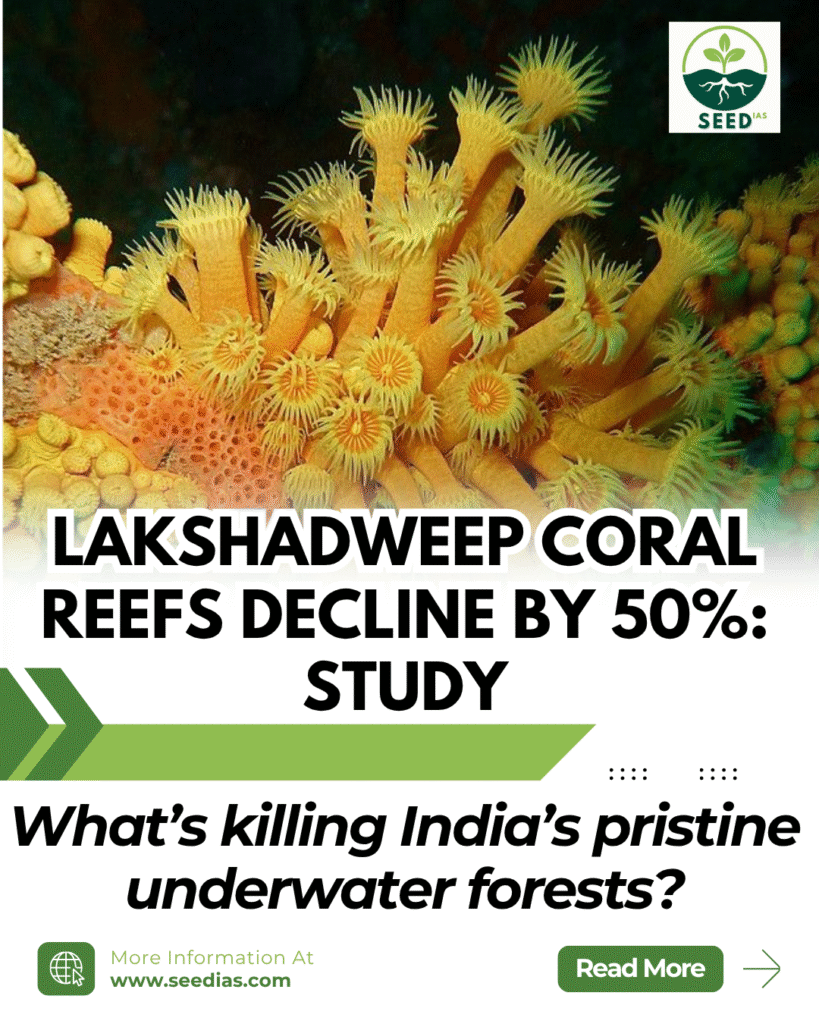
Why in NEWS
A long-term coral reef health monitoring study across Agatti, Kadmat, and Kavaratti atolls in Lakshadweep revealed that coral cover has declined drastically from 37.24% in 1998 to 19.6% in 2022, primarily due to repeated marine heatwaves and climate change.
Key Terms and Concepts
| Term | Explanation |
|---|---|
| Coral Bleaching | Whitening of corals due to expulsion of algae (zooxanthellae) under stress like increased sea temperature |
| Ocean Acidification | Decrease in pH of oceans due to absorption of atmospheric CO₂, weakening coral skeletons |
| El Niño | Periodic warming of Pacific Ocean that leads to global climate anomalies including marine heatwaves |
| Biorock Technology | A method of using electric currents to accelerate coral growth on metal structures underwater |
| Super Corals | Genetically selected or lab-modified corals that are more resistant to heat stress and acidification |
Key Findings of the Study
| Finding | Description |
|---|---|
| Massive Coral Decline | Coral cover reduced by nearly 50% due to marine heatwaves in 1998, 2010, and 2016 |
| Slow Recovery | Reefs need 6+ years without bleaching to show signs of recovery |
| Six Coral Response Types | Based on variation in depth, wave exposure, and heat tolerance |
| Restoration vs Emissions | Local restoration helps, but global emission cuts are vital for long-term reef survival |
Key Reasons for Coral Reef Depletion
| Cause | Explanation |
|---|---|
| Marine Heatwaves | Caused by global warming and El Niño, leading to bleaching and mass coral death |
| High UV Radiation | Increases coral vulnerability to diseases and bleaching |
| Ocean Acidification | Weakens coral skeletons, slows reef building |
| Pollution & Runoff | Leads to algal blooms and sedimentation that block sunlight |
| Destructive Human Activities | Fishing with explosives, anchoring, unregulated tourism damage corals |
Implications of Coral Depletion
| Impact Area | Consequence |
|---|---|
| Biodiversity | Collapse of reef ecosystems, extinction of marine species |
| Economy | Decline in fish catch and tourism income, threatening livelihoods |
| Coastal Protection | Increased risk of erosion, storm surges, and flooding in island regions |
| Scientific Discovery | Loss of potential medicinal compounds from reef biodiversity |
| Climate Regulation | Reduced CO₂ absorption and oxygen release, worsening climate impacts |
Major Coral Protection Initiatives
| Initiative | Description |
|---|---|
| ICRI | Global network for coral conservation through knowledge exchange and partnerships |
| GFCR | UN-led public-private finance mechanism for coral restoration and community resilience |
| Biorock | Used in Gulf of Kachchh for rapid reef restoration |
| Super Corals | Human-assisted evolution of heat-tolerant coral species |
| Cryomesh/Frozen Coral | Preservation of coral larvae at ultra-low temperatures for future regeneration |
Recommended Measures to Protect Coral Reefs
| Strategy | Action |
|---|---|
| Climate Mitigation | Shift to renewables, meet Paris Agreement targets, protect blue carbon ecosystems |
| Control Local Stressors | Reduce nutrient runoff, regulate coastal development, enforce fishing bans |
| Active Restoration | Transplant heat-resistant corals, use artificial reefs and super corals |
| Community Involvement | Promote reef-friendly tourism, alternative livelihoods, local reef monitoring |
In a Nutshell
Code: “HEAT SINK”
Heatwaves trigger bleaching
Emissions fuel warming
Acid oceans weaken corals
Tourism & fishing add stress
Super corals,
International action,
Nature-based solutions,
Keep reefs alive!
Prelims Practice Questions
- Which of the following contributes to coral bleaching?
A. Increased UV radiation
B. Ocean acidification
C. Rise in sea surface temperatures
D. All of the above - The term “super corals” refers to:
A. Naturally occurring coral species that grow rapidly
B. Coral species modified to withstand environmental stress
C. Corals that occur only in deep oceans
D. None of the above - Biorock technology is primarily used for:
A. Oil extraction from deep-sea beds
B. Artificial fish breeding
C. Coral reef restoration
D. Underwater mining
Mains Practice Questions
- Coral reefs are often called “rainforests of the sea.” Discuss the significance of coral ecosystems and assess the threats they face today. 15 Marks (GS3 – 2020)
- Evaluate the role of community-led initiatives in coral reef conservation. Suggest viable models for India’s island territories. 10 Marks
Answers and Explanations (Prelims)
| Qn | Answer | Explanation |
|---|---|---|
| 1 | D | All factors listed contribute to coral bleaching |
| 2 | B | Super corals are enhanced through breeding or genetic methods to survive heat stress |
| 3 | C | Biorock helps in faster coral growth using electric mineral accretion techniques |