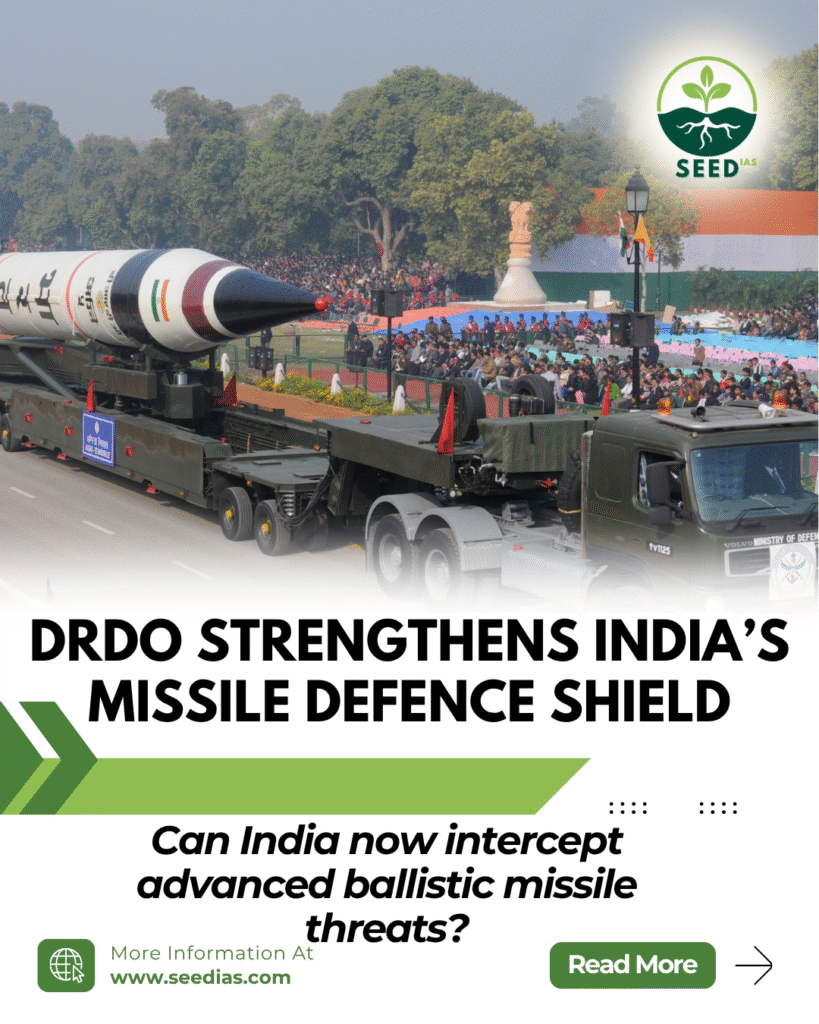
Context of the News
The Defence Research and Development Organisation (DRDO) successfully conducted multiple strategic missile tests, including:
- Validation of the Multi-layered Ballistic Missile Defence (BMD) System Phase-II
- Maiden test of the Naval Anti-Ship Missile–Medium Range (NASM-MR)
- Successful flight test of the Long-Range Land Attack Cruise Missile (LRLACM)
These developments significantly strengthen India’s strategic deterrence, missile defence capabilities, and indigenous defence ecosystem.
Background
India launched its Ballistic Missile Defence (BMD) Programme in 1999 in response to the growing missile and nuclear capabilities in its neighbourhood.
The objective was to create a layered defence system capable of intercepting hostile ballistic missiles before they reach their targets.
Over the years, India has gradually developed:
- Long-range tracking radars
- Interceptor missiles
- Command-and-control networks
- Advanced guidance systems
With the successful validation of Phase-II, India joins a select group of nations possessing advanced missile interception capabilities.
News Breakdown
Key Definitions
Ballistic Missile
A missile that follows a ballistic trajectory after its powered phase and re-enters the atmosphere to strike a target.
Ballistic Missile Defence (BMD)
An integrated system designed to:
- Detect incoming ballistic missiles
- Track their movement
- Intercept and destroy them before impact
Exo-Atmospheric Interception
Destruction of a missile outside Earth’s atmosphere.
Endo-Atmospheric Interception
Destruction of a missile within Earth’s atmosphere.
ICBM (Intercontinental Ballistic Missile)
A ballistic missile with a range exceeding 5,500 km, capable of striking targets across continents.
Hypersonic Glide Vehicle (HGV)
A maneuverable weapon system that travels at speeds above Mach 5 and can alter its flight path, making interception difficult.
MIRV (Multiple Independently Targetable Re-entry Vehicle)
A technology where a single missile carries multiple warheads that can strike different targets independently.
What is India’s Multi-layered Ballistic Missile Defence System?
The Ballistic Missile Defence System is an automated network consisting of:
- Long-range tracking radars
- Command and control centres
- Interceptor missiles
- Communication networks
Its purpose is to provide a protective shield against enemy ballistic missile attacks.
Why is the Recent Test Significant?
India has now demonstrated the capability to intercept:
- Short-Range Ballistic Missiles (SRBMs)
- Medium-Range Ballistic Missiles (MRBMs)
- Intermediate-Range Ballistic Missiles (IRBMs)
- Potentially ICBM-class threats
With this achievement, India joins the elite group of nations comprising:
| Country |
|---|
| United States |
| Russia |
| China |
| Israel |
| India |
that possess advanced ballistic missile interception capabilities.
Phases of India’s BMD Programme
Phase-I (Completed in 2019)
Objective
Intercept ballistic missiles having ranges up to 2,000 km.
Key Interceptors
| Interceptor | Function |
| PDV (Prithvi Defence Vehicle) | Exo-atmospheric interception |
| AAD (Advanced Air Defence) | Endo-atmospheric interception |
Radar Support
Swordfish Long Range Tracking Radar (LRTR)
Features:
- Active phased-array radar
- Long-range target tracking
- Simultaneous tracking of multiple targets
Phase-II (Under Validation)
Objective
Intercept:
- IRBMs
- ICBM-class missiles
Range coverage:
3,000 km to over 5,500 km
New Interceptors
AD-1
Designed for:
- Endo-atmospheric interception
- Low exo-atmospheric interception
AD-2
Designed for:
- Faster ballistic missiles
- Intermediate-range threats
- ICBM-class targets
Significance
Marks a major advancement towards a comprehensive national missile shield.
Phase-III (Under Development)
Focus
Counter emerging missile technologies.
Future Interceptors
| System | Purpose |
| AD-AH | Anti-Hypersonic Interceptor |
| AD-AM | Anti-MIRV Interceptor |
AD-AH (Anti-Hypersonic)
Designed to intercept:
- Hypersonic Glide Vehicles
- Weapons travelling above Mach 5
AD-AM (Anti-Missile)
Designed to neutralize:
- MIRV-equipped missiles
- Multiple warheads released from a single missile
Mission Sudarshan Chakra
What is Mission Sudarshan Chakra?
Mission Sudarshan Chakra is India’s proposed AI-enabled integrated missile and air defence architecture.
Objective
Create a multi-layered national shield protecting:
- Strategic military assets
- Critical infrastructure
- Major cities
- National command centres
Key Features
Hard-Kill Systems
Destroy incoming threats physically through:
- Missile interceptors
- Directed energy weapons
- Close-in weapon systems
Soft-Kill Systems
Neutralize threats through:
- Electronic warfare
- GPS disruption
- Radio-frequency jamming
Naval Anti-Ship Missile – Medium Range (NASM-MR)
What is NASM-MR?
The Naval Anti-Ship Missile–Medium Range (NASM-MR) is an indigenous anti-ship cruise missile developed by DRDO for the Indian Navy.
It is designed to destroy:
- Frigates
- Corvettes
- Destroyers
- Other hostile naval vessels
Key Features of NASM-MR
Sea-Skimming Flight Profile
The missile flies very close to the sea surface.
Advantages:
- Reduced radar detection
- Higher survivability
- Better penetration of enemy air defence
Indigenous Engine
Powered by:
Small Gas Turbine Jet Engine (SGTJE)
developed indigenously.
Multi-Platform Capability
Future variants will support:
- Ship launch
- Air launch
- Submarine launch
All-Weather Capability
Can operate effectively under adverse weather conditions.
Range and Payload
| Parameter | Capability |
| Maximum Range | 350 km |
| Warhead Weight | Over 200 kg |
Advanced Guidance System
Uses:
- Active Radar Seeker
- Imaging Infrared (IR) Seeker
This dual-mode guidance ensures accuracy even under electronic countermeasures.
How NASM-MR Complements Existing Systems
| Missile | Role |
| NASM-SR | Short-range anti-ship capability |
| NASM-MR | Medium-range anti-ship capability |
Together they create a layered maritime strike capability for the Indian Navy.
Long-Range Land Attack Cruise Missile (LRLACM)
What is LRLACM?
The Long-Range Land Attack Cruise Missile (LRLACM) is a fully indigenous cruise missile developed for long-range precision strikes against land-based targets.
Key Features
Indigenous Development
Developed through collaboration between:
- DRDO laboratories
- Indian defence industries
Supports the vision of:
Aatmanirbhar Bharat in Defence Manufacturing
Nodal Laboratory
Aeronautical Development Establishment (ADE), Bengaluru
served as the lead laboratory.
Strategic Significance
The missile enhances India’s capability to:
- Conduct deep precision strikes
- Target strategic enemy assets
- Improve deterrence capability
Comparison: Ballistic Missile vs Cruise Missile
| Feature | Ballistic Missile | Cruise Missile |
| Flight Path | Ballistic trajectory | Controlled aerodynamic flight |
| Speed | Usually higher | Relatively lower |
| Maneuverability | Limited | High |
| Detection | Easier during flight | Difficult due to low-altitude flight |
| Examples | Agni Series | LRLACM |
Prelims Focus
High-Value Facts
DRDO
- Established in 1958
- Functions under the Ministry of Defence
- India’s premier defence research organisation
Swordfish Radar
- Long Range Tracking Radar (LRTR)
- Derived from Israeli Green Pine radar technology
- Active phased-array radar
ICBM
- Range exceeds 5,500 km
- Capable of intercontinental strikes
Mach Number
- Represents speed relative to the speed of sound.
- Hypersonic speed = Mach 5 or above
MIRV Technology
Countries possessing operational MIRV capability include:
- United States
- Russia
- China
- France
- United Kingdom
- India (Agni-V MIRV capability demonstrated)
Cruise Missile
Powered throughout most of its flight using engines.
Examples:
- BrahMos
- Nirbhay
- LRLACM
Conclusion / Way Forward
Strengthening indigenous missile defence, precision strike systems, and advanced interception technologies is essential for securing India against evolving strategic threats.
Prelims Check
Question 1
With reference to India’s Ballistic Missile Defence Programme, consider the following statements:
- The Prithvi Defence Vehicle (PDV) is designed for exo-atmospheric interception.
- AD-2 interceptor is intended to engage ICBM-class threats.
- Swordfish is a submarine-based tracking radar.
Which of the statements given above are correct?
(a) 1 and 2 only
(b) 2 and 3 only
(c) 1 and 3 only
(d) 1, 2 and 3
Question 2
Consider the following pairs:
| Missile/System | Type |
| 1. NASM-MR | Anti-Ship Cruise Missile |
| 2. LRLACM | Long-Range Land Attack Cruise Missile |
| 3. AD-AH | Anti-Hypersonic Interceptor |
| 4. AAD | Exo-Atmospheric Interceptor |
How many pairs given above are correctly matched?
(a) Only one
(b) Only two
(c) Only three
(d) All four
Question 3
Consider the following statements regarding MIRV technology:
- A single missile can carry multiple warheads.
- Each warhead can be directed toward different targets.
- MIRV technology reduces the effectiveness of missile defence systems.
Which of the statements given above are correct?
(a) 1 and 2 only
(b) 2 and 3 only
(c) 1 and 3 only
(d) 1, 2 and 3
Answers and Explanations
Answer 1: (a)
Explanation:
- PDV is India’s exo-atmospheric interceptor.
- AD-2 is being developed to counter IRBM and ICBM-class threats.
- Swordfish is a land-based long-range tracking radar, not submarine-based.
Answer 2: (c)
Explanation:
- NASM-MR is an anti-ship cruise missile.
- LRLACM is a long-range land attack cruise missile.
- AD-AH is an anti-hypersonic interceptor.
- AAD is an endo-atmospheric interceptor, making Pair 4 incorrect.
Answer 3: (d)
Explanation:
- MIRV allows multiple warheads on one missile.
- Each warhead can engage a separate target.
- MIRVs complicate interception and challenge missile defence systems.
“Nations remain secure not merely through strength, but through continuous innovation, preparedness, and self-reliance.”