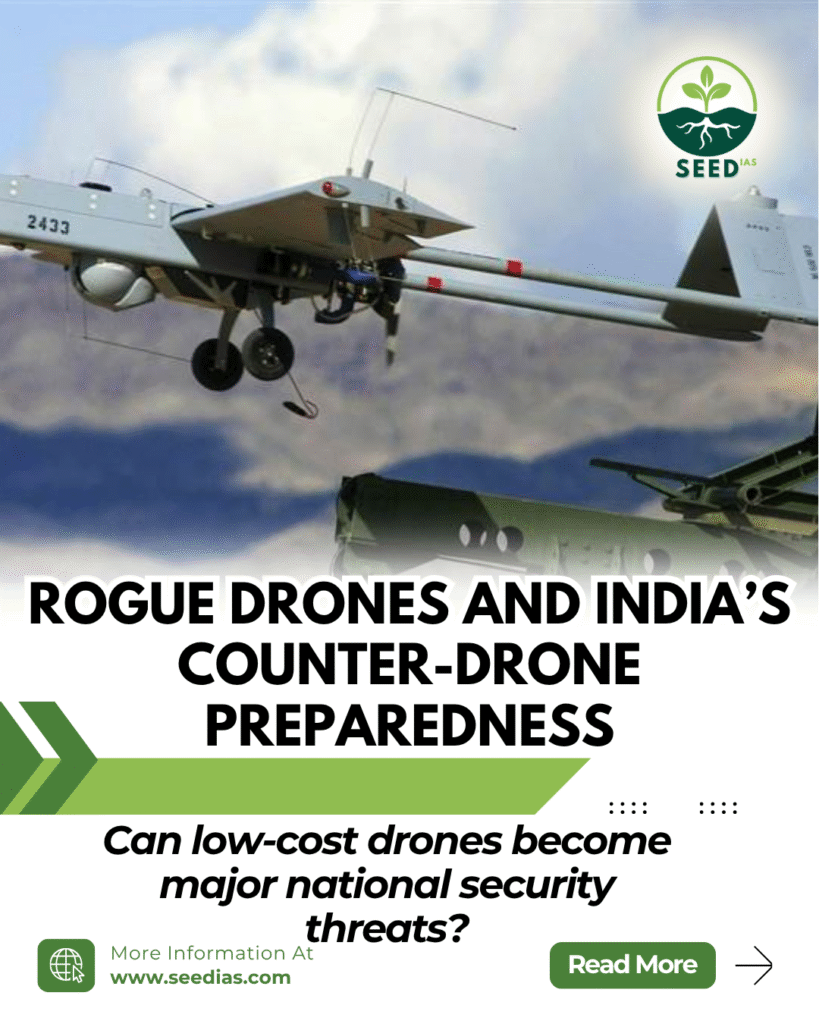
Context of the News
The Union Government has warned about potential rogue drone attacks targeting critical installations near India’s borders. In response, security agencies are accelerating the deployment of advanced counter-drone systems to protect strategic assets and critical infrastructure.
The concern has intensified due to recent conflicts in Ukraine and West Asia, where inexpensive commercial drones have transformed modern warfare.
Background
The nature of warfare is undergoing a major transformation.
Traditionally, military power depended on tanks, fighter aircraft, missiles, and large troop deployments. However, recent conflicts have demonstrated that relatively inexpensive drones can perform surveillance, intelligence gathering, precision strikes, and even strategic attacks.
Countries across the world are now investing heavily in both drone warfare capabilities and counter-drone technologies.
India has also witnessed security challenges involving drones along its borders, particularly through:
- Arms smuggling
- Drug trafficking
- Surveillance activities
- Cross-border infiltration support
As a result, strengthening counter-drone capabilities has become a major national security priority.
News Breakdown
Key Definitions
Drone (Unmanned Aerial Vehicle – UAV)
A remotely operated or autonomous aircraft that flies without a human pilot onboard.
UAS (Unmanned Aerial System)
A complete system consisting of:
- Drone/UAV
- Ground control station
- Communication links
- Supporting equipment
FPV Drone (First Person View Drone)
A drone operated through live video transmission from an onboard camera, enabling highly precise targeting.
Loitering Munition
A weapon system that can remain airborne over a target area and attack when a suitable target is identified.
Electronic Warfare (EW)
The use of electromagnetic signals to disrupt, deceive, jam, or disable enemy communications and systems.
Counter-Drone System
A technology designed to detect, track, identify, and neutralize hostile drones.
Why Are Drones Becoming Important in Modern Warfare?
Modern battlefields increasingly rely on drones because of their effectiveness and affordability.
1. Cost-Effective Military Platform
- Drones are significantly cheaper than fighter aircraft and helicopters.
- They can perform missions at a fraction of the cost.
- Large numbers can be deployed simultaneously.
2. Multi-Role Capabilities
Drones can perform:
- Intelligence gathering
- Surveillance
- Reconnaissance (ISR)
- Artillery spotting
- Logistics support
- Electronic warfare
- Precision strikes
3. High Operational Flexibility
- Easily modified for different missions.
- Rapid deployment capability.
- Useful for both state and non-state actors.
4. Precision Strike Capability
FPV drones and loitering munitions can accurately destroy:
- Tanks
- Armoured vehicles
- Radar stations
- Ammunition depots
These are often referred to as “Kamikaze Drones.”
5. Resistance to Electronic Warfare
New-generation drones increasingly use:
- Fibre-optic communication
- Advanced navigation systems
- Anti-jamming technologies
This improves battlefield survivability.
6. Persistent Surveillance
Drones create a continuously monitored battlefield.
As a result:
- Troop movements become visible.
- Supply lines become vulnerable.
- Traditional safe zones become difficult to maintain.
Concerns Associated with Drone Warfare
1. Increased Asymmetric Warfare
The low cost of drones enables:
- Terrorist organizations
- Insurgent groups
- Criminal networks
to access sophisticated attack capabilities.
2. Lower Threshold for Conflict
Because drones are expendable and inexpensive:
- Countries may undertake riskier actions.
- Conflicts may escalate more frequently.
3. Threat to Critical Infrastructure
Drones can target:
- Airports
- Ports
- Oil refineries
- Power plants
- Military installations
4. Cross-Border Security Challenges
Drones are increasingly used for:
- Arms smuggling
- Drug trafficking
- Counterfeit currency movement
across international borders.
5. Detection Difficulties
Small drones:
- Fly at low altitude.
- Have small radar signatures.
- Are difficult to detect through conventional radar systems.
6. Swarm Attacks
A drone swarm involves dozens or hundreds of drones attacking simultaneously.
Such attacks can overwhelm traditional air defence systems.
7. Governance and Ethical Challenges
Key concerns include:
- Civilian casualties
- Accountability issues
- Privacy concerns
- Legal ambiguities under international law
India’s Counter-Drone Preparedness
1. Indian Army’s UAS Technology Roadmap
The Army released a comprehensive roadmap covering:
- 30 categories of UAS
- Around 80 variants
The roadmap provides technical guidance to domestic defence manufacturers and start-ups.
Objective
Develop:
- Short-range drones
- Medium-range drones
- Long-range drones
- Loitering munitions
for future battlefield requirements.
2. Massive Drone Acquisition Programme
The Government approved a programme worth Rs 32,350 crore.
Objective
Procurement of:
- 87 Medium Altitude Long Endurance (MALE) Drones
for:
- Indian Army
- Indian Navy
- Indian Air Force
3. Foreign and Indigenous Platforms
| Foreign Systems | Indigenous Systems |
|---|---|
| MQ-9B Predator | TAPAS-BH-201 |
| SkyGuardian | Rustom Series |
Purpose
- Immediate operational capability through imports.
- Long-term strategic self-reliance through indigenous development.
4. Strengthening the Drone Innovation Ecosystem
iDEX (Innovations for Defence Excellence)
Promotes innovation through:
- Grants
- Funding support
- Startup participation
ADITI Scheme
Supports development of advanced defence technologies.
5. AI-Based Autonomous Targeting
The Indian Army launched a challenge for:
“AI Module for UAS for Autonomous Recognition, Identification and Targeting.”
Objective:
Develop systems capable of:
- Target recognition
- Autonomous navigation
- Mission completion even under GPS jamming
6. Mission Sudarshan Chakra
What is it?
A proposed AI-enabled Integrated Multi-Domain Defence Architecture expected by 2035.
Core Components
Hard-Kill Systems
Physically destroy drones using:
- Close-In Weapon Systems (CIWS)
- Directed Energy Weapons
- Laser Weapons
Soft-Kill Systems
Neutralize drones through:
- Radio-frequency jamming
- GPS disruption
- Electronic warfare
Significance
Provides cost-effective defence without exhausting expensive missile inventories.
How Can Drones Be Used Responsibly?
Comprehensive Legal Framework
- Strengthen domestic regulations.
- Promote international norms for drone usage.
Human Oversight
- Ensure authorized operators control military drones.
- Maintain accountability in targeting decisions.
Identification and Tracking Systems
Implement:
- Geo-fencing
- Remote identification
- Real-time tracking
Layered Counter-Drone Defence
Combine:
- Radar systems
- RF detection
- Electro-optical sensors
- Jamming systems
- Kinetic interceptors
Indigenous Capability Development
Strengthen collaboration among:
- DRDO (Defence Research and Development Organisation)
- BEL (Bharat Electronics Limited)
- Start-ups
- Academic institutions
Institutional Coordination
Enhance coordination among:
- Ministry of Home Affairs (MHA)
- Ministry of Defence (MoD)
- Border Security Force (BSF)
- Central Industrial Security Force (CISF)
- Intelligence agencies
Prelims Focus
High-Value Facts
MQ-9B Predator
- Manufactured by General Atomics (USA).
- Classified as a MALE Drone.
- Can conduct long-endurance surveillance and strike missions.
TAPAS-BH-201
- Developed by DRDO.
- Indigenous MALE UAV.
- Formerly known as Rustom-II.
iDEX
- Launched by the Ministry of Defence.
- Encourages innovation and indigenous defence technologies.
CISF
- Established in 1969.
- Responsible for protecting critical infrastructure and strategic establishments.
BSF
- Established in 1965.
- Guards India’s international borders.
Directed Energy Weapons
Weapons that use:
- Lasers
- High-energy electromagnetic waves
to disable or destroy targets.
Drone Rules, 2021
India’s regulatory framework governing civilian drone operations.
Conclusion / Way Forward
India must build a layered, AI-driven counter-drone ecosystem combining indigenous technology, institutional coordination, legal safeguards, and continuous surveillance to secure critical infrastructure.
Prelims Check
Question 1
With reference to drone warfare, consider the following statements:
- Loitering munitions can remain airborne before striking a target.
- FPV drones rely on live video transmission for targeting.
- All MALE drones are designed exclusively for combat missions.
Which of the statements given above are correct?
(a) 1 and 2 only
(b) 2 and 3 only
(c) 1 and 3 only
(d) 1, 2 and 3
Question 2
Consider the following pairs:
| Programme/System | Description |
| 1. iDEX | Defence innovation support initiative |
| 2. TAPAS-BH-201 | Indigenous MALE UAV |
| 3. MQ-9B Predator | Russian-origin combat drone |
| 4. CISF | Border guarding force |
How many pairs given above are correctly matched?
(a) Only one
(b) Only two
(c) Only three
(d) All four
Question 3
Consider the following:
- Radio-frequency jamming
- Directed energy lasers
- GPS spoofing
- Electro-optical tracking
Which of the above can be components of a modern counter-drone defence architecture?
(a) 1 and 2 only
(b) 1, 2 and 3 only
(c) 2, 3 and 4 only
(d) 1, 2, 3 and 4
Answers and Explanations
Answer 1: (a)
Explanation:
- Loitering munitions hover over a target area before attacking.
- FPV drones use real-time video feeds for accurate targeting.
- MALE drones are used for surveillance, reconnaissance, communication and strike missions; not exclusively combat.
Answer 2: (b)
Explanation:
- iDEX promotes defence innovation and start-ups.
- TAPAS-BH-201 is India’s indigenous MALE UAV.
- MQ-9B Predator is an American drone, not Russian.
- CISF protects critical infrastructure, while BSF guards borders.
Answer 3: (d)
Explanation:
- RF jamming can disrupt drone communication.
- Directed energy weapons can physically neutralize drones.
- GPS spoofing is a soft-kill countermeasure.
- Electro-optical systems assist in drone detection and tracking.
“Every emerging challenge creates an opportunity for innovation. Those who prepare today will shape the security and success of tomorrow.”