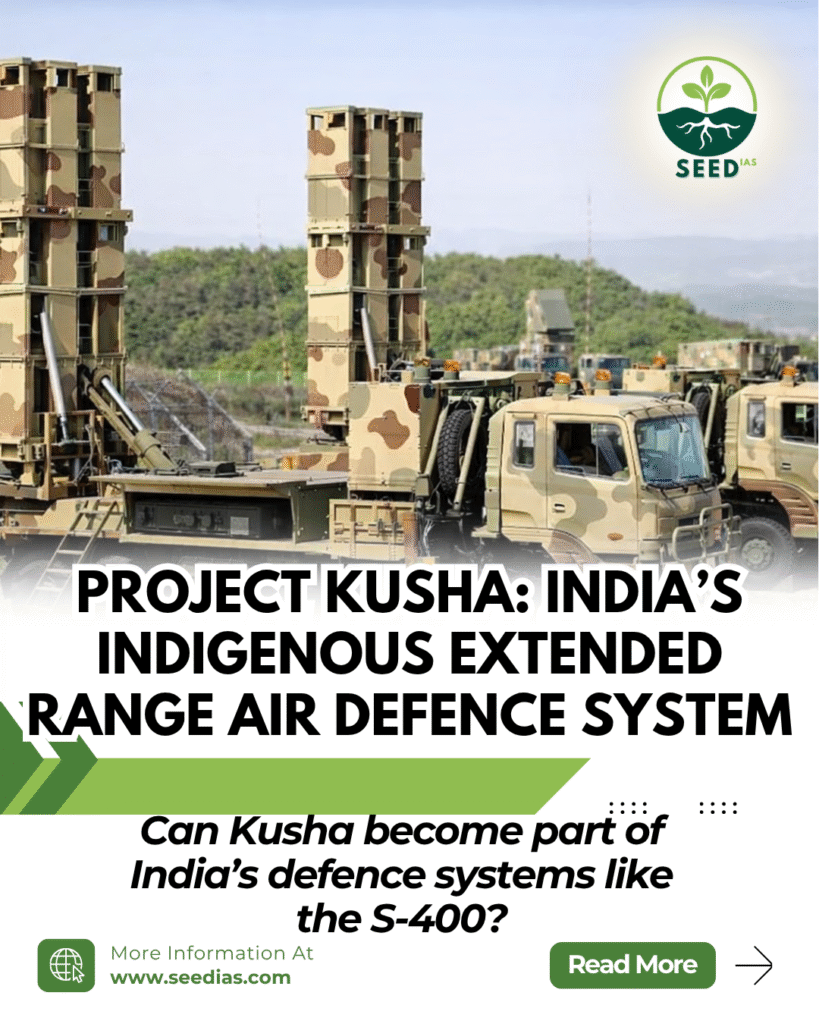
Why in News?
Recently, the Defence Minister described Project Kusha as a “game changer” for India’s security architecture while inaugurating the Advanced Weapon System Complex at the Defence Research and Development Organisation (DRDO)‘s Dr APJ Abdul Kalam Missile Complex in Hyderabad.
The project is expected to significantly strengthen India’s indigenous air and missile defence capabilities.
About Project Kusha
Project Kusha, also known as the Extended Range Air Defence System (ERADS), is an indigenous long-range surface-to-air missile (SAM) system being developed by DRDO.
It aims to establish a robust, multi-layered air defence shield capable of intercepting a wide range of aerial threats.
Objective
The project seeks to:
- Protect critical military and civilian assets.
- Strengthen India’s air defence network.
- Reduce dependence on imported systems.
- Enhance strategic autonomy in defence technology.
Key Features
Three-Tier Interceptor System
Project Kusha is expected to deploy three interceptor missile variants:
| Interceptor | Approximate Range |
|---|---|
| M1 | 150 km |
| M2 | 250 km |
| M3 | 350–400 km |
Significance
The multi-tier architecture enables interception of threats at varying distances and altitudes, creating a layered defence shield.
Threat Coverage
Project Kusha is designed to neutralize a broad spectrum of aerial threats.
Capable of Intercepting
- Fighter aircraft
- Stealth aircraft
- Unmanned Aerial Vehicles (UAVs)/Drones
- Cruise missiles
- Precision-guided munitions
- Certain ballistic missile threats
This makes it a versatile air defence platform suited for modern warfare environments.
Operational Integration
Integration with IACCS
The system will be integrated with the Integrated Air Command and Control System (IACCS) of the Indian Air Force.
Benefits
- Real-time threat detection
- Faster response capability
- Network-centric warfare integration
- Seamless coordination among defence assets
Radar Network Integration
Project Kusha will connect with:
- Military radar networks
- Civilian radar infrastructure
- Air surveillance systems
This will improve situational awareness and threat tracking across Indian airspace.
Place in India’s Air Defence Architecture
Project Kusha will function as part of a comprehensive multi-layered defence ecosystem.
Complementary Systems
QRSAM
Quick Reaction Surface-to-Air Missile (QRSAM)
- Short-to-medium range
- Designed for rapid deployment
VSHORADS
Very Short Range Air Defence System (VSHORADS)
- Protects against low-flying threats
- Man-portable capability
Ballistic Missile Defence (BMD) Systems
- Intercepts incoming ballistic missiles
- Strategic defence role
Future Directed-Energy Weapons
Potential integration with:
- Laser weapons
- High-energy microwave systems
for advanced air and missile defence.
Strategic Significance
Strengthening Indigenous Capability
Project Kusha represents a major step toward:
- Defence self-reliance
- Indigenous weapons development
- Reduced import dependence
in line with the vision of Atmanirbhar Bharat.
Reducing Dependence on Foreign Systems
India currently operates the S-400 Triumf acquired from Russia.
Project Kusha aims to provide a domestic alternative with:
- Indigenous technology
- Easier upgrades
- Greater operational flexibility
Enhancing Strategic Autonomy
The system will:
- Reduce vulnerability to external supply disruptions.
- Strengthen sovereign defence capabilities.
- Promote indigenous defence manufacturing.
Countering Emerging Threats
Modern warfare increasingly relies on:
- Drones
- Stealth aircraft
- Precision-guided weapons
- Long-range missiles
Project Kusha is being designed to address these evolving threats effectively.
Comparison: Project Kusha vs S-400
| Feature | Project Kusha | S-400 |
|---|---|---|
| Origin | India | Russia |
| Type | Long-range Air Defence System | Long-range Air Defence System |
| Maximum Range | 350–400 km (expected) | Up to 400 km |
| Developer | DRDO | Almaz-Antey |
| Indigenous Control | Yes | No |
| Strategic Objective | Self-reliance | Imported Capability |
Challenges Ahead
Technological Complexity
Developing advanced interception systems requires:
- Sophisticated sensors
- High-speed interceptors
- Advanced guidance systems
Integration Challenges
Seamless coordination with multiple defence networks is critical.
Cost and Timelines
Large-scale development and deployment demand sustained investment and testing.
Prelims Focus
Key Facts
- Project Kusha is also known as the Extended Range Air Defence System (ERADS).
- Developed by DRDO.
- Features three interceptor variants:
- M1 (150 km)
- M2 (250 km)
- M3 (350–400 km)
- Designed to counter:
- Aircraft
- Drones
- Cruise missiles
- Precision-guided weapons
- Certain ballistic missiles
- Will integrate with the Indian Air Force’s IACCS.
- Intended to complement:
- QRSAM
- VSHORADS
- Ballistic Missile Defence systems
UPSC Prelims Practice Questions
Q1. Consider the following statements regarding Project Kusha:
- It is an indigenous long-range surface-to-air missile system.
- It is being developed by DRDO.
- It is designed to counter aircraft, drones and certain ballistic missile threats.
Which of the statements given above are correct?
(a) 1 only
(b) 1 and 2 only
(c) 2 and 3 only
(d) 1, 2 and 3
Q2. Which of the following air defence systems are expected to complement Project Kusha?
- QRSAM
- VSHORADS
- Ballistic Missile Defence System
Select the correct answer using the code below:
(a) 1 only
(b) 1 and 2 only
(c) 2 and 3 only
(d) 1, 2 and 3
Q3. Consider the following pairs:
| System | Purpose |
|---|---|
| QRSAM | Quick-reaction air defence |
| VSHORADS | Very short-range air defence |
| Project Kusha | Extended-range air defence |
How many pairs are correctly matched?
(a) Only one
(b) Only two
(c) All three
(d) None
Answers
Q1. (d) 1, 2 and 3
Q2. (d) 1, 2 and 3
Q3. (c) All three
Mains Value Addition
“Project Kusha reflects India’s transition from being a major importer of advanced defence systems to becoming a developer of indigenous, network-centric air and missile defence capabilities, strengthening strategic autonomy and national security.”