Context of the News
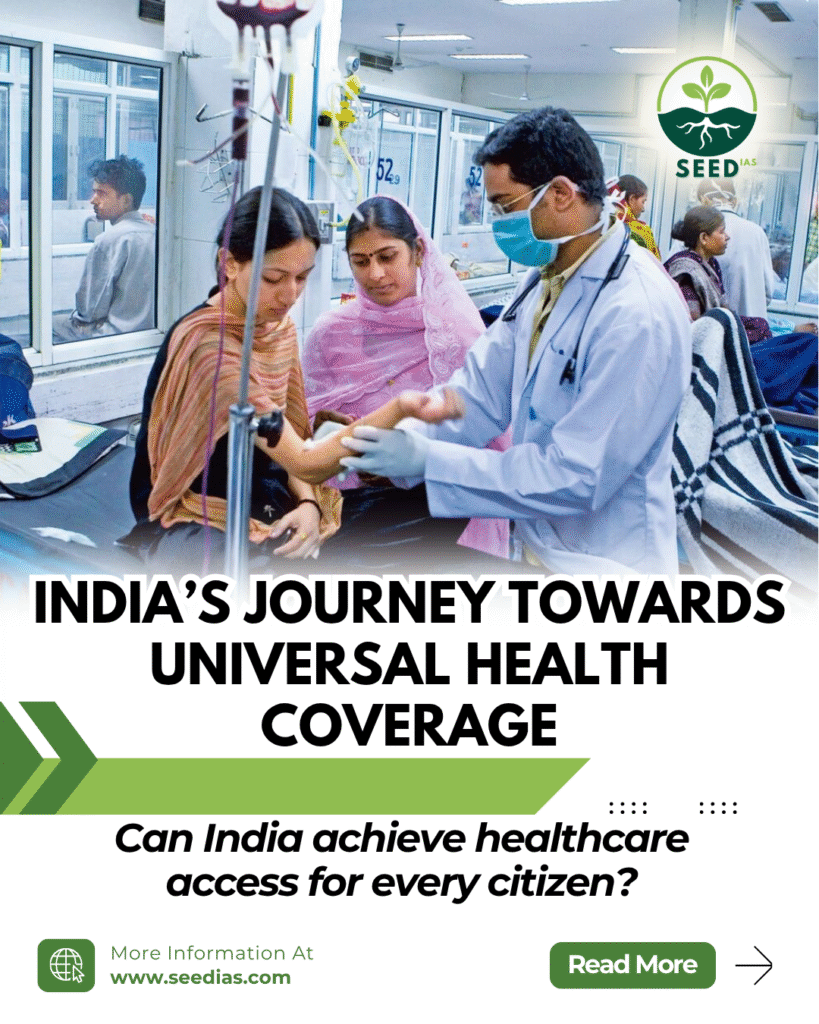
India’s progress towards Universal Health Coverage (UHC) has come into focus after the National Statistical Office (NSO) 2025 Survey reported:
- Increased utilization of public healthcare facilities.
- Reduced Out-of-Pocket Expenditure (OOPE).
- Improved access to affordable healthcare services.
These improvements have largely been driven by flagship initiatives such as Ayushman Bharat and the National Health Mission (NHM).
Background
What is Universal Health Coverage (UHC)?
Universal Health Coverage (UHC) means that all individuals and communities receive the health services they need without suffering financial hardship.
It is a key target under Sustainable Development Goal (SDG) 3: Good Health and Well-being.
India’s healthcare reforms gained momentum through:
- National Health Policy (NHP), 2017
- Ayushman Bharat Programme (2018)
- Expansion of digital healthcare infrastructure
- Strengthening primary healthcare systems
News Breakdown
India has witnessed significant improvements in healthcare access, affordability, and outcomes. However, several structural challenges continue to hinder the achievement of complete Universal Health Coverage.
Major Achievements in India’s Healthcare Sector
1. Universal Health Coverage and Health Insurance
What is AB-PMJAY?
Ayushman Bharat Pradhan Mantri Jan Arogya Yojana (AB-PMJAY) is the world’s largest publicly funded health insurance scheme.
| Feature | Details |
|---|---|
| Launch Year | 2018 |
| Policy Basis | National Health Policy 2017 |
| Coverage | ₹5 lakh per family per year |
| Beneficiaries | 12 crore vulnerable families |
Key Achievements
- Over 44.14 crore Ayushman Cards issued.
- More than 12.03 crore hospitalizations funded.
- Ayushman App available in 19 languages.
- Healthcare access has become more inclusive and paperless.
Senior Citizen Coverage
The Ayushman Bharat Vay Vandana Scheme was launched in October 2024.
Key highlights:
- Covers all citizens above 70 years of age.
- By June 2026, over 1.20 crore senior citizens enrolled.
- Treatments worth ₹3,000 crore provided.
2. Strengthening Primary Healthcare
What are Ayushman Arogya Mandirs (AAMs)?
Ayushman Arogya Mandirs (AAMs) are upgraded health facilities providing comprehensive primary healthcare services.
Achievements
- More than 1.86 lakh facilities upgraded.
- Includes:
- Sub-Centres
- Primary Health Centres (PHCs)
- AYUSH Centres
- Provide 12 comprehensive healthcare services free of cost.
- Recorded over 540 crore cumulative patient visits.
Impact Example
The Lalmati Sub-Centre in Assam:
- Introduced NCD screening.
- Expanded mental health support.
- Achieved zero maternal and child mortality from preventable causes since 2024.
3. Pandemic Preparedness and Health Infrastructure
PM-ABHIM
Pradhan Mantri Ayushman Bharat Health Infrastructure Mission (PM-ABHIM) aims to create resilient public health infrastructure.
Infrastructure Expansion
- 744 Integrated Public Health Laboratories
- 631 Critical Care Hospital Blocks
- Coverage extended to districts with population above 5 lakh
India’s COVID-19 Response
| Indicator | Achievement |
| Vaccine Doses Administered | 220+ crore |
| ICU Beds Expanded | 2,168 to 1.45 lakh |
| Vaccine Maitri Exports | 300 million doses to 100 countries |
4. Maternal and Child Health Improvements
Safe Motherhood Initiatives
PMSMA
Pradhan Mantri Surakshit Matritva Abhiyan
- 7.47 crore pregnant women examined.
JSSK
Janani Shishu Suraksha Karyakram
- Free deliveries.
- Zero OOPE for maternal healthcare.
Role of ASHA Workers
Accredited Social Health Activists (ASHAs):
- Promote institutional deliveries.
- Ensure antenatal and postnatal care.
5. Immunization and Disease Elimination
Mission Indradhanush
- Vaccinated 5.46 crore previously unimmunized children.
Zero-Dose Children
Zero-Dose Child: A child who has not received even the first vaccine dose.
- Reduced to just 0.06% by April 2026.
Tuberculosis and Malaria Control
TB Mukt Bharat Abhiyaan
- 20 crore people screened
- 3.78 lakh Nikshay Mitras involved
- Nutrition support provided to 20 lakh TB patients
Disease Reduction
- Malaria mortality reduced by 78%
- Mother-to-child HIV transmission reduced by 74.5% since 2010
6. Tackling Non-Communicable Diseases (NCDs)
What are NCDs?
Non-Communicable Diseases (NCDs) are chronic diseases that are not transmitted from person to person.
Examples:
- Heart disease
- Diabetes
- Cancer
- Stroke
Screening Achievements
| Disease | Screenings Conducted |
| Hypertension | 41.5 crore |
| Diabetes | 41.3 crore |
| Oral, Breast & Cervical Cancer | 60+ crore |
Dialysis and Cancer Care
- 4 crore free dialysis sessions under PMNDP.
- Cancer care approved in all 22 new AIIMS.
Lifestyle-Based Interventions
- Eat Right India
- Fit India Movement
Tobacco Control
India received the Bloomberg Philanthropies Award 2025 for:
- Reducing tobacco use by 17.3%
- Effective implementation of the National Tobacco QuitLine.
7. Digital Health Revolution
ABDM
Ayushman Bharat Digital Mission (ABDM) aims to digitize healthcare delivery.
Key Achievements
- Over 20.49 crore ABHA IDs generated.
ABHA
Ayushman Bharat Health Account (ABHA) is a unique digital health identity.
U-WIN Platform
Tracks:
- Vaccination status of 11.87 crore children
- 3.96 crore pregnant women
Telemedicine Expansion
eSanjeevani
- More than 47 crore teleconsultations completed.
Tele-MANAS
- Mental health support in 20 languages
- Through 53 dedicated cells
Drone-Based Healthcare
i-DRONE Initiative
Implemented by Indian Council of Medical Research (ICMR).
Achievements:
- Delivered over 22,000 medical supplies
- Covered 7,700 km of difficult terrain
8. Artificial Intelligence in Healthcare
AI-Powered Innovations
| AI Tool | Purpose |
| CDSS | Clinical Decision Support |
| Cough Against TB | Detect hidden TB cases |
| MadhuNetrAI | Diabetic Retinopathy Screening |
Benefits
- Faster diagnosis
- Early disease detection
- Reduced dependence on specialists
9. Affordable Medicines and Diagnostics
Jan Aushadhi Kendras
- More than 18,000 Kendras
- Medicines available at 50–90% lower prices
AMRIT Pharmacies
- Patient savings of ₹8,400 crore
Free Diagnostics Initiative
- Up to 57 diagnostic tests available free at district hospitals.
10. Healthcare Workforce Expansion
Medical Education
- Number of medical colleges has doubled.
Nursing Infrastructure
- 157 new nursing colleges under establishment.
AYUSH Integration
- Integrated across 13,093 healthcare facilities
- AYUSH Visa launched in July 2023 to promote medical tourism.
Major Challenges in India’s Healthcare
Fiscal Constraints
National Health Policy Target
Target:
- Public Health Expenditure = 2.5% of GDP by 2025
Reality:
- Target remains unmet.
Declining Union Health Spending
| Year | Health Spending as % of GDP |
| 2020-21 | 0.37% |
| 2025-26 | 0.29% |
Low Public Health Spending
India spends significantly less per capita than:
- Bhutan
- Sri Lanka
- Thailand
- Malaysia
- BRICS countries
Fragmented Governance
Healthcare determinants are managed separately:
- Water
- Nutrition
- Sanitation
- Air Quality
This weakens integrated health outcomes.
High Out-of-Pocket Expenditure
According to a NITI Aayog Evaluation Study:
- 65% PMJAY beneficiaries still paid from their pockets
- Only 35% received fully cashless treatment
Absence of a Right to Health Law
India lacks a nationwide statutory Right to Health Act.
Consequences:
- Weak accountability
- Uneven healthcare access
- Regional disparities
Rising NCD Burden
- NCDs account for 60% of all deaths in India
- Long-term treatment creates financial pressure.
Mental Health Challenges
Issues include:
- Social stigma
- Limited specialists
- Urban concentration of psychiatric services
Measures to Strengthen Healthcare
Fiscal Reforms
- Increase public health spending to 2.5–3% of GDP.
Expand AI Diagnostics
- Scale MadhuNetrAI
- Expand Cough Against TB
National Drone Network
- Expand i-DRONE for remote healthcare delivery.
Community-Led Health Campaigns
- Strengthen Jan Andolan model.
- Expand Nikshay Mitra participation.
Digital Integration
- Universal adoption of ABHA ID.
- Full integration of U-WIN.
AYUSH Grid Expansion
- Integrate traditional and modern healthcare digitally.
Right to Health Framework
- Enact a comprehensive national Right to Health law.
Prelims Focus
High-Value Facts
- AB-PMJAY launched in 2018.
- Health insurance cover under PMJAY: ₹5 lakh per family annually.
- ABHA stands for Ayushman Bharat Health Account.
- PM-ABHIM focuses on health infrastructure strengthening.
- Tele-MANAS is India’s national tele-mental health programme.
- i-DRONE is implemented by ICMR.
- Public health and sanitation fall under Entry 6 of the State List.
- NCDs account for approximately 60% of deaths in India.
- Mission Indradhanush targets full immunization coverage.
Conclusion
India has substantially advanced Universal Health Coverage, but sustained funding, stronger regulation, digital integration, and legal accountability remain essential for inclusive healthcare.
Prelims Check
Question 1
Consider the following statements regarding Ayushman Bharat:
- AB-PMJAY provides health insurance coverage of ₹5 lakh per family annually.
- Ayushman Bharat was launched under the National Health Policy, 2017 framework.
- Ayushman Bharat Vay Vandana provides coverage only to BPL senior citizens above 70 years.
Which of the statements given above is/are correct?
(a) 1 and 2 only
(b) 2 and 3 only
(c) 1 and 3 only
(d) 1, 2 and 3
Question 2
Consider the following pairs:
| Initiative | Purpose |
| 1. U-WIN | Vaccination tracking |
| 2. Tele-MANAS | Mental health support |
| 3. MadhuNetrAI | Tuberculosis diagnosis |
| 4. i-DRONE | Medical logistics |
How many pairs given above are correctly matched?
(a) Only one
(b) Only two
(c) Only three
(d) All four
Question 3
Consider the following statements:
- Public health and sanitation are listed under the State List of the Seventh Schedule.
- Non-Communicable Diseases account for more than half of all deaths in India.
- PM-ABHIM primarily focuses on expanding health insurance coverage.
Which of the statements given above are correct?
(a) 1 and 2 only
(b) 2 and 3 only
(c) 1 and 3 only
(d) 1, 2 and 3
Answers and Explanations
Q1. Answer: (a) 1 and 2 only
Explanation:
- PMJAY provides ₹5 lakh annual health insurance cover.
- It was launched under the framework of National Health Policy 2017.
- Vay Vandana covers all citizens above 70 years, not only BPL families.
Q2. Answer: (c) Only three
Explanation:
- U-WIN correctly tracks immunization records.
- Tele-MANAS provides tele-mental healthcare.
- MadhuNetrAI is used for diabetic retinopathy screening, not TB diagnosis.
- i-DRONE supports delivery of medicines, vaccines, and samples.
Q3. Answer: (a) 1 and 2 only
Explanation:
- Public health falls under Entry 6 of the State List.
- NCDs account for nearly 60% of deaths in India.
- PM-ABHIM focuses on health infrastructure, not insurance coverage.
“A healthy nation is built not only by hospitals and medicines, but by vision, innovation, and collective commitment to human well-being.”