Why in NEWS
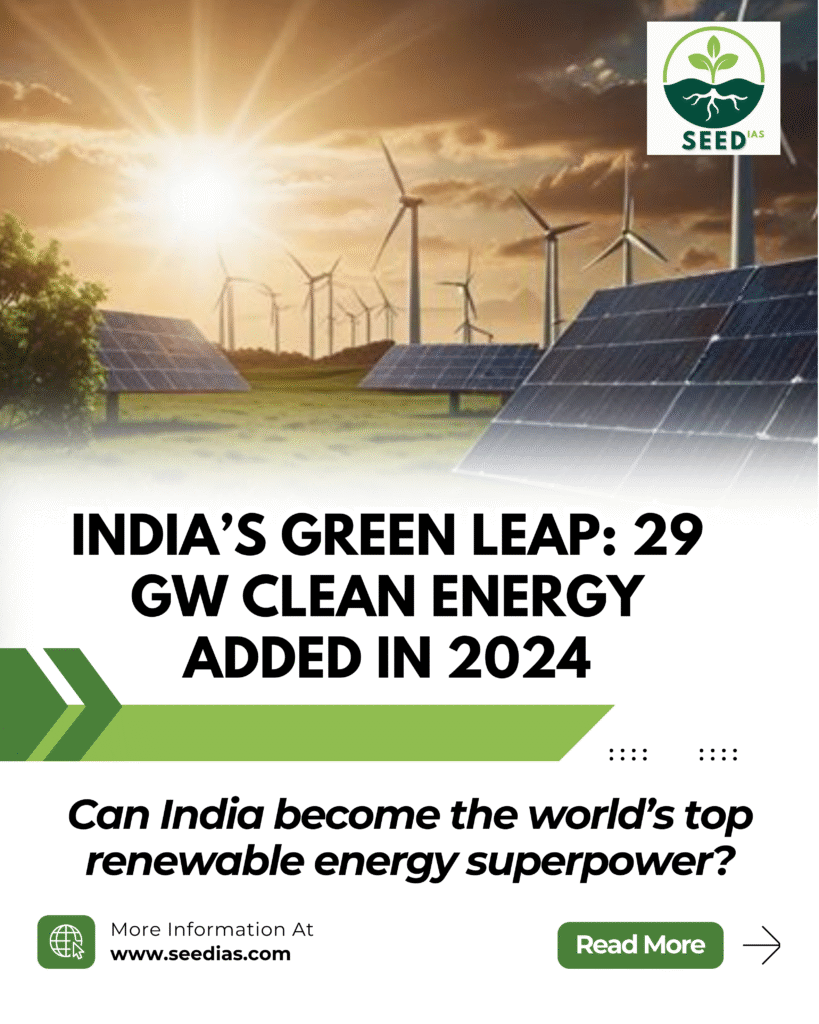
India added a record 29 GW of renewable energy in 2024, reaching a total installed capacity of 232 GW, with 176 GW under construction. This cements India’s position as a global clean energy leader, steering global sustainability through visionary reforms.
Key Concepts Explained
| Term/Concept | Explanation |
|---|---|
| Renewable Energy | Energy derived from natural sources (solar, wind, biomass, etc.) that are replenished constantly. |
| ISTS Charges | Inter-State Transmission System charges are levied for power transmission between states. |
| Green Hydrogen | Hydrogen produced using renewable electricity, without CO₂ emissions. |
| Agrivoltaics | Dual use of agricultural land for both solar energy generation and crop cultivation. |
| Floating Solar | Solar photovoltaic panels installed on water bodies to save land and water. |
| RE-SEZ | Renewable Energy Special Economic Zones dedicated to clean energy industries. |
| VAWT | Vertical Axis Wind Turbines – windmills with vertical rotation suited for urban spaces. |
India’s Renewable Energy Status (as of 2025)
| Metric | Data & Achievements |
|---|---|
| Global Ranking | 3rd in Solar, 4th in Wind & Total RE capacity |
| Solar Energy | 2.63 GW in 2014 → 108 GW in 2025 (41x increase) |
| Wind Energy | Surpassed 51 GW |
| Non-Fossil Fuel Goal | 500 GW by 2030; 1800 GW by 2047 |
| Manufacturing Boost | Solar module capacity: 38 GW → 74 GW (Mar 2024–25) |
| Major Programs | PM Surya Ghar Yojana, PM-KUSUM, NGHM, EBP, SATAT |
| FDI in RE | 8% of total FDI inflow in FY 2024-25 |
| Investor Commitment | ₹32.45 lakh crore committed by 2030 at RE-Invest 2024 |
Key Issues in India’s RE Sector
| Challenge | Details |
|---|---|
| Coal Dependency | Employment, infrastructure & state economies linked to coal |
| Financing Gaps | ₹2 trillion/year needed to meet 2030 targets |
| Grid & Storage | Need 411 GWh storage by 2032; current: only 219.1 MWh |
| Import Dependence | 56% solar cells from China; 70% lithium from China |
| Land & Ecology | Solar needs 4–5 acres/MW; leads to land conflicts and biodiversity loss |
| E-waste Crisis | India may become 4th-largest solar panel waste generator by 2050 |
Proposed Solutions to Boost RE Growth
| Strategy | Description |
|---|---|
| Floating Solar + Agrivoltaics | Combines clean energy, water conservation, and farming |
| RE-SEZs + RE Parks | Accelerates growth with pre-approved zones and integrated infrastructure |
| Smart Tech Adoption | Blockchain trading, pumped hydro, smart grids for better RE integration |
| Rooftop & Urban RE Solutions | VAWTs, rooftop solar, microgrids in urban & off-grid regions |
| Circular Bio-Energy Parks | Converts urban waste into clean energy (e.g., Jamnagar WtE Park) |
| Global Cooperation | ISA, OSOWOG, and clean energy diplomacy |
In a Nutshell (Memory Code: “S.P.A.R.K.”)
- S – Solar surge (41x growth)
- P – PLI boost & PM schemes
- A – Agrivoltaics & storage gaps
- R – RE-SEZs & rooftop solutions
- K – Keen investor interest + ₹32L Cr committed
Prelims Practice Questions
- Which of the following statements about PM Surya Ghar: Muft Bijli Yojana is correct?
A. It aims to install centralized solar power stations in remote areas
B. It targets 1 crore households with decentralized solar capacity
C. It offers 100% subsidy on solar panels for large industries
D. It focuses only on urban households - Consider the following:
- Floating solar helps reduce water evaporation
- Solar panels require no land if installed over reservoirs
- Floating solar has higher transmission loss than land-based systems
Which are correct?
A. 1 and 2 only
B. 2 and 3 only
C. 1 and 3 only
D. 1, 2, and 3
- Which program provides subsidies for farmers to adopt solar-powered irrigation?
A. PM Surya Ghar Yojana
B. SATAT
C. PM-KUSUM
D. National Green Hydrogen Mission
Mains Practice Questions
- India’s renewable energy journey is globally recognized, but the road ahead is fraught with challenges. Discuss key roadblocks and suggest a multipronged strategy for sustainable growth. (GS3 – 2023 Inspired)
- How can India balance its growing energy needs with environmental sustainability, especially with rising land and ecological concerns tied to renewable energy expansion? (GS3 – Sustainable Development)
Prelims Answers with Explanations
| Q No. | Correct Answer | Explanation |
|---|---|---|
| 1 | B | The scheme aims at decentralized rooftop solar installation in 1 crore households. |
| 2 | A | Statements 1 and 2 are true; statement 3 is false – floating solar may have lower transmission loss. |
| 3 | C | PM-KUSUM offers up to 60% subsidy for farmers to install solar-powered irrigation pumps. |