How does ethanol blending work and what are the challenges?
Why in News?
The Indian government plans to blend 20% ethanol (E20) with petrol by 2025. The goal is to cut carbon emissions and reduce dependence on imported oil. While modern vehicles can run on E20, there are concerns about older cars, fuel efficiency, engine wear, and maintenance costs. Experts say ethanol is useful as a cleaner fuel, but vehicles and engines need to adjust properly.
Concept Corner
1. Ethanol as a Biofuel
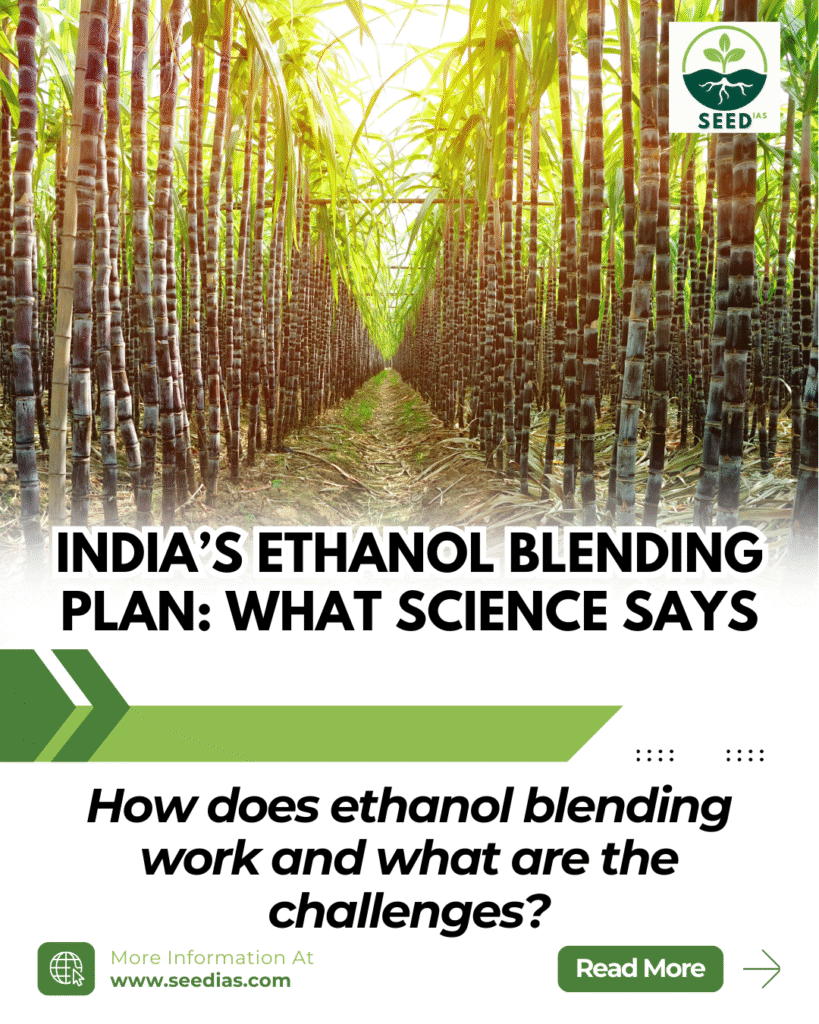
- Ethanol is made from plants or plant waste, like sugarcane, broken rice, maize, or leftover plant material.
- It helps petrol burn more completely, reducing harmful emissions.
- Ethanol has a higher octane rating than petrol, which prevents engine knocking.
- Its energy content is lower than petrol, so mileage might drop slightly.
- Ethanol absorbs water easily, which can cause corrosion in fuel tanks and pipes if not handled well.
2. How Ethanol is Made
- From sugarcane: Molasses (thick syrup) is fermented using yeast enzymes. Sugars are converted into ethanol and carbon dioxide.
- C-heavy molasses: final sugar byproduct (28–32% sugar).
- B-heavy molasses: intermediate byproduct (48–52% sugar).
- From grains and plant waste: first broken into sugars, then fermented into ethanol.
- Fermentation steps: sucrose → glucose → ethanol + CO₂.
3. Effects on Vehicles and Engines
- Modern vehicles with electronic control units (ECUs) can adjust to E20 easily.
- Older mechanically carbureted vehicles may face lower efficiency, engine issues, and extra maintenance.
- Ethanol can damage rubber components, fuel injectors, and fuel tanks if water accumulates.
- Government says replacing rubber parts is affordable and needed only once in a vehicle’s life.
4. Global Lessons – Brazil vs India
- Brazil started ethanol blending slowly in 1975 with a long-term plan, flex-fuel cars, and incentives.
- India’s rapid rollout means older vehicles struggle with E20.
- Experts suggest gradual implementation, technical upgrades, and awareness campaigns.
Core Highlights
Ethanol blending helps energy security, reduces carbon emissions, and saves on imported oil. Modern vehicles adapt well to E20, but older cars need engine recalibration and some component changes. Moisture in fuel and rubber component wear are the main concerns. Gradual rollout and proper maintenance can make the program successful.
Recent Developments
- Government is sourcing ethanol from sugarcane, maize, broken rice, and plant waste.
- MoPNG clarified that rubber part replacement is affordable and a one-time requirement.
- E20 rollout has started for BS-VI vehicles made after April 2025.
- Experts stress gradual adoption and vehicle calibration to prevent issues.
Practice Questions
Prelims Question
Consider the following statements about ethanol blending in India:
- Ethanol increases the octane rating of fuel but lowers its energy content.
- E20 fuel is safe for all vehicles, including older mechanically carbureted models.
- Ethanol absorbs water and may cause corrosion in fuel system parts if not managed.
Which of the above statements is/are correct?
A) 1 and 2 only
B) 1 and 3 only
C) 2 and 3 only
D) 1, 2 and 3
Mains Question
Explain India’s ethanol blending policy in terms of energy security, environmental benefits, and vehicle adaptation. What challenges exist, and how can they be managed?
Answer Key with Explanation (Prelims)
| Q. No. | Answer | Explanation |
| 1 | B) 1 and 3 only | Statement 1 is correct: Ethanol increases octane but lowers energy per litre. Statement 2 is incorrect: older carbureted vehicles may face problems with E20. Statement 3 is correct: ethanol’s water-absorbing nature can corrode fuel system parts if precautions are not taken. |