Why in NEWS?
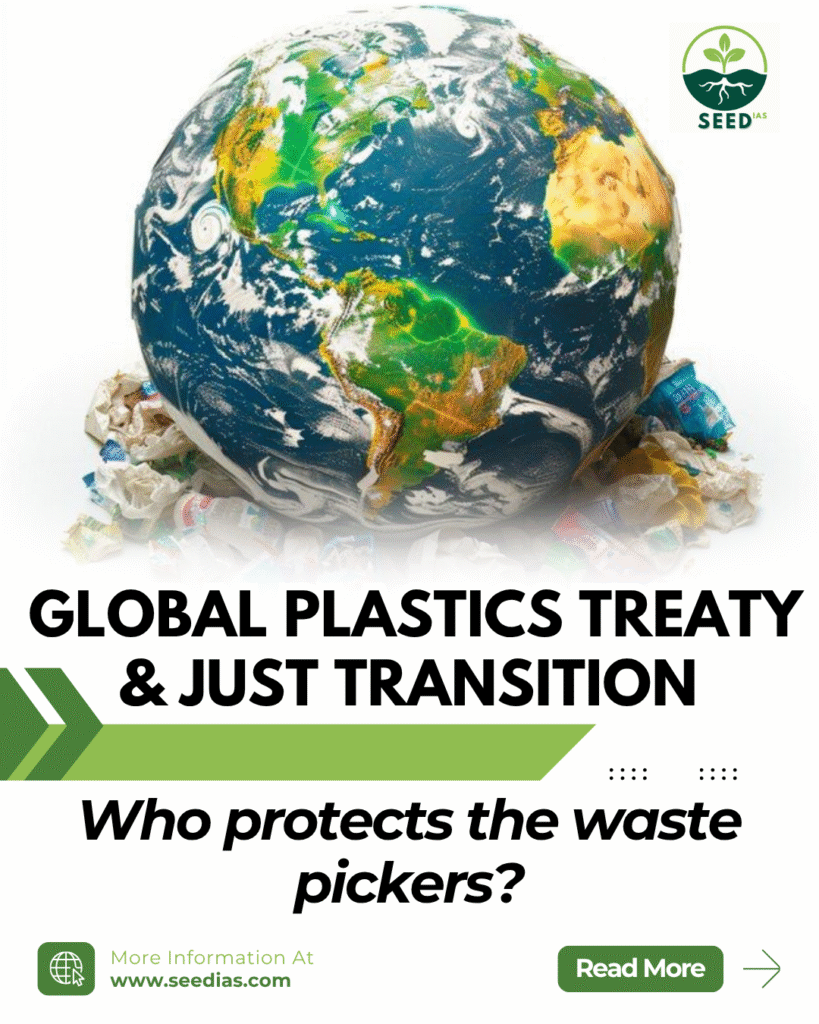
The Global Plastics Treaty, under negotiation since UNEA Resolution 5/14 (2022), gained renewed focus at INC-5.1 in Busan (2024) for lacking binding commitments on Just Transition—especially for informal waste workers who play a crucial role in recycling but face economic displacement in the plastic phase-out.
Key Terms & Concepts
| Term | Explanation |
|---|---|
| UNEA Resolution 5/14 | Resolution adopted in 2022 to negotiate a global legally binding treaty to end plastic pollution. |
| Just Transition | A shift to sustainable economies ensuring protection, retraining, and recognition of workers at risk. |
| Informal Waste Workers | Individuals engaged in unregulated recycling work, crucial for waste recovery in developing nations. |
| Extended Producer Responsibility (EPR) | A system that holds producers accountable for plastic waste generated from their products. |
Highlights of the News
| Aspect | Details |
|---|---|
| Treaty Goal | A legally binding agreement covering the entire life cycle of plastics. |
| INC Process | INC-1 (Uruguay), INC-2 (Paris), INC-3 (Nairobi), INC-4 (Ottawa), INC-5.1 (Busan), INC-5.2 (Geneva, Aug 2025) |
| Focus at INC-5.1 | Social equity and legal recognition of informal waste workers in the treaty framework |
| Concern | Draft treaty lacks binding clauses on social protections, roles, or financial mechanisms for a Just Transition. |
Why is Just Transition Essential?
| Rationale | Explanation |
|---|---|
| Protecting Livelihoods | Workers in the plastic value chain risk job loss with plastic bans and eco-alternatives. |
| Waste Pickers’ Role | Account for over 50% of urban plastic waste recovery in developing nations. |
| Current Gaps | Treaty only “encourages” inclusion (Articles 8 & 9); no mandates or funding provisions (Article 11). |
| Equity & Rights | Without legal protection, informal workers may be excluded from sustainable transitions. |
Where Countries Stand
| Country/Group | Stand on Just Transition |
|---|---|
| India | Supports it but wants national flexibility; opposes overlap with other treaties. |
| EU | Favors legal recognition and safe working conditions. |
| PSIDS | Seeks inclusion of indigenous/local communities. |
| US & African Group | Support inclusion of vulnerable groups; African Group cautious on legal recognition. |
| Iran | Demands finance/tech transfer but opposes legal terms like “vulnerable groups.” |
Plastic Pollution Data
| Indicator | Figures |
|---|---|
| Global Production | 460+ million tonnes/year |
| Leakage into Environment | 20 million tonnes/year (88% macroplastics) |
| India’s Plastic Waste | 9.46 million tonnes/year (UNDP) |
| Uncollected Waste in India | 40%, contributing 4% to national emissions |
| Projected Economic Loss | $133 billion (FICCI, from packaging waste by 2030) |
India’s Anti-Plastic Measures
| Initiative | Description |
|---|---|
| Plastic Waste Management Rules 2024 | Mandates digital waste audits and local body reporting |
| India Plastics Pact | Public-private initiative with time-bound plastic reduction goals |
| Project REPLAN | Converts plastic waste into handmade paper |
| Un-Plastic Collective | Encourages circular economy practices by companies |
Roadmap for Operationalizing Just Transition
| Strategy | Action |
|---|---|
| Binding Provisions | Make worker protections and retraining obligations legally enforceable |
| Clear Definitions | Explicitly recognize informal waste workers and their roles |
| Global Just Transition Fund | Finance worker retraining and integration into formal waste systems |
| Tech Transfer + Capacity Building | Share green tech and train workers to adapt |
| South-South Collaboration | Promote affordable local recycling tech in developing countries |
In a Nutshell
Mnemonic: “FAIR SHIFT”
Financial support
Acknowledgment of informal roles
ILO Convention backing
Retraining programs
Social equity
Human rights frameworks
Inclusive definitions
Formal integration
Technology transfer
Prelims Questions
- Which of the following sessions discussed the inclusion of Just Transition in the Global Plastics Treaty?
A) INC-1, Uruguay
B) INC-3, Nairobi
C) INC-5.1, Busan
D) INC-2, Paris - Which article(s) of the draft treaty address the Just Transition clause without binding obligations?
A) Article 5
B) Article 8 and 9
C) Article 4 and 6
D) Article 11 only - Which of the following best defines a ‘Just Transition’ in context of the Global Plastics Treaty?
A) Ban on all single-use plastics
B) Transfer of plastic waste to informal workers
C) Protecting vulnerable workers while moving to sustainable alternatives
D) Taxing plastic producers to raise government revenue
Mains Questions
- Explain the significance of integrating a ‘Just Transition’ framework in the Global Plastics Treaty. How can it help achieve inclusive environmental justice? 10 Marks
- Discuss the challenges and opportunities of implementing a Just Transition for informal waste workers in India. (GS3: Environment – Conservation & Employment) 15 Marks
Prelims Answer Key
| Qn | Answer | Explanation |
|---|---|---|
| 1 | C | INC-5.1 (Busan, 2024) specifically highlighted Just Transition gaps |
| 2 | B | Articles 8 & 9 encourage inclusion but are non-binding |
| 3 | C | Core idea of Just Transition is social fairness during environmental reforms |