Why in NEWS
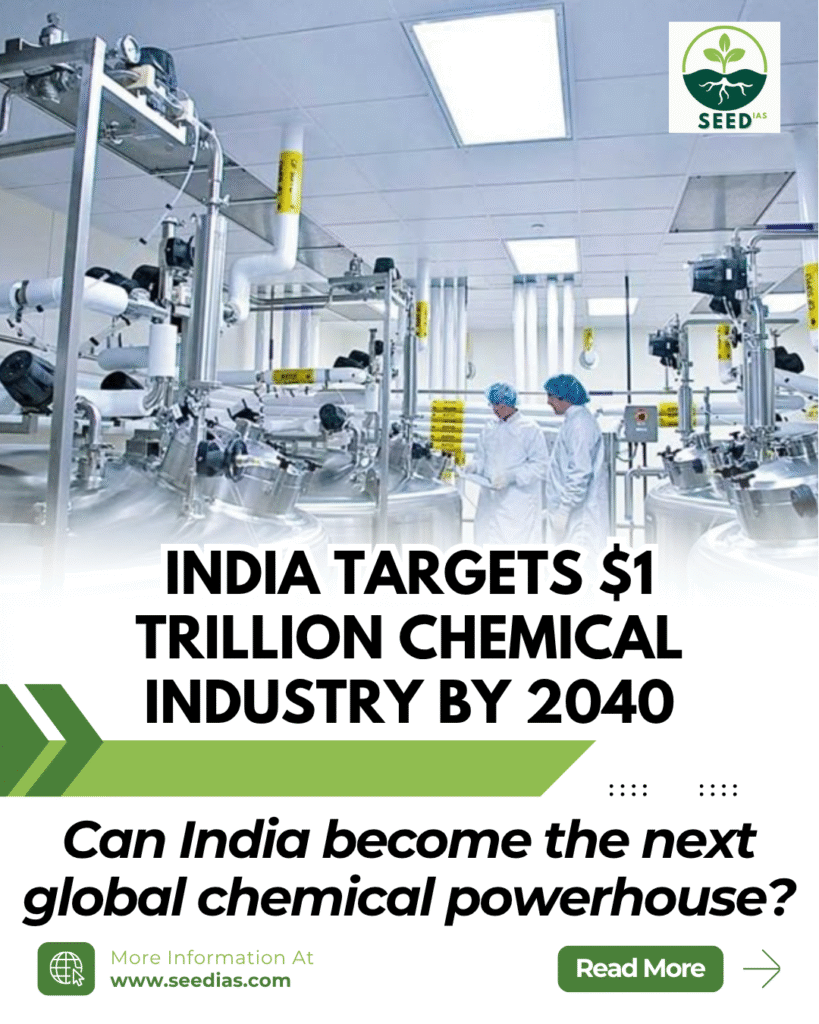
NITI Aayog released a report titled ‘Chemical Industry: Powering India’s Participation in Global Value Chains’, setting a vision for India to achieve a 12% share in global chemical value chains and USD 1 trillion output by 2040.
Key Terms and Concepts
| Term | Meaning |
|---|---|
| Global Value Chains (GVC) | International production networks where different stages of manufacturing occur in different countries |
| Feedstock | Raw materials used to produce chemicals |
| Green Chemistry | Chemical processes and products designed to reduce or eliminate hazardous substances |
| OPEX Subsidy | Financial support for operational expenditures to enhance production |
| Viability Gap Funding (VGF) | Financial aid to bridge the gap between project cost and return on investment |
| PCPIR | Petroleum, Chemicals and Petrochemicals Investment Region aimed at cluster-based investment |
| Mutual Recognition Agreements (MRAs) | Agreements to mutually accept standards and certifications between countries |
Current Status of India’s Chemical Industry
| Aspect | Details |
|---|---|
| Global Rank | 6th largest chemical producer globally |
| GDP Contribution | Over 7% to manufacturing GDP |
| Industrial Linkage | Supports pharma, textiles, agriculture, construction |
| Production Focus | Over-concentration in bulk chemicals |
| GVC Participation | Only 3.5% share, USD 31 billion trade deficit (2023) |
| MSME Dominance | Sector remains fragmented, with growth in Gujarat, Maharashtra, Tamil Nadu |
| Skill Shortage | 30% deficit, especially in green chemistry, nanotech, safety |
| R&D Spending | Only 0.7% of revenue vs global 2.3% |
| Import Dependence | 60%+ API imports from China, feedstock from Gulf |
| Regulatory Bottlenecks | 12–18 months delay in approvals |
Opportunities for Growth
| Area | Potential |
|---|---|
| Domestic Demand | Agrochemicals (4th globally), Pharma (3rd), Construction, Auto |
| Refinery Boost | Expansion by Reliance, BPCL to raise petrochemical production |
| Employment | 7 lakh skilled jobs expected by 2030 |
| Global Shift | Supply chain diversification from China opens new markets |
| Sustainable Chemistry | India can lead in bioplastics, bio-lubricants using sugar & biomass |
NITI Aayog’s Policy Interventions
| Policy Area | Details |
|---|---|
| Chemical Hubs | Empowered Committee, Chemical Fund, VGF for infra |
| Port Infrastructure | Dedicated Chemical Committee and 8 port-based clusters |
| OPEX Subsidy Scheme | Targeted at import-reducing and export-enhancing production |
| R&D Push | Industry-academia grants, tech partnerships with MNCs |
| Environmental Clearances | Fast-tracking via DPIIT audit mechanism |
| Trade Facilitation | Secure FTAs, improve rules of origin and tariff access |
| Skill Development | Expand ITIs, petrochemical-specific training courses |
Existing Government Initiatives
| Initiative | Objective |
|---|---|
| PLI Scheme | Support greenfield plants for APIs, KSMs, Drug Intermediates |
| PCPIR Paradip | USD 8.84 billion investment, 40,000 jobs |
| Jan Aushadhi Kendras | Target of 25,000 outlets for affordable medicines |
Steps to Strengthen the Sector
| Focus Area | Suggested Actions |
|---|---|
| Global Integration | Sign MRAs, set up export council, align with global standards |
| Safety Norms | Enforce real-time monitoring, stricter Chemical Accident Rules |
| Sustainability | Incentivize ZLD, clean tech, waste recycling |
| Financial Access | Lower interest loans, VC funding, insurance for startups |
| Skill Upskilling | Revamp chemical engineering curriculum with green focus |
In a nutshell
Memory Code: C-H-E-M-I-C-A-L
Clusters near ports
High-skill job creation
Environmental clearances fast-tracked
MSME empowerment
Import substitution
Clean & green chemistry
Agreements (FTAs, MRAs)
Logistics upgrade
Prelims Questions
- Which of the following is a major reason for India’s low participation in global chemical value chains?
a) High domestic demand
b) High R&D investment
c) Fragmented industry structure
d) Abundance of skilled labor - The OPEX subsidy scheme proposed by NITI Aayog is aimed at:
a) Reducing capital costs of greenfield plants
b) Supporting export potential and reducing import dependency
c) Subsidizing logistics in remote areas
d) Promoting Jan Aushadhi Kendras - Which of the following is a correct match?
a) PCPIR – Renewable energy production
b) Jan Aushadhi – Petrochemical innovation
c) MRAs – Global chemical safety standards
d) Green Chemistry – Low-emission and sustainable chemical processes
Mains Questions
- Discuss the key challenges and opportunities in India’s chemical industry in the context of global value chains. (GS3 – Economy)
- How can India leverage green chemistry and sustainable practices to become a leader in the global chemical market? (GS3 – Environment and Science & Tech)
Answer Key Table
| Q.No | Answer | Explanation |
|---|---|---|
| 1 | c | The sector is fragmented and MSME-dominated, limiting scale and efficiency in GVCs |
| 2 | b | OPEX subsidy aims to incentivize production with a focus on reducing imports and boosting exports |
| 3 | d | Green chemistry promotes eco-friendly chemical production; other matches are incorrect |