Context of the News
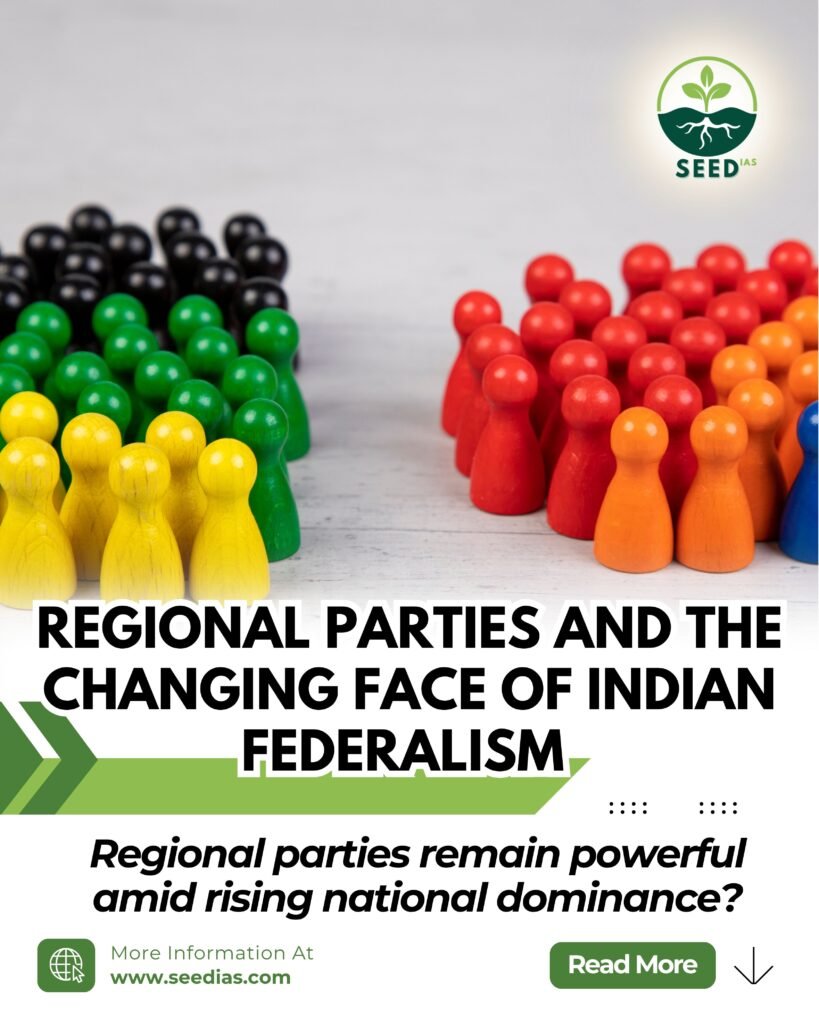
The relevance of regional parties in Indian politics is being debated amid electoral setbacks, defections, organisational challenges and the growing influence of national parties. The debate has also intensified with discussions around One Nation, One Election (ONOE).
Background
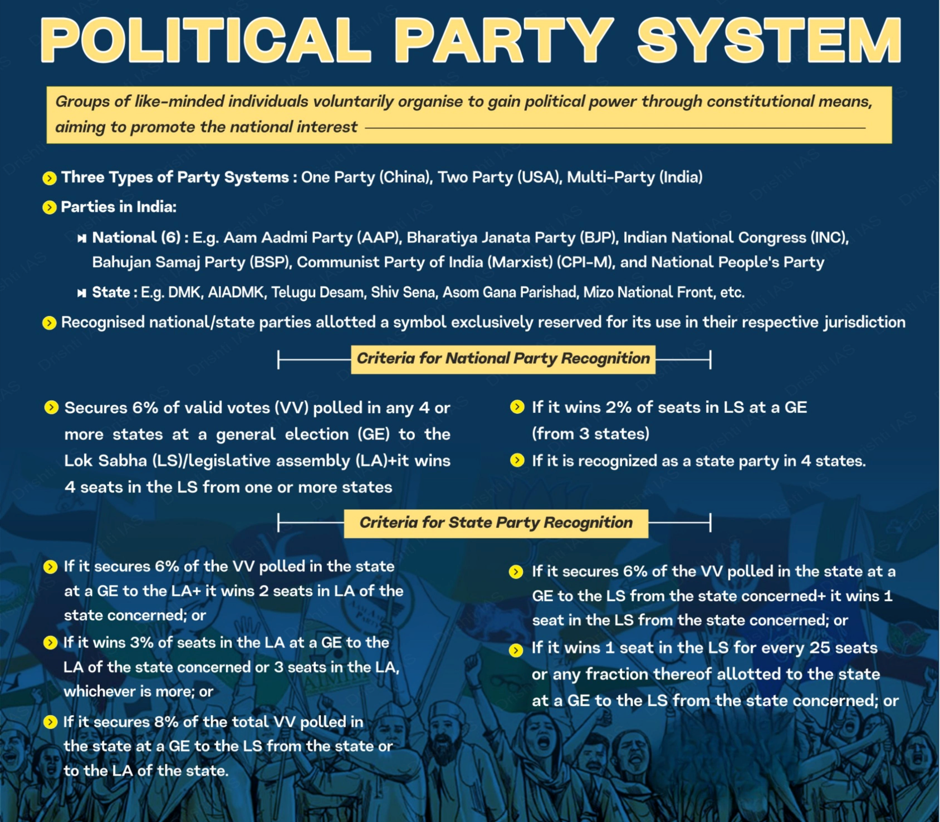
India follows a multi-party political system, where both national and regional political forces compete at the Union and State levels.
The Election Commission of India formally classifies recognised political parties as National Parties and State Parties under the Election Symbols (Reservation and Allotment) Order, 1968.
The evolution of India’s party system can broadly be understood in three phases:
| Phase | Period | Major Characteristic |
|---|---|---|
| One-Party Dominance | 1952–1967 | Dominance of one major party at Centre and States |
| Rise of Regional Aspirations | 1967–1989 | Growth of linguistic, cultural and regional political identities |
| Coalition Politics | 1989–2014 | Regional parties became important coalition partners and “kingmakers” |
The 52nd Constitutional Amendment Act, 1985 introduced the Tenth Schedule, dealing with political defections.
News Breakdown
What is a Regional Party?
A regional party is a political party whose electoral and organisational influence is primarily concentrated in one or a few States.
In India’s constitutional framework, the formal term used by the Election Commission is State Party, rather than “regional party”.
Regional parties often derive their political strength from:
- Regional identity
- Linguistic and cultural interests
- State autonomy
- State-specific welfare policies
- Regional economic concerns
- Local leadership
Why is the Political Space for Regional Parties Shrinking?
1. Rise of Dominant National Parties
The expanding electoral and organisational reach of major national parties has increased competition for regional parties.
As of August 2026, regional parties independently head governments in Andhra Pradesh, Meghalaya and Nagaland, and in the Union Territory of Puducherry. This represents a significant decline from the period between 2015 and 2020, when regional parties independently governed nine States.
This does not necessarily mean that regional parties have lost their electoral relevance.
2. First-Past-the-Post System
India uses the First-Past-the-Post (FPTP) electoral system.
Under FPTP, the candidate securing the highest number of votes in a constituency wins, even without obtaining more than 50% of the votes.
Therefore:
- A small decline in vote share can result in a large loss of seats.
- A party with geographically concentrated support can win many seats with a relatively modest vote share.
- Seat share may therefore not accurately represent the overall strength of a party’s voter base.
3. Organisational Weakness and Dynastic Politics
Several regional parties are heavily centred around a dominant leader or political family.
This can create:
- Succession crises
- Factionalism
- Leadership conflicts
- Party splits
- Limited opportunities for emerging leaders
Weak internal democracy can also encourage capable political leaders to move towards parties offering greater organisational opportunities.
4. Resource Asymmetry
Election campaigns require significant financial and organisational resources.
The expenditure ceiling for individual candidates is:
| Election | Larger States | Smaller States |
|---|---|---|
| Lok Sabha | ₹95 lakh | ₹75 lakh |
| State Assembly | ₹40 lakh | ₹28 lakh |
However, political parties themselves do not currently face an overall expenditure ceiling during elections.
This can create a resource advantage for larger national parties over smaller regional organisations.
5. Defections and the Anti-Defection Law
The Tenth Schedule was introduced to address political defections.
However, the provisions relating to mergers and defections have generated political and judicial controversies.
The source highlights concerns that the existing two-thirds merger provision can potentially be used to engineer political splits in regional parties.
6. Fiscal and Administrative Constraints
Regional governments derive much of their political relevance from their ability to implement State-specific policies.
However, issues such as:
- Governor’s discretionary role,
- delays in assenting to State legislation,
- dependence on Centrally Sponsored Schemes (CSS),
- matching-fund requirements, and
- increasing use of cesses and surcharges
can constrain the availability of untied fiscal resources for States.
This can affect the capacity of regional governments to pursue independent development priorities.
How Could One Nation, One Election Affect Regional Parties?
One Nation, One Election (ONOE) refers to synchronising elections to the Lok Sabha and State Legislative Assemblies.
A major concern is that simultaneous elections could increase the influence of national-level issues over State-specific concerns.
Regional parties generally benefit from electoral debates centred on:
- State development
- Regional identity
- Local governance
- State-specific welfare
- Regional economic interests
If national and State elections are held together, national political narratives may receive greater attention.
The source therefore argues that any move towards ONOE should include constitutional safeguards for State-level issues and regional narratives.
Why Regional Parties Still Matter
Despite these challenges, regional parties have demonstrated considerable resilience.
1. Stable Vote Share
Regional parties secured around one-third of the total Lok Sabha vote share, recording 33.52% in the 2024 Lok Sabha elections, according to the source.
Therefore, a decline in the number of States governed independently by regional parties does not automatically mean a similar decline in their electoral support.
2. Stronger State-Level Performance
Voters may distinguish between their preferences in Lok Sabha elections and State Assembly elections.
Regional parties can therefore remain powerful at the State level even when national parties dominate Parliament.
3. Coalition Politics
Regional parties continue to influence government formation and policymaking through coalition politics.
The source identifies their role in governments or coalitions involving Andhra Pradesh, Meghalaya, Nagaland, Puducherry, Bihar, Uttar Pradesh, Assam, Goa, Maharashtra, Tripura, Jharkhand, Jammu and Kashmir and Kerala.
Significance of Regional Parties for Indian Democracy
1. Strengthening Federalism
Regional parties can act as a counterweight to excessive centralisation by demanding greater administrative and financial powers for States.
2. Representing Regional Aspirations
India has enormous linguistic, cultural, ethnic and economic diversity.
Regional parties provide political representation to interests that may not receive sufficient attention in national-level politics.
3. Bringing State Issues to National Politics
Regional parties can bring issues such as:
- Inter-State river disputes
- Regional infrastructure
- Agricultural concerns
- Special financial requirements
- State-specific development demands
into national policymaking.
4. Promoting Policy Innovation
States governed by regional parties have sometimes pioneered welfare initiatives that later influenced national policy.
The Midday Meal Scheme, pioneered and expanded in Tamil Nadu, is cited as an example.
5. Strengthening Electoral Competition
Regional parties provide voters with alternatives to national parties and thereby contribute to political competition and democratic participation.
How Can Regional Parties Be Strengthened?
State Funding of Elections
The Indrajit Gupta Committee (1998) supported the idea of state funding of elections. Partial state funding could reduce financial inequalities between political parties.
Reforming the Anti-Defection Framework
The Dinesh Goswami Committee (1990) recommended changes concerning the authority responsible for deciding disqualification.
The Law Commission’s 170th Report (1999) recommended an independent tribunal for deciding such matters.
Strengthening Intra-Party Democracy
Regional parties can reduce succession crises by developing:
- Institutionalised leadership structures
- Internal democratic processes
- Second-rung leadership
- Transparent succession mechanisms
Promoting Developmental Regionalism
Regional parties need to move beyond narrow identity-based mobilisation and combine regional aspirations with effective governance.
A strong regional political model can focus on:
Infrastructure + Health + Employment + Fiscal Prudence + Regional Identity
Prelims Focus
High-Value Facts
- India follows a multi-party political system.
- Political parties are registered under Section 29A of the Representation of the People Act, 1951.
- Recognised political parties are classified as National Parties and State Parties.
- The Election Symbols (Reservation and Allotment) Order, 1968 provides the framework for recognition and classification.
- The 52nd Constitutional Amendment Act, 1985 introduced the Tenth Schedule.
- The Tenth Schedule deals with anti-defection provisions.
- The First-Past-the-Post system can produce significant differences between vote share and seat share.
- Centrally Sponsored Schemes (CSS) generally involve financial participation by both the Union and State governments.
- The Indrajit Gupta Committee (1998) examined state funding of elections.
- The Dinesh Goswami Committee (1990) examined electoral reforms.
- The Law Commission’s 170th Report (1999) recommended an independent tribunal for deciding disqualification matters.
Prelims Check
Question 1
With reference to political parties in India, consider the following statements:
- The Constitution originally contained an explicit definition of the term “political party”.
- The Election Commission formally recognises political parties as National Parties or State Parties.
- The Tenth Schedule was introduced through the 52nd Constitutional Amendment Act.
Which of the statements given above is/are correct?
(a) 1 and 2 only
(b) 2 and 3 only
(c) 1 and 3 only
(d) 1, 2 and 3
Question 2
Consider the following statements regarding regional parties in India:
- A regional party may have substantial influence in State elections even when its representation in the Lok Sabha is limited.
- The First-Past-the-Post system can produce a substantial difference between a party’s vote share and seat share.
- Regional parties have no significant role in coalition governments once a national party obtains a majority in the Lok Sabha.
Which of the statements given above are correct?
(a) 1 and 2 only
(b) 2 and 3 only
(c) 1 and 3 only
(d) 1, 2 and 3
Question 3
Consider the following pairs:
| Committee/Institution | Associated with |
|---|---|
| 1. Indrajit Gupta Committee | State funding of elections |
| 2. Dinesh Goswami Committee | Electoral reforms |
| 3. Law Commission’s 170th Report | Independent tribunal for disqualification matters |
How many of the above pairs are correctly matched?
(a) Only one
(b) Only two
(c) All three
(d) None
Answers and Explanations
Answer 1: (b) 2 and 3 only
- Statement 1 is incorrect: The term “political party” was not explicitly mentioned in the original Constitution.
- Statement 2 is correct: Recognised parties are classified as National Parties and State Parties.
- Statement 3 is correct: The 52nd Constitutional Amendment Act, 1985 introduced the Tenth Schedule dealing with defections.
Answer 2: (a) 1 and 2 only
- Statement 1 is correct: Regional parties can retain considerable influence in State Assembly elections.
- Statement 2 is correct: Under FPTP, vote share and seat share can differ substantially.
- Statement 3 is incorrect: Regional parties continue to be important coalition partners in several States.
Answer 3: (c) All three
- Indrajit Gupta Committee (1998): Associated with the idea of state funding of elections.
- Dinesh Goswami Committee (1990): Examined electoral reforms, including issues concerning disqualification.
- Law Commission’s 170th Report (1999): Recommended an independent tribunal for deciding disqualification matters.
Conclusion / Way Forward
India’s federal democracy needs strong regional voices alongside national parties, supported by internal democracy, electoral reforms and meaningful fiscal federalism.
“Democracy grows stronger when every voice has the space to be heard.”