
Subject: Internal Security
Context of the News
The 13th edition of the Global Terrorism Index (GTI) 2026 reported that global terrorism declined in 2025, with terrorism-related deaths falling by 28% and terrorist incidents declining by 22%. However, the report warns that terrorism is becoming more concentrated, digitally driven, decentralised, and adaptive, creating new security challenges for countries across the world, including India.
Background
What is the Global Terrorism Index (GTI)?
Global Terrorism Index (GTI) is an annual report that measures the impact of terrorism across countries using indicators such as terrorist incidents, deaths, injuries, and hostage situations.
Published by
- Institute for Economics & Peace (IEP)
- An independent, non-profit think tank
- Headquarters: Sydney, Australia
Purpose of GTI
The report helps governments and policymakers:
- Assess terrorism trends.
- Identify emerging threats.
- Develop effective counter-terrorism policies.
- Compare the impact of terrorism across countries.
News Breakdown
Global Terrorism Declined in 2025
The GTI 2026 presents encouraging statistics regarding the overall decline in terrorism.
Key Findings
| Indicator | 2025 Status |
|---|---|
| Terrorism-related deaths | Declined by 28% |
| Terrorist incidents | Declined by 22% |
| Overall global trend | Declining terrorism activity |
However, the report makes an important observation.
Although the number of attacks has decreased, terrorism itself is becoming more dangerous, sophisticated, and concentrated in vulnerable regions.

Emerging Trends in Global Terrorism
1. Geographical Concentration of Terrorism
Definition
Geographical concentration means that terrorist activities are increasingly confined to a few regions instead of being spread across the world.
What does the report say?
Nearly 70% of global terrorism-related deaths occurred in just five countries:
- Pakistan
- Burkina Faso
- Nigeria
- Niger
- Democratic Republic of the Congo (DRC)
Important Observation
The Sahel Region of Sub-Saharan Africa accounted for more than half of all terrorism-related fatalities worldwide.
Country Ranking
| Country | Observation |
|---|---|
| Pakistan | World’s most terrorism-affected country |
| India | 13th in GTI 2026 |
2. Terrorism is Closely Linked with Armed Conflict
Definition
Conflict-driven terrorism refers to terrorism that grows in areas affected by war, political instability, or weak governance.
Key Finding
Around 99% of terrorism-related deaths occurred in countries experiencing:
- Armed conflicts
- Civil wars
- Political instability
- Weak governance
Why is this important?
Where governments lose control over territory, terrorist organisations exploit the resulting security vacuum to expand their influence.
3. Rise of Decentralised Terrorism
Definition
Decentralised terrorism is a form of terrorism where attacks are carried out by small independent groups or individual attackers instead of a large organised network.
Key Features
- Increase in lone-wolf attacks
- Small autonomous terrorist cells
- Minimal communication with central leadership
- Difficult for intelligence agencies to detect
Why is it dangerous?
Traditional intelligence systems mainly monitor organised terrorist groups. Independent attackers often leave very few detectable signs before carrying out attacks.
4. Digital Radicalisation
Definition
Radicalisation is the process through which an individual adopts extremist beliefs that may encourage violence.
Digital radicalisation occurs when this process happens through online platforms.
How are terrorist groups using technology?
They increasingly use:
- Social media
- Encrypted messaging applications
- Artificial Intelligence (AI)-based recommendation systems
- Online propaganda videos
- Dark Web platforms
Impact
- Faster recruitment
- Global reach
- Anonymous communication
- Self-radicalisation without direct organisational contact
This makes modern terrorism more difficult to monitor.
5. Border Regions Becoming Terror Hotspots
Definition
A terror hotspot is a region that witnesses frequent terrorist activities.
Key Finding
More than 60% of terrorist attacks occurred within 100 kilometres of international borders.
Why are border areas vulnerable?
Border regions facilitate:
- Cross-border infiltration
- Arms smuggling
- Terror financing
- Illegal movement of militants
These factors increase security challenges for neighbouring countries.
6. Adaptive Terror Networks
Definition
An adaptive terrorist organisation quickly changes its structure and methods to survive security operations.
How are terrorist organisations adapting?
They increasingly:
- Split into smaller groups
- Exploit local ethnic or religious grievances
- Change communication methods frequently
- Shift operational bases quickly
This improves their ability to survive sustained military operations.
7. Dominance of Major Terror Organisations
Although many terrorist groups exist globally, a few organisations account for a significant share of terrorist violence.
Major Global Terror Groups
| Organisation | Region of Operation |
|---|---|
| Islamic State (IS) | West Asia and beyond |
| Jama’at Nusrat al-Islam wal-Muslimin (JNIM) | Sahel Region |
| Tehrik-e-Taliban Pakistan (TTP) | Pakistan |
| Lashkar-e-Taiba (LeT) | Pakistan and India-focused |
| Al-Shabaab | Somalia and East Africa |
These organisations continue to influence regional security through violence, recruitment, and cross-border operations.
8. Geopolitical Conflicts Fuel Extremism
Definition
Geopolitical conflict refers to political or military disputes between countries or regions that affect international stability.
Key Observation
Conflicts in West Asia and other politically unstable regions create conditions that encourage:
- Recruitment by extremist groups
- Expansion of terrorist organisations
- Emergence of new radical movements
Long-term conflicts weaken governance and create fertile ground for terrorism.
Understanding Terrorism
Is there a universally accepted definition?
No.
There is no universally accepted legal definition of terrorism, mainly because countries differ in their political and legal interpretations.
Common Elements of Terrorism
Despite differences, most definitions include three common features:
- Use or threat of violence
- Targeting civilians or non-combatants
- Political, ideological, or religious objectives
United Nations’ Understanding
The United Nations (UN) broadly describes terrorism as:
Criminal acts intended to cause death or serious injury, create fear among the public, or compel governments or international organisations to act.
Definition under Indian Law
Bharatiya Nyaya Sanhita (BNS), 2023
The BNS, 2023 defines a terrorist act as any act threatening India’s:
- Sovereignty
- Unity
- Integrity
- Security
- Economic security
Examples include:
- Lethal violence
- Destruction of critical infrastructure
- Kidnapping
- Circulation of counterfeit currency
Unlawful Activities (Prevention) Act (UAPA), 1967
- Section 15 defines a terrorist act.
- Section 2(1)(k) states that the terms terrorism and terrorist are interpreted according to Section 15.
The UAPA remains India’s principal anti-terror legislation.
Why Does Declining Terrorism Not Mean a Safer World?
Although global terrorism has reduced statistically, the GTI highlights several reasons for continued concern.
1. The Complacency Trap
As terrorism becomes concentrated in fragile states, many countries may wrongly assume that the global threat has diminished.
However, violence remains intense in conflict-prone regions.
2. Growth of Lone-Wolf Terrorism
Over the last five years, 93% of fatal terrorist attacks in Western countries were carried out by lone actors.
These attacks are difficult to predict because they often occur without direct organisational support.
3. Technology Multiplies Terror Capabilities
Digital technologies enable extremist organisations to:
- Recruit members globally.
- Spread propaganda rapidly.
- Raise funds online.
- Coordinate attacks anonymously.
Technology allows terrorism to expand without a large physical presence.
4. Weak Governance Encourages Extremism
Terrorist organisations thrive where governments are unable to maintain law and order.
Poor governance creates opportunities for extremist groups to establish influence and recruit vulnerable populations.
5. Terror Networks Have Become Highly Resilient
Modern terrorist groups have shifted from rigid organisational structures to flexible local networks.
This makes them:
- Harder to dismantle
- Faster to reorganise
- Better able to survive counter-terror operations
Prelims Focus
Institute for Economics & Peace (IEP)
- Independent, non-profit think tank.
- Headquarters: Sydney, Australia.
- Publishes the Global Terrorism Index.
Sahel Region
Countries include:
- Mali
- Niger
- Burkina Faso
- Chad
- Mauritania
The region has become the global epicentre of terrorism.
Important Anti-Terror Laws in India
| Law | Purpose |
|---|---|
| Unlawful Activities (Prevention) Act, 1967 | Principal anti-terror law |
| Bharatiya Nyaya Sanhita, 2023 | Defines terrorist acts and organised crime |
How Terrorism Threatens India’s Internal Security
India continues to face terrorism in multiple forms, ranging from cross-border infiltration to cyber-enabled extremism. Unlike conventional warfare, terrorism targets civilians, critical infrastructure, and public confidence, making it a major challenge to India’s national security.
News Breakdown
How Does Terrorism Continue to Threaten India’s Internal Security?
1. Cross-Border Terrorism and Proxy Warfare
Definition
Cross-border terrorism refers to terrorist activities that are planned, supported, or executed from another country.
Proxy warfare is a strategy where a country weakens its rival by supporting terrorist or militant groups instead of fighting directly.
India’s Security Challenge
India continues to face cross-border terrorism primarily from Pakistan-sponsored terrorist organisations.
Major Terrorist Organisations
| Organisation | Known Objective |
|---|---|
| Lashkar-e-Taiba (LeT) | Cross-border terrorism against India |
| Jaish-e-Mohammed (JeM) | Terror attacks targeting Indian security forces and civilians |
Major Terror Attacks
| Year | Incident |
|---|---|
| 2001 | Parliament Attack |
| 2016 | Uri Terror Attack |
| 2025 | Pahalgam Terror Attack |
Other Concerns
- Pakistan’s Inter-Services Intelligence (ISI) has been accused of supporting extremist networks.
- The China-Pakistan strategic partnership has increased concerns regarding hybrid security threats along India’s borders.
- Terror infrastructure across the border continues to pose long-term security challenges.
2. Urban Terrorism
Definition
Urban terrorism refers to terrorist attacks carried out in cities or densely populated areas to maximise casualties, fear, and economic disruption.
Major Threats
Urban centres remain vulnerable because of:
- Crowded public places
- Critical infrastructure
- Transport hubs
- Religious sites
- Tourist destinations
Examples
- 2008 Mumbai Terror Attacks
- 2025 Blast near Delhi’s Red Fort
Emerging Trends
Modern urban terrorism increasingly involves:
- Improvised Explosive Devices (IEDs)
- Lone-wolf attackers
- Vehicle attacks
- Drone-assisted surveillance
- Online operational planning
3. Internal Insurgencies
Definition
An insurgency is an organised armed movement against the authority of the State.
Major Areas of Concern
India continues to face insurgencies in:
- Jammu & Kashmir
- North-Eastern States
- Left-Wing Extremism (LWE)-affected regions
Why do insurgencies continue?
Factors include:
- Local grievances
- Difficult terrain
- Illegal arms movement
- External support in some cases
- Weak governance in remote regions
4. Cyber Terrorism
Definition
Cyber terrorism is the use of digital technologies or cyberspace to carry out terrorist activities.
How Terrorists Use Cyberspace
They increasingly use:
- Social media for recruitment
- Encrypted messaging platforms
- Online propaganda
- Cryptocurrency transactions
- Dark Web marketplaces
- Artificial Intelligence tools
Emerging Threats
Cyber terrorism can target:
- Government databases
- Banking systems
- Power grids
- Communication networks
- Defence infrastructure
This makes cyber security an integral part of national security.
5. Terror Financing through Organised Crime
Definition
Terror financing refers to raising, storing, or transferring funds to support terrorist activities.
Major Sources
- Drug trafficking
- Hawala transactions
- Counterfeit currency
- Arms smuggling
- Cryptocurrency transactions
India’s Geographic Challenge
India is located close to two major narcotics-producing regions:
| Region | Location |
|---|---|
| Golden Crescent | Afghanistan–Pakistan–Iran |
| Golden Triangle | Myanmar–Laos–Thailand |
These regions contribute to illegal financial flows that may support terrorism.
6. Maritime Security Threats
Definition
Maritime terrorism refers to terrorist activities conducted through the sea.
Why is India Vulnerable?
India has:
- A coastline of approximately 7,500 km
- Numerous ports
- Busy shipping routes
- Island territories
Potential Threats
- Coastal infiltration
- Arms smuggling
- Drug trafficking
- Sabotage of ports
- Attacks on offshore infrastructure
The 2008 Mumbai attacks highlighted the importance of coastal security.
India’s Counter-Terrorism Doctrine
India has gradually shifted from a reactive approach to an intelligence-led, preventive, and technology-driven counter-terrorism strategy.
What is a Counter-Terrorism Doctrine?
A counter-terrorism doctrine is a comprehensive national strategy to prevent, detect, investigate, and respond to terrorism using legal, military, intelligence, diplomatic, and technological measures.
Key Features of India’s Counter-Terrorism Doctrine
1. Zero-Tolerance Policy
Definition
A zero-tolerance policy means that terrorism is unacceptable under any circumstances and no distinction is made between terrorists and those who support them.
Key Principles
- No justification for terrorism.
- Equal accountability for terrorists and their sponsors.
- Strong legal and diplomatic response.
- International cooperation against terrorism.
2. Proactive and Pre-emptive Strategy
Definition
A pre-emptive strategy aims to neutralise terrorist threats before an attack takes place.
Major Examples
| Operation | Year | Purpose |
|---|---|---|
| Surgical Strikes | 2016 | Destroy terrorist launch pads across the Line of Control |
| Balakot Air Strike | 2019 | Target terrorist training camps |
| Operation Sindoor | 2025 | Strike terrorist infrastructure after the Pahalgam attack |
These operations marked India’s shift from defensive responses to calibrated retaliation.
PRAHAAR Framework
What is PRAHAAR?
PRAHAAR is India’s strategic framework that formally shifts internal security from reactive containment to intelligence-led pre-emptive deterrence.
Main Objectives
- Prevent attacks before they occur.
- Improve intelligence coordination.
- Enhance surveillance.
- Strengthen inter-agency cooperation.
- Use technology for counter-terror operations.
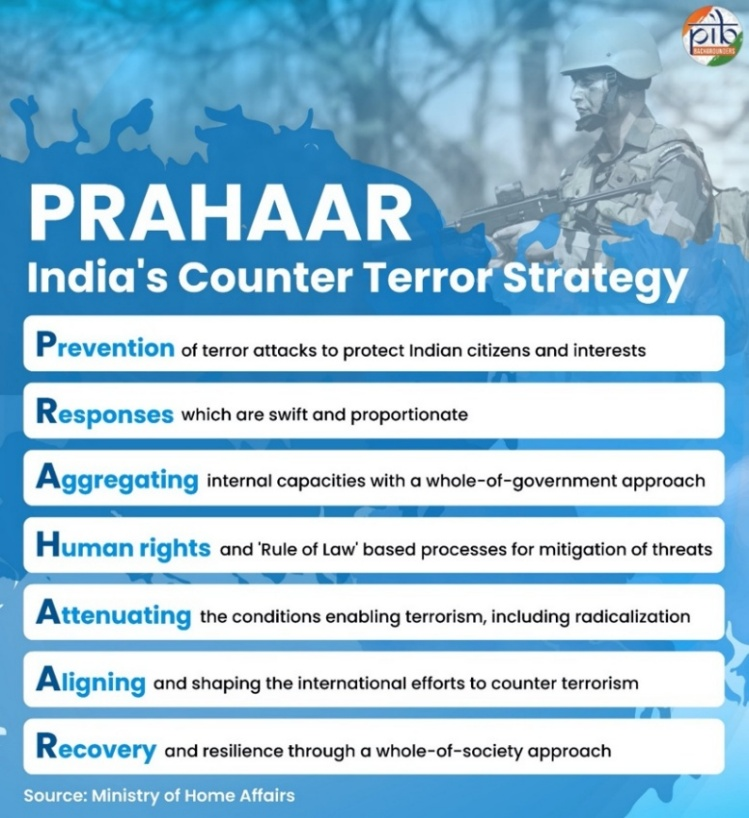
Core Principle
The framework follows a Zero-Tolerance Policy while clearly separating terrorism from any religion, ethnicity, or civilisation.
The Four Pillars of India’s Counter-Terror Policy
India’s modern counter-terror strategy is built on four major pillars.
| Pillar | Focus Area |
|---|---|
| Pillar I | Legislative Empowerment |
| Pillar II | Institutional Strengthening |
| Pillar III | Cross-Border Counter-Terror Operations |
| Pillar IV | International Counter-Terror Cooperation |
Pillar I – Legislative Empowerment
India has strengthened its legal framework to improve investigation, prosecution, and prevention of terrorism.
1. Unlawful Activities (Prevention) Amendment Act, 2019
Key Features
- Allows the Central Government to designate individuals as terrorists.
- Expanded the powers of the National Investigation Agency (NIA).
- Increased jurisdiction over:
- Cyber terrorism
- Human trafficking
- Counterfeit currency
- Crimes committed outside India affecting Indian interests
2. National Investigation Agency (Amendment) Act, 2019
Major Changes
- Expanded jurisdiction beyond India.
- Allowed investigation of offences committed abroad.
- Strengthened powers to attach terror-linked property.
3. Prevention of Money Laundering Act (PMLA) Amendments
Purpose
To weaken terror financing.
Key Provisions
- Trace illegal financial transactions.
- Freeze suspicious assets.
- Confiscate terror-linked property.
- Target hawala and cryptocurrency funding.
4. Bharatiya Nyaya Sanhita (BNS), 2023
Significance
For the first time, terrorism and organised crime have been comprehensively incorporated into India’s primary criminal code.
Major Features
The law criminalises:
- Terror recruitment
- Terror financing
- Training terrorists
- Harbouring terrorists
- Criminal conspiracy
Punishments include:
- Life imprisonment
- Death penalty (for specified terrorist acts causing death)
5. Arms (Amendment) Act, 2019
Key Objectives
- Stronger punishment for illegal arms trafficking.
- Better firearm traceability.
- Digital licensing system.
- Restrict terrorist access to weapons.
Pillar II – Strengthening Institutions
Laws alone cannot defeat terrorism. Strong institutions are equally important.
India has significantly strengthened intelligence-sharing, investigation, policing, and technology since 2014.
The key institutions include:
- National Investigation Agency (NIA)
- Multi-Agency Centre (MAC)
- National Intelligence Grid (NATGRID)
- Crime and Criminal Tracking Network and Systems (CCTNS) 2.0
- Police Modernisation Programme
These institutions work together to improve intelligence gathering, data integration, and real-time coordination against terrorism.
Important Security Terms
| Term | Meaning |
|---|---|
| Proxy Warfare | Supporting armed groups instead of direct military conflict |
| Lone-Wolf Terrorism | Terror attack carried out by an individual without direct organisational control |
| Cyber Terrorism | Use of cyberspace to conduct terrorist activities |
| Hawala | Informal money transfer system often misused for terror financing |
| IED | Improvised Explosive Device |
Institutional Strengthening (Detailed)
India has strengthened its counter-terrorism capabilities by building integrated institutions, improving real-time intelligence sharing, and adopting technology-driven policing.
1. National Investigation Agency (NIA)
Definition
The National Investigation Agency (NIA) is India’s premier central counter-terrorism investigation agency responsible for investigating offences affecting national security.
Background
- Established under the National Investigation Agency Act, 2008.
- Created after the 2008 Mumbai Terror Attacks (26/11).
Major Responsibilities
- Investigate terrorism-related offences.
- Prosecute terror financing cases.
- Investigate organised crime linked to terrorism.
- Coordinate with State Police and international agencies.
Recent Strengthening
Since 2014:
- 53 Special NIA Courts established.
- Expanded regional offices across India.
- Creation of the National Terror Database Fusion and Analysis Centre (NTDFAC).
- Jurisdiction expanded to offences committed outside India affecting Indian interests.
Key Achievement
The NIA has achieved a conviction rate of approximately 92.7%, among the highest for counter-terror agencies globally.
2. Multi-Agency Centre (MAC)
Definition
The Multi-Agency Centre (MAC) is India’s apex intelligence-sharing platform.
Operated by
- Intelligence Bureau (IB)
Purpose
To ensure seamless sharing of intelligence among various security agencies.
Key Features
- Connects 28 intelligence and security agencies.
- Facilitates real-time exchange of intelligence.
- Helps prevent intelligence failures.
Recent Development
The Cyber Multi-Agency Centre (Cyber MAC) launched in 2025 enhances:
- Cyber threat monitoring
- Digital intelligence sharing
- Real-time response to cyber-enabled terrorism
3. National Intelligence Grid (NATGRID)
Definition
National Intelligence Grid (NATGRID) is an integrated intelligence database that enables authorised agencies to access information from multiple government databases.
Purpose
To detect suspicious activities by integrating fragmented information.
Data Sources Integrated
- Immigration records
- Banking transactions
- Income Tax data
- Telecom records
- Travel records
- Passport information
Coverage
As of March 2026, NATGRID connects:
- 11 Central User Agencies
- All States and Union Territories
Importance
NATGRID significantly improves:
- Terror investigation
- Financial intelligence
- Tracking terror networks
- Inter-agency coordination
4. Crime and Criminal Tracking Network and Systems (CCTNS) 2.0
Definition
Crime and Criminal Tracking Network and Systems (CCTNS) is a nationwide digital platform connecting police stations across India.
Objective
To improve criminal investigations through digital integration.
Recent Upgrades
The upgraded CCTNS 2.0 includes:
- Artificial Intelligence-enabled analytics
- Real-time criminal database
- Facial recognition integration
- Better sharing of terrorism-related information
Benefits
- Faster investigation
- Improved crime analysis
- Better coordination among police forces
5. Police Modernisation Programme
India has invested significantly in strengthening police infrastructure.
Allocation
More than ₹6,300 crore allocated under:
- Assistance to States for Modernisation of Police Scheme
- Modernisation Plan-IV (2021–2026)
Focus Areas
- Modern weapons
- Surveillance systems
- Secure communication
- Cyber forensic laboratories
- Modern training
- Artificial Intelligence tools
Pillar III – Operations Against Cross-Border Terrorism
India’s security doctrine now supports swift, precise, and proportionate responses against terrorist infrastructure.
1. Surgical Strikes (2016)
Background
Conducted after the Uri Terror Attack.
Date
29 September 2016
Objective
Destroy terrorist launch pads across the Line of Control (LoC).
Significance
Marked India’s transition from strategic restraint to proactive military response.
2. Balakot Air Strike (2019)
Background
Conducted after the Pulwama Terror Attack.
Date
26 February 2019
Objective
Target Jaish-e-Mohammed (JeM) terrorist training camp in Balakot, Pakistan.
Significance
Demonstrated India’s willingness to undertake pre-emptive action beyond the Line of Control against terrorist infrastructure.
3. Operation Sindoor (2025)
Background
Launched after the Pahalgam Terror Attack.
Date
7 May 2025
Objective
Target terrorist infrastructure in:
- Pakistan
- Pakistan-Occupied Jammu & Kashmir (PoJK)
Importance
Reinforced India’s doctrine of:
- Swift response
- Precision strikes
- Proportionate retaliation
Pillar IV – Multilateral and Diplomatic Counter-Terror Architecture
India believes terrorism cannot be defeated by one country alone.
International cooperation remains essential.
1. Financial Action Task Force (FATF)
Definition
The Financial Action Task Force (FATF) is an intergovernmental organisation that develops global standards to combat:
- Money laundering
- Terror financing
- Proliferation financing
India
- Member since 2010
Importance
Helps:
- Track terror financing
- Strengthen anti-money laundering laws
- Increase international cooperation
2. No Money for Terror (NMFT) Conference
Definition
A global ministerial initiative to strengthen international cooperation against terror financing.
Background
- Started in Paris (2018)
India’s Contribution
Hosted the 3rd Ministerial Conference in New Delhi (2022).
3. Comprehensive Convention on International Terrorism (CCIT)
Definition
A proposed international treaty seeking a universal legal framework against terrorism.
Proposed by India
- United Nations
- 1996
Objective
Develop a universally accepted legal definition of terrorism and strengthen international cooperation.
4. United Nations Security Council (UNSC)
Major Achievement
India successfully secured the designation of Masood Azhar as a Global Terrorist under the UN Security Council in 2019.
5. Tahawwur Rana Extradition (2025)
Background
Tahawwur Rana was accused in the 2008 Mumbai Terror Attacks.
Importance
His extradition from the United States strengthened India’s efforts to bring terrorism-related offenders to justice.
6. Joint Working Groups
India currently has:
- Joint Working Groups on Counter-Terrorism with 27 countries
- Cooperation through 5 multilateral forums
Purpose
- Intelligence sharing
- Capacity building
- Joint investigations
- Counter-radicalisation
7. BHARATPOL (2025)
Definition
BHARATPOL is India’s integrated platform connecting Indian law enforcement agencies with INTERPOL.
Objective
Strengthen international coordination against:
- Terrorism
- Organised crime
- Human trafficking
- Cybercrime
8. Delhi Declaration (2022)
Adopted during India’s Chairmanship of the UN Security Council Counter-Terrorism Committee.
Focus Areas
- Misuse of drones
- Social media
- Artificial Intelligence
- Online radicalisation
- Terror financing
Outcomes of India’s Counter-Terrorism Reforms (2014–2026)
India’s integrated approach has produced measurable improvements in internal security.
1. Improved Security in Jammu & Kashmir
- Terrorist-initiated incidents declined from 228 (2018) to 12 (2025).
- Significant reduction in cross-border violence.
2. Reduced Casualties
Improved intelligence and coordinated operations have led to a substantial decline in:
- Civilian casualties
- Security personnel casualties
3. Restoration of Normalcy
- Stone-pelting incidents have remained near zero since 2022.
- Strikes and shutdowns have significantly reduced.
- Public services and governance have improved.
4. Economic Revival
Improved security has encouraged:
- Tourism
- Infrastructure development
- Employment generation
- Private investment
particularly in Jammu & Kashmir.
5. Intelligence-Led Prevention
Advanced surveillance and inter-agency coordination have enabled authorities to foil terrorist plots before execution, shifting the focus from response to prevention.
6. Decline in Hinterland Terrorism
Since the 2013 Hyderabad blasts, India has witnessed relatively few major urban terrorist attacks, reflecting the effectiveness of intelligence-led counter-terrorism.
Conclusion / Way Forward
A resilient counter-terror strategy requires strong institutions, advanced technology, international cooperation, and continuous vigilance to address evolving security threats while upholding democratic values.
Prelims Check
Question 1
With reference to India’s counter-terrorism architecture, consider the following statements:
- The National Investigation Agency (NIA) was established through an Act enacted after the 2008 Mumbai terror attacks.
- NATGRID integrates databases such as banking, immigration and telecom records to assist authorised agencies.
- The Multi-Agency Centre (MAC) functions under the National Investigation Agency.
Which of the statements given above are correct?
(a) 1 and 2 only
(b) 2 and 3 only
(c) 1 and 3 only
(d) 1, 2 and 3
Question 2
Consider the following pairs:
| Operation | Triggering Event |
|---|---|
| 1. Surgical Strikes | Uri Terror Attack |
| 2. Balakot Air Strike | Pulwama Terror Attack |
| 3. Operation Sindoor | Mumbai Terror Attacks |
How many of the above pairs are correctly matched?
(a) Only one
(b) Only two
(c) All three
(d) None
Question 3
With reference to international counter-terrorism initiatives, consider the following statements:
- India proposed the Comprehensive Convention on International Terrorism (CCIT) at the United Nations.
- The Financial Action Task Force (FATF) primarily sets global standards against money laundering and terror financing.
- BHARATPOL is an initiative to integrate Indian law enforcement agencies with INTERPOL.
Which of the statements given above are correct?
(a) 1 and 2 only
(b) 2 and 3 only
(c) 1 and 3 only
(d) 1, 2 and 3
Answers with Explanations
Q1. Answer: (a) 1 and 2 only
Explanation:
- Statement 1: Correct. The NIA was established under the NIA Act, 2008, enacted after the Mumbai terror attacks.
- Statement 2: Correct. NATGRID integrates multiple databases to support authorised intelligence and investigation agencies.
- Statement 3: Incorrect. The Multi-Agency Centre (MAC) functions under the Intelligence Bureau (IB), not the NIA.
Q2. Answer: (b) Only two
Explanation:
- Pair 1: Correct. Surgical Strikes followed the 2016 Uri Terror Attack.
- Pair 2: Correct. Balakot Air Strike followed the 2019 Pulwama Terror Attack.
- Pair 3: Incorrect. Operation Sindoor was launched after the 2025 Pahalgam Terror Attack, not the Mumbai attacks.
Q3. Answer: (d) 1, 2 and 3
Explanation:
- Statement 1: Correct. India proposed the CCIT at the United Nations in 1996.
- Statement 2: Correct. FATF develops global standards to combat money laundering and terror financing.
- Statement 3: Correct. BHARATPOL enhances coordination between Indian law enforcement agencies and INTERPOL.
“Eternal vigilance is the price of liberty; informed citizens are the strongest guardians of national security.”
Mains Question– GS Paper III | 10 Marks | 150 Words
How has India’s counter-terrorism doctrine evolved from a reactive approach to an intelligence-led preventive strategy? Illustrate with suitable examples.