Context of the News
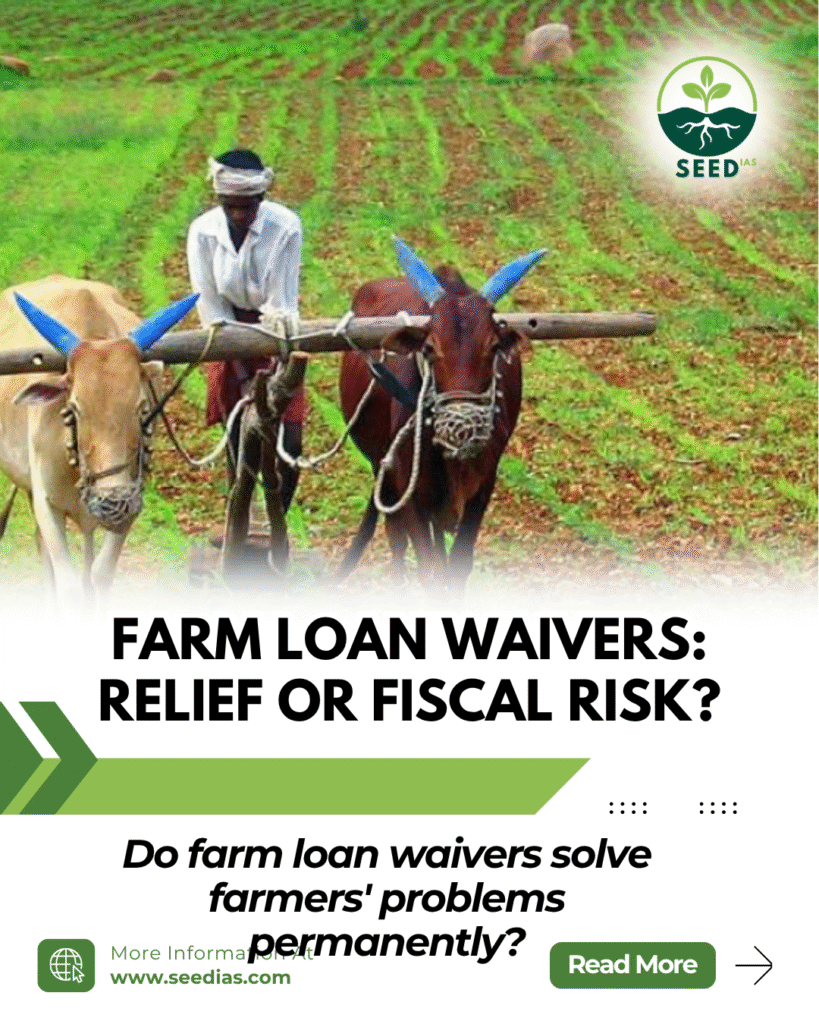
The Tamil Nadu Government recently announced a full waiver of cooperative crop loans up to Rs 75,000 for farmers.
However, this announcement came shortly after the state’s White Paper on Fiscal Management revealed a massive debt burden of Rs 13.18 lakh crore.
The development has renewed the debate over whether farm loan waivers provide genuine agricultural relief or weaken fiscal discipline and economic stability.
Background
Farm loan waivers have been a recurring policy tool in India to provide relief during periods of agrarian distress.
These waivers are generally announced after:
- Severe crop failures
- Natural disasters
- Droughts
- Market price crashes
- Rural distress
Over time, loan waivers have increasingly become a politically sensitive issue, especially during election periods.
Historical Evolution of Farm Loan Waivers
| Scheme | Year | Key Feature |
|---|---|---|
| Agricultural and Rural Debt Relief Scheme (ARDRS) | 1990 | Relief up to Rs 10,000 per farmer |
| Agricultural Debt Waiver and Debt Relief Scheme (ADWDRS) | 2008 | Cost Rs 52,500 crore; targeted small and marginal farmers |
| State-led Waivers | Since 2014 | Implemented by multiple states |
Since 2014, state governments have collectively spent approximately Rs 2.5 lakh crore on farm loan waivers.
News Breakdown
What is a Farm Loan Waiver?
A Farm Loan Waiver is a government intervention in which the government repays agricultural loans on behalf of farmers.
Objective
Its purpose is to provide immediate financial relief to farmers facing severe distress due to:
- Crop losses
- Climate shocks
- Falling market prices
- Natural calamities
Why Are Farm Loan Waivers Controversial?
While they provide short-term relief, economists and policy experts have raised several concerns.
Concern 1: Political Economy vs Genuine Distress
Definition
Political Economy refers to the interaction between politics and economic policy decisions.
According to the Reserve Bank of India (RBI) Internal Working Group on Agricultural Credit (2019):
- Loan waivers often coincide with election cycles.
- Many waivers appear politically motivated.
- Relief measures are not always linked to actual agrarian crises.
Thus, waivers may become electoral tools rather than targeted welfare interventions.
Concern 2: Exclusion of the Most Vulnerable Farmers
A major limitation of loan waivers is that they benefit only farmers who have taken loans from formal institutions.
Who Gets Excluded?
- Tenant farmers
- Sharecroppers
- Landless agricultural labourers
- Farmers dependent on moneylenders
These groups often rely on informal credit sources charging very high interest rates.
As a result, the most vulnerable farmers receive no benefit from loan waivers.
Concern 3: Moral Hazard and Weakening of Credit Culture
What is Moral Hazard?
Moral Hazard occurs when individuals take greater risks because they expect someone else to bear the consequences.
In the context of loan waivers:
- Farmers may intentionally delay repayment.
- Borrowers expect future waivers.
- Honest borrowers feel penalized.
- Strategic defaults increase.
This weakens repayment discipline and damages the rural credit ecosystem.
Impact of Farm Loan Waivers on State Finances
Rising Debt Burden
The combined outstanding debt of Indian states is currently around 27–29% of GDP.
This is significantly higher than the 20% benchmark recommended by the FRBM Review Committee (2019).
What is FRBM?
Fiscal Responsibility and Budget Management (FRBM) Act aims to ensure fiscal discipline and prudent management of government finances.
States are generally expected to maintain a fiscal deficit below 3% of Gross State Domestic Product (GSDP).
Crowding Out Capital Expenditure
What is Capital Expenditure (Capex)?
Capital Expenditure refers to spending that creates long-term productive assets.
Examples:
- Irrigation systems
- Rural roads
- Warehouses
- Cold storage infrastructure
When states finance loan waivers:
- Budget resources become limited.
- Capital expenditure is often reduced.
- Long-term agricultural productivity suffers.
Studies show that waiver announcements are often accompanied by nearly one-third reduction in capital expenditure.
Revenue Deficit Trap
What is Revenue Deficit?
Revenue Deficit occurs when government revenue receipts are lower than revenue expenditure.
Loan waivers are categorized as revenue expenditure because they do not create productive assets.
Consequences include:
- Increased borrowing
- Growing debt burden
- Reduced fiscal flexibility
- Future budgetary constraints
The fiscal burden of waivers generally ranges from 0.1% to 4.5% of GSDP.
Off-Budget Borrowings
To bypass FRBM limits, some states resort to:
- Special Purpose Vehicles (SPVs)
- Public Sector Undertakings (PSUs)
These borrowings remain outside regular budget documents.
Why is it a Concern?
- Actual liabilities remain hidden.
- Transparency declines.
- Fiscal risks increase.
Increase in Non-Performing Assets (NPAs)
What are NPAs?
Non-Performing Assets (NPAs) are loans on which borrowers stop making repayments.
Loan waivers can encourage:
- Anticipatory defaults
- Delayed repayments
- Weakening of bank balance sheets
As a result, agricultural NPAs tend to rise after large waiver announcements.
Alternatives to Farm Loan Waivers
Experts recommend structural reforms rather than repeated debt forgiveness.
1. Direct Income Support
Examples:
- PM-KISAN (Pradhan Mantri Kisan Samman Nidhi)
- KALIA Scheme (Odisha)
- Rythu Bandhu (Telangana)
Benefits:
- Covers more farmers
- Includes vulnerable groups
- Does not disrupt credit discipline
2. Expanding Institutional Credit
Strengthening access to:
- Kisan Credit Card (KCC)
- Cooperative banks
- Regional Rural Banks
This reduces dependence on informal moneylenders.
3. Better Agricultural Markets
Key measures:
- Strengthening e-NAM (National Agriculture Market)
- Effective MSP procurement
- Promotion of Farmer Producer Organizations (FPOs)
Benefits:
- Better price realization
- Increased bargaining power
- Improved farm incomes
4. Stronger Crop Insurance
PMFBY
Pradhan Mantri Fasal Bima Yojana (PMFBY) provides insurance coverage against crop losses.
Improvements needed:
- Faster claim settlement
- Wider coverage
- Better awareness
5. Investment in Agricultural Infrastructure
Funds can be redirected toward:
- Micro-irrigation
- Warehousing
- Agro-processing
- Rural logistics
- Cold chains
Such investments improve productivity and resilience permanently.
Important Committee Recommendations
RBI Internal Working Group (2019)
Recommended:
- Direct income support
- Better agricultural infrastructure
- Strengthening e-NAM
- Reduced reliance on waivers
Expert Group on Agricultural Indebtedness (2007)
Recommended:
- Expansion of formal credit
- Promotion of Joint Liability Groups (JLGs)
- Better financial inclusion of vulnerable farmers
Prelims Focus
Important Facts
- FRBM Act promotes fiscal discipline and sustainable public finances.
- States generally maintain a fiscal deficit limit of 3% of GSDP.
- PM-KISAN provides direct income support to eligible farmer families.
- e-NAM is a pan-India electronic agricultural trading platform.
- PMFBY was launched in 2016.
- Joint Liability Groups (JLGs) facilitate credit access for farmers without collateral.
- Agricultural Debt Waiver and Debt Relief Scheme (ADWDRS), 2008 cost approximately Rs 52,500 crore.
- Farm loan waivers are categorized as revenue expenditure, not capital expenditure.
Conclusion / Way Forward
Sustainable agricultural prosperity requires strengthening farm incomes, credit access, insurance coverage, and infrastructure rather than relying on recurring loan waivers.
Prelims Check
Question 1
Consider the following statements regarding farm loan waivers:
- Farm loan waivers benefit all categories of farmers including tenant farmers and sharecroppers.
- Farm loan waivers are treated as revenue expenditure.
- Repeated loan waivers may create moral hazard in agricultural credit markets.
Which of the statements given above is/are correct?
(a) 1 only
(b) 2 and 3 only
(c) 1 and 3 only
(d) 1, 2 and 3
Question 2
Consider the following schemes:
- PM-KISAN
- KALIA
- Rythu Bandhu
Which of the above are examples of direct income support schemes for farmers?
(a) 1 only
(b) 1 and 2 only
(c) 2 and 3 only
(d) 1, 2 and 3
Question 3
With reference to the Fiscal Responsibility and Budget Management (FRBM) framework, consider the following statements:
- The FRBM framework seeks to promote fiscal discipline.
- Capital expenditure creates productive assets.
- Revenue expenditure necessarily creates long-term economic assets.
Which of the statements given above are correct?
(a) 1 and 2 only
(b) 2 and 3 only
(c) 1 and 3 only
(d) 1, 2 and 3
Answers and Explanations
Answer 1: (b)
Explanation:
- Tenant farmers and sharecroppers are often excluded from formal credit systems.
- Farm loan waivers are classified as revenue expenditure.
- Repeated waivers may encourage strategic defaults and weaken credit culture.
Answer 2: (d)
Explanation:
- PM-KISAN provides direct cash support to farmers.
- Odisha’s KALIA scheme provides financial assistance to cultivators.
- Telangana’s Rythu Bandhu offers direct investment support to farmers.
Answer 3: (a)
Explanation:
- FRBM aims to ensure fiscal prudence and sustainability.
- Capital expenditure creates long-term productive assets such as roads and irrigation systems.
- Revenue expenditure generally finances consumption or recurring expenses and does not create productive assets.
“Sustainable progress comes not from temporary relief, but from building systems that empower people for generations.”