Context of the News
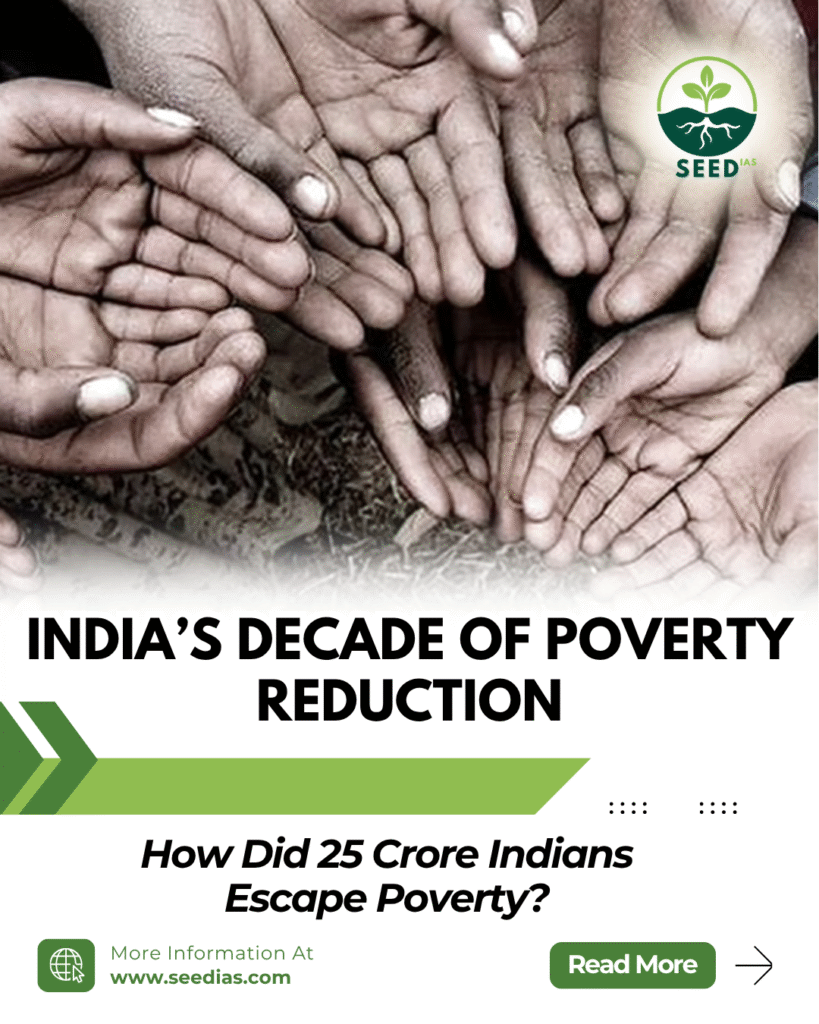
India has recorded a significant decline in Multidimensional Poverty, with nearly 25 crore people moving out of poverty between 2013-14 and 2022-23. The poverty rate declined from 29.17% to 11.28%, reflecting the impact of welfare schemes, digital governance reforms, infrastructure expansion, and targeted social interventions.
Background
What is Multidimensional Poverty?
Multidimensional Poverty measures deprivation across multiple aspects of life rather than income alone.
It generally includes indicators related to:
- Health
- Education
- Standard of Living
Unlike income poverty, it captures whether people have access to basic services such as sanitation, electricity, housing, clean cooking fuel, nutrition, and education.
India’s Poverty Reduction Strategy
Over the past decade, India’s welfare approach has shifted from:
Entitlement-Based Delivery → Saturation-Based Development
The focus has been on ensuring that every eligible beneficiary receives essential services through:
- Digital governance
- Direct Benefit Transfers (DBT)
- Infrastructure development
- Financial inclusion
- Women-led empowerment
News Breakdown
Universal Access to Basic Needs
Jal Jeevan Mission (JJM)
Jal Jeevan Mission aims to provide Functional Household Tap Connections (FHTCs) to all rural households.
Key Achievements
- Rural tap water connections increased from 3.23 crore (2019) to 15.84 crore (May 2026).
- Nearly 82% of rural households now have tap water access.
- More than 9.23 lakh schools connected.
- More than 9.66 lakh Anganwadi Centres connected.
Why is it Important?
- Reduces water-borne diseases.
- Saves time spent collecting water.
- Improves health and sanitation outcomes.
Swachh Bharat Mission
What is ODF Plus?
ODF Plus (Open Defecation Free Plus) refers to villages that sustain sanitation gains while managing solid and liquid waste effectively.
Key Achievements
- More than 12.11 crore household toilets constructed.
- Rural sanitation achieved 100% initial coverage by 2019.
- More than 5 lakh villages achieved ODF Plus (Model) status.
Impact
- Improved public health.
- Reduced open defecation.
- Enhanced rural cleanliness.
Pradhan Mantri Ujjwala Yojana (PMUY)
Objective
Provide clean cooking fuel to poor households.
Achievements
- More than 10.57 crore LPG connections provided.
- Beneficiaries are primarily women from economically weaker households.
Benefits
- Reduced indoor air pollution.
- Improved women’s health.
- Reduced dependence on firewood and biomass.
Universal Electrification
SAUBHAGYA Scheme
Pradhan Mantri Sahaj Bijli Har Ghar Yojana (SAUBHAGYA) aimed to provide electricity access to all households.
Achievements
- 100% village electrification achieved by 2025.
- Rural electricity supply increased from 12.5 hours/day (2014) to 22.6 hours/day (2025).
Outcomes
- Improved quality of life.
- Enhanced educational opportunities.
- Better economic productivity.
Housing for All
PMAY
| Scheme | Target Area | Houses Completed |
|---|---|---|
| PMAY-Urban | Urban Areas | 98.10 lakh |
| PMAY-Gramin | Rural Areas | 3.03 crore |
Key Feature
A majority of houses are registered in the name of women, strengthening:
- Asset ownership
- Financial security
- Women’s empowerment
Rural Connectivity
Pradhan Mantri Gram Sadak Yojana (PMGSY)
Achievements
- Connected 99.6% of eligible habitations through all-weather roads.
Benefits
- Better access to markets.
- Improved healthcare accessibility.
- Enhanced school attendance.
Advancements in Public Health and Food Security
Ayushman Bharat
What is Ayushman Bharat?
The world’s largest publicly funded health insurance scheme.
Features
- Health coverage of ₹5 lakh per family annually.
- Focus on vulnerable households.
Achievements
- 43.93 crore health cards issued.
Ayushman Bharat Digital Mission (ABDM)
Objective
Create a unified digital healthcare ecosystem.
Achievements
- 88.33 crore ABHA (Ayushman Bharat Health Account) IDs created.
- 97.81 crore health records digitally linked.
Benefits
- Paperless healthcare.
- Better portability of medical records.
- Improved service delivery.
Maternal and Child Health
Janani Suraksha Yojana (JSY)
Key Achievement
Maternal Mortality Ratio (MMR) declined:
| Period | MMR (per 100,000 live births) |
| 2014-16 | 130 |
| 2021-23 | 88 |
Significance
- Improved institutional deliveries.
- Better maternal healthcare services.
Food Security through PMGKAY
PM Garib Kalyan Anna Yojana (PMGKAY)
Achievements
- Free food grains to over 81 crore beneficiaries.
- 99.8% Fair Price Shops digitized.
Importance
- Strengthens food security.
- Reduces leakages through Aadhaar authentication.
Strengthening Education and Learning Outcomes
Samagra Shiksha
Achievements
Female primary school dropout rates reduced:
| Year | Dropout Rate |
| 2013-14 | 4.6% |
| 2024-25 | 0.3% |
Focus Areas
- Infrastructure development.
- Inclusive education.
- Learning outcomes.
Beti Bachao Beti Padhao
Achievements
- National Sex Ratio improved to 1020.
- Female secondary school enrollment reached 80.2%.
Significance
Promotes gender equality and educational access.
Kasturba Gandhi Balika Vidyalayas (KGBV)
Achievements
- Enrollment increased to 7.11 lakh girls by 2024.
Target Group
Girls from disadvantaged communities.
Digital Education Platforms
SWAYAM
Study Webs of Active Learning for Young Aspiring Minds
Achievements
- More than 5.80 crore enrollments.
DIKSHA
Provides digital educational content for students and teachers.
Women-Led Development and Employment
DAY-NRLM
Deendayal Antyodaya Yojana – National Rural Livelihoods Mission
Achievements
| Indicator | Earlier | May 2026 |
| Women in SHGs | 2.37 crore | 10 crore |
| SHGs | 21.31 lakh | 91.75 lakh |
Lakhpati Didi Initiative
- Enabled 3.07 crore rural women to become entrepreneurs.
Skill Development
PMKVY
Pradhan Mantri Kaushal Vikas Yojana
Achievements
- Over 1.64 crore youth trained.
Focus Areas
- Artificial Intelligence (AI)
- Industry 4.0
- Emerging technologies
Employment Security
MGNREGA
Achievements
- Generated over 3,036 crore person-days of employment since 2014.
Importance
- Rural livelihood support.
- Employment during economic distress.
eShram Portal
Objective
Formalization of unorganized workers.
Achievement
- 31.64 crore workers registered.
Financial Inclusion and Digital Governance
PM Jan Dhan Yojana
Achievement
- 58.16 crore beneficiaries enrolled.
Importance
- Banking access.
- Direct Benefit Transfers.
- Financial inclusion.
PM MUDRA Yojana
Key Fact
- Around 66% of loans have been provided to women entrepreneurs.
BharatNet
Objective
Provide broadband connectivity to rural India.
Achievement
- Connected 2.19 lakh Gram Panchayats.
Unified Payments Interface (UPI)
Achievement
- Processes over 2,100 crore transactions monthly.
Significance
- Digital payments revolution.
- Increased financial inclusion.
- Reduced transaction costs.
Tribal Development Through Integrated Interventions
PM-JANMAN Mission
Full Form
Pradhan Mantri Janjati Adivasi Nyaya Maha Abhiyan
Target Group
75 Particularly Vulnerable Tribal Groups (PVTGs).
Services Provided
- Housing
- Piped water
- Electricity
- Mobile healthcare
Eklavya Model Residential Schools (EMRS)
Achievements
| Indicator | Earlier | Current |
| Operational Schools | 129 | 499 |
| Student Enrollment | – | 1.54 lakh |
Objective
Quality residential education for Scheduled Tribe students.
Van Dhan Vikas Kendras
Achievement
- 1,146 Kendras sanctioned.
Purpose
- Promote tribal entrepreneurship.
- Enhance value addition of Minor Forest Produce (MFP).
Prelims Focus
High-Value Facts
- MPI stands for Multidimensional Poverty Index.
- PM-JANMAN focuses on 75 PVTGs.
- ABHA stands for Ayushman Bharat Health Account.
- MGNREGA provides a legal guarantee of wage employment.
- SWAYAM is India’s national online learning platform.
- BharatNet is one of the world’s largest rural broadband projects.
- EMRS are residential schools for Scheduled Tribe students.
- PMUY was launched in 2016.
- Jal Jeevan Mission was launched in 2019.
Conclusion / Way Forward
Sustained investments in human development, digital inclusion, and women-led growth can transform poverty reduction into long-term socio-economic empowerment.
Prelims Check
Question 1
With reference to the Pradhan Mantri Janjati Adivasi Nyaya Maha Abhiyan (PM-JANMAN), consider the following statements:
- It targets Particularly Vulnerable Tribal Groups (PVTGs).
- It aims to provide basic infrastructure and essential services.
- It is implemented only in Scheduled Areas under the Fifth Schedule.
Which of the statements given above are correct?
(a) 1 and 2 only
(b) 2 and 3 only
(c) 1 and 3 only
(d) 1, 2 and 3
Question 2
Consider the following pairs:
| Initiative | Objective |
| 1. BharatNet | Rural broadband connectivity |
| 2. ABHA | Digital health identity |
| 3. SWAYAM | Online higher education and learning |
How many of the above pairs are correctly matched?
(a) Only one
(b) Only two
(c) All three
(d) None
Question 3
With reference to Multidimensional Poverty Index (MPI), consider the following statements:
- It considers only income deprivation.
- It includes indicators related to health, education and living standards.
- It is broader than traditional poverty measurement.
Which of the statements given above are correct?
(a) 2 and 3 only
(b) 1 and 2 only
(c) 1 and 3 only
(d) 1, 2 and 3
Answers
Q1 Answer: (a)
Explanation:
- PM-JANMAN targets 75 PVTGs.
- It delivers housing, water, electricity and healthcare services.
- It is not restricted only to Fifth Schedule Areas.
Q2 Answer: (c)
Explanation:
- BharatNet provides rural broadband connectivity.
- ABHA serves as a digital health identity.
- SWAYAM is India’s online education platform.
Q3 Answer: (a)
Explanation:
- MPI goes beyond income-based poverty.
- It measures deprivations in health, education and living standards.
- It provides a more comprehensive assessment of poverty.
“Progress is not measured by how far the strongest move ahead, but by how many are empowered to move forward together.”