Context of the News
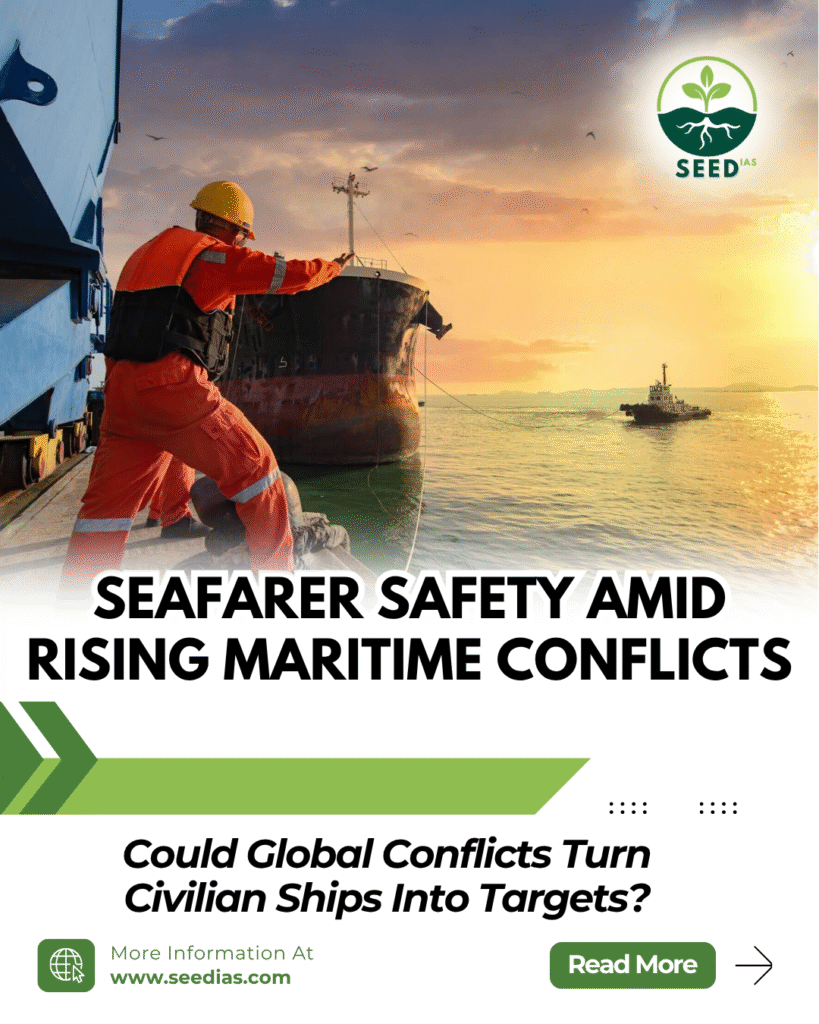
The issue of seafarer safety has gained attention after the death of three Indian seafarers aboard MT Settebello following a US military strike in the Gulf of Oman. The incident highlights the growing risks faced by commercial shipping crews operating in conflict-prone maritime regions.
Background
Global maritime trade depends heavily on civilian merchant vessels. Traditionally, the major threat at sea was piracy. However, modern maritime conflicts have changed significantly.
Today, commercial vessels are exposed to:
- Drone attacks
- Missile strikes
- Military blockades
- Sanctions-related restrictions
- Geopolitical confrontations between states and non-state actors
Important maritime chokepoints such as the Strait of Hormuz, Bab-el-Mandeb Strait, and the Red Sea have become increasingly volatile due to regional conflicts.
News Breakdown
What is a Seafarer?
A Seafarer is a person employed or engaged in any capacity on board a ship that operates in maritime navigation.
What is Asymmetric Maritime Warfare?
Asymmetric Maritime Warfare refers to conflicts where weaker actors use unconventional methods such as drones, missiles, cyber attacks, and guerrilla tactics against stronger naval powers.
Why Are Seafarers Increasingly Vulnerable?
Modern maritime threats have evolved beyond piracy.
- Commercial vessels are now targeted using precision-guided missiles, armed drones, and loitering munitions.
- Both state militaries and non-state actors can attack ships operating in conflict zones.
- Merchant ships generally remain unarmed and have limited defensive capabilities.
Geopolitical Blockades and Maritime Risks
What is a Blockade?
A Blockade is an attempt by a country or military force to restrict movement of goods, ships, or trade routes to weaken another country economically or strategically.
Key concerns:
- Merchant ships may become collateral victims of geopolitical disputes.
- Vessels transporting crude oil, Liquefied Natural Gas (LNG), or other combustible cargo face elevated risks.
- Civilian crews often become unintended casualties despite having no role in the conflict.
Sanctioned Vessels and Their Vulnerabilities
What is a Sanctioned Vessel?
A Sanctioned Vessel is a ship that has been blacklisted or restricted under international or national economic and security laws.
Common Reasons for Sanctions
- Ownership by blacklisted entities
- Links with terrorism financing
- Transportation of prohibited cargo
- Illegal oil trade
- Weapons trafficking
- Sanctions evasion practices
Common Sanctions Evasion Methods
- Disabling the Automatic Identification System (AIS)
- Conducting unauthorized Ship-to-Ship (STS) cargo transfers
- Concealing vessel ownership
Applicability of Sanctions: UN vs Unilateral Sanctions
| Feature | UN Sanctions | Unilateral Sanctions |
|---|---|---|
| Imposed By | UN Security Council | Individual countries or blocs |
| Legal Status | Globally Binding | Limited to imposing jurisdiction |
| Recognition by India | Yes | Not automatically recognized |
| Example | UNSC Resolutions | US, EU, UK sanctions |
India’s Position
India enforces only UN Security Council-mandated sanctions.
Therefore:
- A vessel sanctioned by the United States is not automatically illegal under Indian law.
- Such vessels may still face international operational difficulties.
Why is Seafarer Safety Important for India?
Massive Global Workforce Contribution
India is one of the world’s largest suppliers of maritime manpower.
Key Facts
- Over 300,000 trained seafarers (2025).
- Nearly 12% of the global seafaring workforce.
- India ranks third globally after Philippines and China.
Maritime India Vision 2030
India aims to increase its global seafarer share to 20% by 2030 through enhanced maritime training and skilling.
Exposure to High-Risk Maritime Zones
Approximately 18,000 Indian sailors operate in the:
- Persian Gulf
- Gulf of Oman
- Red Sea
- Strait of Hormuz
- Bab-el-Mandeb Strait
These regions are among the world’s most strategically sensitive waterways.
Flags of Convenience (FoC)
What is a Flag of Convenience?
A Flag of Convenience (FoC) is a practice where ship owners register vessels in foreign countries to benefit from lower taxes and regulatory requirements.
Common FoC Countries:
- Panama
- Liberia
- Palau
Why is it a Concern?
- Most Indian seafarers work on foreign-registered ships.
- Legal jurisdiction becomes complicated during attacks.
- India has limited authority to intervene directly.
Economic Importance
Indian seafarers contribute significantly through foreign remittances.
Maritime Trade Significance
- More than 90% of India’s trade by volume
- Around 70% of India’s trade by value
moves through maritime routes.
Impact of Maritime Insecurity
Increased risks lead to:
- Higher War Risk Insurance Premiums
- Increased shipping costs
- Costlier imports of Crude Oil and LNG
- Supply chain disruptions
Legal Provisions for Seafarer Safety
Global Frameworks
United Nations Convention on the Law of the Sea (UNCLOS), 1982
UNCLOS guarantees:
- Freedom of Navigation
- Transit Passage
- Rights and duties of states at sea
Maritime Labour Convention (MLC), 2006
Known as the “Seafarers’ Bill of Rights.”
It ensures:
- Decent working conditions
- Health protection
- Welfare standards
- Repatriation rights
India has ratified the convention.
Important IMO Conventions
IMO
International Maritime Organization (IMO) is the specialized UN agency responsible for maritime safety and shipping regulation.
| Convention | Year | Purpose |
| STCW | 1978 | Standards of training and certification of seafarers |
| SOLAS | 1974 | Safety standards for ships |
| SAR | 1979 | International maritime search and rescue cooperation |
Indian Legal Framework
Merchant Shipping Act, 1958
The principal law governing:
- Indian merchant vessels
- Safety standards
- Employment conditions
Directorate General of Shipping (DGS)
Functions:
- Vessel certification
- Regulation of shipping companies
- Oversight of seafarer recruitment agencies
Information Fusion Centre – Indian Ocean Region (IFC-IOR)
Located in Gurugram.
Functions:
- Maritime Domain Awareness (MDA)
- Real-time threat monitoring
- Intelligence sharing among partner countries
Measures to Strengthen Seafarer Safety
Strengthen Naval Presence
India should expand:
- Operation Sankalp
- Maritime surveillance
- Search and Rescue (SAR) capabilities
- Naval escort operations
Adopt a Risk-Based Deployment Framework
- Conduct periodic risk assessments.
- Issue timely advisories.
- Strengthen onboard security measures.
- Avoid blanket deployment restrictions.
Ensure Informed Consent
Recruitment agencies must:
- Clearly disclose risks before deployment.
- Obtain informed consent from seafarers.
- Protect sailors who refuse war-zone assignments.
Create an Inter-Ministerial Maritime Security Mechanism
Stakeholders should include:
- Ministry of External Affairs
- Ministry of Defence
- Directorate General of Shipping
- Intelligence agencies
- Shipowners
- Seafarer unions
Use Multilateral Platforms
India should leverage:
- Indian Ocean Rim Association (IORA)
- International Maritime Organization (IMO)
to develop binding protocols protecting civilian mariners during geopolitical conflicts.
Prelims Focus
High-Value Facts
- UNCLOS was adopted in 1982 and entered into force in 1994.
- IMO Headquarters: London, United Kingdom.
- MLC 2006 is often called the Fourth Pillar of International Maritime Law.
- STCW stands for Standards of Training, Certification and Watchkeeping for Seafarers.
- SOLAS stands for Safety of Life at Sea Convention.
- SAR Convention was adopted in 1979.
- Strait of Hormuz connects the Persian Gulf with the Gulf of Oman.
- Bab-el-Mandeb Strait connects the Red Sea with the Gulf of Aden.
- IFC-IOR is located in Gurugram, Haryana.
Conclusion / Way Forward
Protecting seafarers requires stronger international maritime norms, enhanced naval cooperation, and binding mechanisms to safeguard civilian shipping during geopolitical conflicts.
Prelims Check
Question 1
With reference to the Maritime Labour Convention (MLC), 2006, consider the following statements:
- It is administered by the International Labour Organization.
- It is popularly known as the Seafarers’ Bill of Rights.
- India has not ratified the convention.
Which of the statements given above are correct?
(a) 1 and 2 only
(b) 2 and 3 only
(c) 1 and 3 only
(d) 1, 2 and 3
Question 2
Consider the following waterways:
- Strait of Hormuz
- Bab-el-Mandeb Strait
- Bosporus Strait
Which of the above directly connects to the Red Sea?
(a) 1 only
(b) 2 only
(c) 1 and 2 only
(d) 2 and 3 only
Question 3
Consider the following conventions:
| Convention | Purpose |
| 1. STCW | Training and certification of seafarers |
| 2. SOLAS | Safety standards for merchant ships |
| 3. SAR | Search and rescue operations at sea |
How many of the above pairs are correctly matched?
(a) Only one
(b) Only two
(c) All three
(d) None
Answers
Q1 Answer: (a)
Explanation:
- MLC is administered by the International Labour Organization (ILO).
- It is widely called the Seafarers’ Bill of Rights.
- India has ratified the convention; Statement 3 is incorrect.
Q2 Answer: (b)
Explanation:
- Bab-el-Mandeb Strait directly connects the Red Sea and Gulf of Aden.
- Strait of Hormuz connects the Persian Gulf and Gulf of Oman.
- Bosporus Strait connects the Black Sea and Sea of Marmara.
Q3 Answer: (c)
Explanation:
- STCW governs training and certification standards.
- SOLAS establishes ship safety requirements.
- SAR coordinates international maritime rescue operations.
“Every challenge mastered today becomes a strength that serves you tomorrow. Stay consistent, stay curious, and success will follow.”