Context of the News
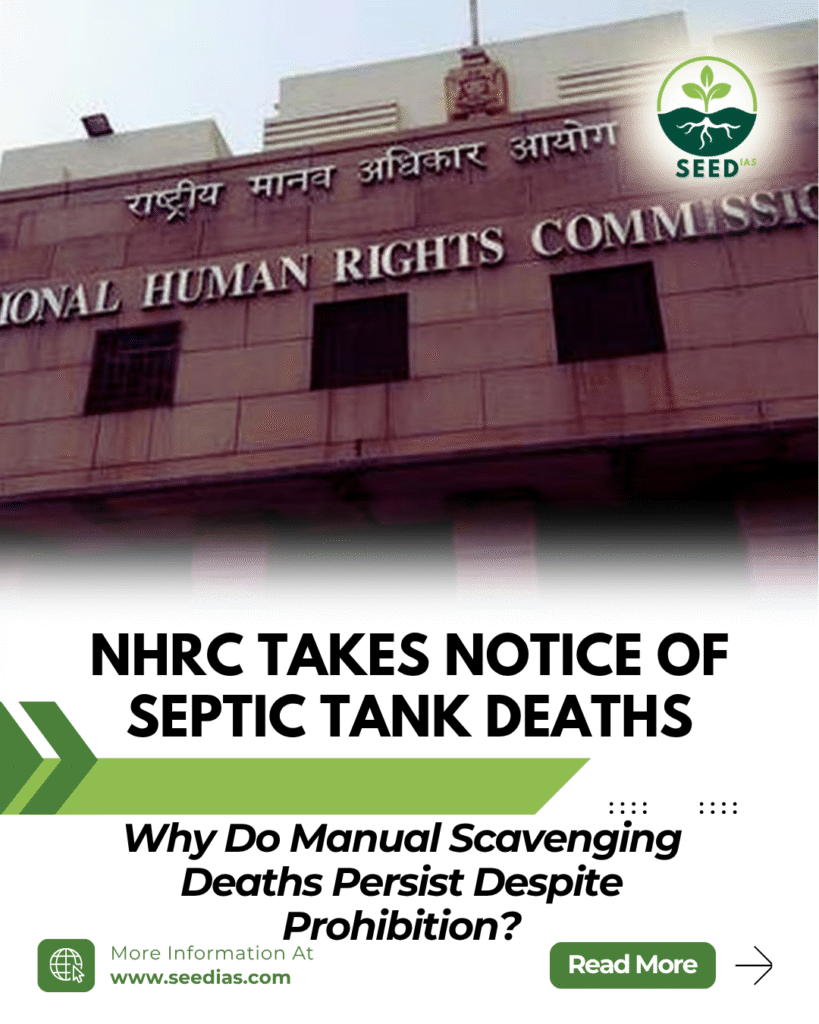
The National Human Rights Commission (NHRC) has taken suo motu cognizance of a media report regarding the death of four workers while cleaning a septic tank at a jewellery manufacturing unit in Surat district, Gujarat, on 7 June 2026.
The workers reportedly entered the tank without proper safety equipment and succumbed to toxic fumes. NHRC has sought a detailed report from the Gujarat Government and Surat Police regarding the incident.
Background
What is NHRC?
The National Human Rights Commission (NHRC) is India’s apex statutory body for the protection and promotion of human rights.
Established Under
Protection of Human Rights Act, 1993
Composition
- Chairperson (former Chief Justice of India or Supreme Court Judge)
- Members with expertise in human rights
- Ex-officio members from national commissions
Functions
- Investigate human rights violations.
- Take suo motu cognizance of violations.
- Recommend compensation and corrective measures.
- Promote human rights awareness.
What is Suo Motu Cognizance?
Suo Motu is a Latin term meaning “on its own motion.”
It refers to the power of a court or commission to initiate proceedings without receiving a formal complaint.
NHRC often takes suo motu cognizance based on:
- Media reports
- Public information
- Reports from civil society organizations
What is Manual Scavenging?
Manual Scavenging refers to the practice of manually cleaning, carrying, disposing or handling human excreta from insanitary latrines, sewers, septic tanks or drains.
It is considered one of the most degrading forms of labour and a serious violation of human dignity.
News Breakdown
According to media reports:
- Four workers entered a septic tank at a jewellery manufacturing unit.
- The tank reportedly stored waste generated during jewellery cleaning processes.
- The workers entered the tank without following prescribed safety protocols.
- They were exposed to toxic gases and fumes.
- Rescue teams shifted them to a hospital.
- Doctors declared all four workers dead.
NHRC’s Response
The Commission observed that the incident raises serious concerns regarding:
- Right to life.
- Right to dignity.
- Occupational safety.
- Human rights protection.
Notices Issued To
| Authority | Purpose |
|---|---|
| Chief Secretary, Gujarat | Detailed report on the incident |
| Commissioner of Police, Surat | Investigation status report |
Information Sought by NHRC
The Commission has directed authorities to submit:
- Investigation status.
- Cause of death.
- Responsibility for negligence.
- Safety protocol compliance.
- Compensation provided to families.
- Preventive measures for future incidents.
The report has been sought within two weeks.
Why Are Septic Tanks Dangerous?
Toxic Gases Commonly Found
| Gas | Hazard |
| Hydrogen Sulphide (H₂S) | Can cause unconsciousness and death |
| Methane (CH₄) | Highly combustible |
| Carbon Monoxide (CO) | Reduces oxygen supply in the body |
| Ammonia (NH₃) | Respiratory damage |
Risks Faced by Workers
- Oxygen deficiency
- Poisoning
- Suffocation
- Explosions
- Permanent health damage
Legal Framework Against Manual Scavenging
Prohibition of Employment as Manual Scavengers and Their Rehabilitation Act, 2013
Key Provisions
- Prohibits manual scavenging.
- Prohibits hazardous cleaning of septic tanks and sewers.
- Provides rehabilitation measures.
- Prescribes penalties for violations.
Rehabilitation Measures
- Skill development.
- Alternative employment opportunities.
- Financial assistance.
- Housing support.
Supreme Court Guidelines (2023)
The Supreme Court emphasized:
- Complete mechanization of sewer cleaning.
- Elimination of hazardous manual entry.
- Compensation for sewer and septic tank deaths.
- Accountability of authorities and employers.
Government Initiatives
NAMASTE Scheme
Full Form
National Action for Mechanised Sanitation Ecosystem (NAMASTE)
Implemented By
- Ministry of Social Justice and Empowerment
- Ministry of Housing and Urban Affairs
Objectives
- Mechanization of sanitation work.
- Safety of sanitation workers.
- Skill development.
- Elimination of hazardous manual cleaning.
Swachh Bharat Mission (SBM)
Promotes:
- Safe sanitation infrastructure.
- Scientific waste management.
- Improved public health outcomes.
Human Rights Dimension
The incident highlights violations of:
Article 21
Right to Life and Personal Liberty
The Supreme Court has interpreted Article 21 to include:
- Right to dignity.
- Safe working conditions.
- Protection from hazardous employment.
Directive Principles of State Policy
Relevant provisions include:
| Article | Provision |
| Article 39(e) | Protection of workers’ health |
| Article 42 | Humane working conditions |
| Article 47 | Improvement of public health |
Significance of the Issue
Governance Perspective
- Indicates implementation gaps in existing laws.
- Highlights need for stricter enforcement.
Social Perspective
- Manual scavenging disproportionately affects marginalized communities.
- Reinforces social inequality.
Human Rights Perspective
- Violates dignity and equality.
- Reflects continuing occupational vulnerabilities.
Economic Perspective
- Families lose primary earners.
- Creates long-term livelihood insecurity.
Prelims Focus
National Human Rights Commission (NHRC)
| Particular | Details |
| Established | 1993 |
| Governing Law | Protection of Human Rights Act, 1993 |
| Nature | Statutory Body |
| Headquarters | New Delhi |
NAMASTE Scheme
Objectives
- Mechanized sanitation.
- Worker safety.
- Elimination of hazardous cleaning.
- Livelihood enhancement for sanitation workers.
Important Constitutional Provisions
| Article | Subject |
| Article 21 | Right to Life and Dignity |
| Article 39(e) | Worker Protection |
| Article 42 | Humane Working Conditions |
| Article 47 | Public Health Improvement |
Conclusion / Way Forward
Strict enforcement of anti-manual scavenging laws, complete mechanization of sanitation work and accountability for violations are essential to protect human dignity and workers’ lives.
Prelims Check
Question 1
With reference to the National Human Rights Commission (NHRC), consider the following statements:
- It is a constitutional body.
- It was established under the Protection of Human Rights Act, 1993.
- It can take suo motu cognizance of human rights violations.
Which of the statements given above are correct?
(a) 2 and 3 only
(b) 1 and 2 only
(c) 1 and 3 only
(d) 1, 2 and 3
Question 2
Consider the following statements regarding the Prohibition of Employment as Manual Scavengers and Their Rehabilitation Act, 2013:
- It prohibits hazardous cleaning of septic tanks and sewers.
- It provides for rehabilitation of identified manual scavengers.
- It permits manual cleaning of septic tanks without safety equipment in emergencies.
Which of the statements given above are correct?
(a) 1 and 2 only
(b) 2 and 3 only
(c) 1 and 3 only
(d) 1, 2 and 3
Question 3
Consider the following pairs:
| Constitutional Provision | Subject |
| Article 21 | Right to Life |
| Article 42 | Humane Working Conditions |
| Article 47 | Public Health |
| Article 39(e) | Protection of Workers’ Health |
How many of the above pairs are correctly matched?
(a) Only one
(b) Only two
(c) Only three
(d) All four
Answers
- (a)
- (a)
- (d)
Explanation
Question 1
- NHRC is a statutory body, not a constitutional body.
- It was created under the Protection of Human Rights Act, 1993.
- It can initiate suo motu proceedings.
Question 2
- The Act prohibits hazardous manual cleaning.
- It provides rehabilitation and alternative livelihood support.
- Hazardous cleaning without safety measures is not permitted.
Question 3
- Article 21 guarantees the Right to Life and Dignity.
- Article 42 promotes humane working conditions.
- Article 47 relates to public health and nutrition.
- Article 39(e) seeks protection of workers from abuse and health hazards.
“A truly developed society is one where no individual risks their life for basic sanitation and every worker is treated with dignity and respect.”