Context of the News
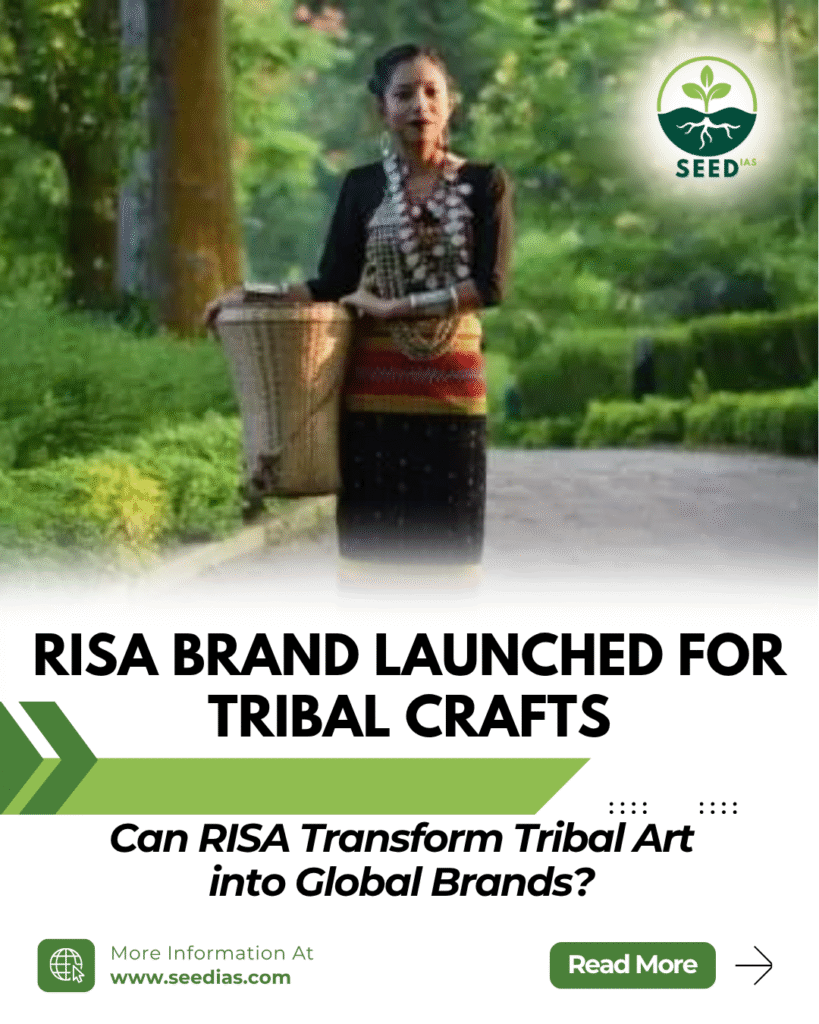
The Ministry of Tribal Affairs, through the Tribal Cooperative Marketing Development Federation of India (TRIFED), has launched RISA – Timeless Tribal, a premium brand dedicated to tribal textiles, embroideries and handicrafts.
An exclusive RISA Store was also inaugurated at Rajiv Gandhi Handicrafts Bhawan, New Delhi, to promote tribal products in premium domestic and international markets.
Background
What is TRIFED?
TRIFED (Tribal Cooperative Marketing Development Federation of India Limited) is a national-level organization under the Ministry of Tribal Affairs.
Established
| Particular | Details |
|---|---|
| Established | 1987 |
| Ministry | Ministry of Tribal Affairs |
| Objective | Socio-economic development of tribal communities through marketing support |
| Headquarters | New Delhi |
Key Functions
- Marketing of tribal products.
- Promotion of tribal livelihoods.
- Development of tribal entrepreneurship.
- Support for Minor Forest Produce (MFP) value chains.
- Skill development and capacity building.
Why Was RISA Launched?
Despite possessing unique artistic traditions, many tribal artisans face challenges such as:
- Limited market access.
- Low brand visibility.
- Inadequate product diversification.
- Weak packaging and presentation.
- Competition from machine-made products.
The RISA initiative seeks to bridge these gaps while preserving tribal cultural heritage.
News Breakdown
What is RISA?
RISA – Timeless Tribal is a premium branding initiative aimed at creating a distinct identity for tribal textiles, embroidery traditions and handicrafts.
The initiative aligns with the vision of:
Viksit Bharat
Aatmanirbhar Bharat
Inclusive Economic Growth
Objectives of RISA
The initiative seeks to:
- Create a strong brand identity for tribal products.
- Improve market access for tribal artisans.
- Promote traditional tribal crafts.
- Facilitate product diversification.
- Encourage design innovation.
- Expand domestic and international market presence.
- Generate sustainable livelihood opportunities.
Major Components of the Initiative
1. Design Development
The initiative will support:
- Modern product designs.
- Contemporary fashion integration.
- Market-oriented product innovation.
2. Capacity Building
Training will be provided for:
- Tribal weavers.
- Embroidery artisans.
- Handicraft producers.
3. Cluster Strengthening
Support includes:
- Weaving clusters.
- Craft clusters.
- Production infrastructure.
- Stitching facilities.
4. Packaging and Branding
Focus areas include:
- Premium packaging.
- Eco-friendly packaging.
- Improved product presentation.
- International market standards.
Seven Tribal Textile Traditions Selected
The first phase focuses on seven major tribal textile and embroidery traditions.
| Tribal Craft | State/UT |
| Eri Silk | Assam |
| Muga Silk | Assam |
| Santal Cotton | Jharkhand |
| Changpa Pashmina | Ladakh |
| Kotpad Cotton | Odisha |
| Dongria Embroidery | Odisha |
| Toda Embroidery | Tamil Nadu |
Understanding the Featured Tribal Crafts
Eri Silk
- Known as the “Peace Silk”.
- Produced without killing the silkworm.
- Primarily found in Assam.
Muga Silk
- Exclusive to Assam.
- Famous for its natural golden sheen.
- Geographical Indication (GI) tagged product.
Changpa Pashmina
- Produced by the Changpa nomadic community of Ladakh.
- Derived from Changthangi goats.
- Known for exceptional softness and warmth.
Toda Embroidery
- Practiced by the Toda tribe of the Nilgiri Hills.
- Characterized by red and black geometric patterns.
Dongria Embroidery
- Associated with the Dongria Kondh tribe of Odisha.
- Reflects tribal symbolism and cultural identity.
Selected Tribal Handicrafts for Promotion
The first phase will also focus on:
| Handicraft | State/UT |
| Longpi Pottery | Manipur |
| Turtuk Brass Cutlery | Ladakh |
| Dokhra Art | Chhattisgarh |
What is Dokhra Art?
Dokhra (Dhokra) Art is a traditional metal casting craft using the lost-wax casting technique.
Features
- One of India’s oldest metal art traditions.
- Practiced by tribal artisan communities.
- Produces unique handcrafted sculptures and artefacts.
What is Longpi Pottery?
- Traditional black pottery of Manipur.
- Made without a potter’s wheel.
- Prepared using a mixture of clay and stone.
Role of Fashion Designers
Several renowned designers have been associated with the initiative:
- Anju Modi
- Manish Tripathi
- Gaurav Jai Gupta
- Abu Jani
- Sandeep Khosla
- Sameera Dalvi
Purpose
- Develop contemporary product lines.
- Improve market appeal.
- Preserve authenticity of tribal crafts.
- Promote tribal products in premium markets.
Institutional Support
National Design Centre (NDC)
The initiative is being implemented through the National Design Centre, an autonomous organization under the Ministry of Textiles.
Responsibilities
- Design interventions.
- Prototype development.
- Skill enhancement.
- Cluster development.
- Product innovation.
National Institute of Design (NID), Haryana
The National Institute of Design (NID), Haryana will develop:
- Premium packaging solutions.
- Sustainable packaging designs.
- International-standard product presentation.
Significance of the Initiative
Economic Benefits
- Increased artisan income.
- Better market access.
- Employment generation.
- Tribal entrepreneurship promotion.
Social Benefits
- Empowerment of tribal women.
- Community-based development.
- Preservation of indigenous knowledge.
Cultural Benefits
- Protection of tribal heritage.
- Revival of traditional crafts.
- Promotion of cultural diversity.
Export Potential
- Strengthens India’s creative economy.
- Expands global market presence.
- Promotes tribal crafts as premium products.
Prelims Focus
Important Facts About TRIFED
- Established in 1987.
- Functions under the Ministry of Tribal Affairs.
- Supports tribal livelihoods through marketing interventions.
- Promotes tribal products and entrepreneurship.
Important Tribal Crafts
| Craft | Associated Region |
| Muga Silk | Assam |
| Eri Silk | Assam |
| Changpa Pashmina | Ladakh |
| Toda Embroidery | Tamil Nadu |
| Kotpad Textile | Odisha |
| Longpi Pottery | Manipur |
| Dokhra Art | Chhattisgarh |
Key Terms
Tribal Cooperative Marketing
A mechanism to improve market access and ensure fair returns to tribal producers.
Lost-Wax Casting
An ancient metal casting technique used in Dokhra Art, where a wax model is replaced by molten metal.
Conclusion / Way Forward
RISA can become a transformative platform that combines tribal heritage with modern markets, ensuring sustainable livelihoods while preserving India’s rich indigenous cultural traditions.
Prelims Check
Question 1
With reference to TRIFED, consider the following statements:
- It functions under the Ministry of Tribal Affairs.
- It was established to promote socio-economic development of tribal communities through marketing support.
- It is a statutory body created by an Act of Parliament.
Which of the statements given above are correct?
(a) 1 and 2 only
(b) 2 and 3 only
(c) 1 and 3 only
(d) 1, 2 and 3
Question 2
Consider the following pairs:
| Craft Tradition | Region |
| Muga Silk | Assam |
| Toda Embroidery | Tamil Nadu |
| Longpi Pottery | Manipur |
| Changpa Pashmina | Ladakh |
How many pairs given above are correctly matched?
(a) Only one
(b) Only two
(c) Only three
(d) All four
Question 3
Consider the following statements:
- Dokhra Art uses the lost-wax casting technique.
- Eri Silk is often called Peace Silk.
- Kotpad textiles are associated with Odisha.
Which of the statements given above are correct?
(a) 1 and 2 only
(b) 2 and 3 only
(c) 1 and 3 only
(d) 1, 2 and 3
Answers
- (a)
- (d)
- (d)
Explanation
Question 1
- TRIFED operates under the Ministry of Tribal Affairs.
- It provides marketing support to tribal communities.
- It is not a statutory body established through a specific Act of Parliament.
Question 2
- Muga Silk originates from Assam.
- Toda Embroidery belongs to Tamil Nadu.
- Longpi Pottery is associated with Manipur.
- Changpa Pashmina comes from Ladakh.
Question 3
- Dokhra Art employs the ancient lost-wax casting method.
- Eri Silk is popularly known as Peace Silk.
- Kotpad textiles are traditionally produced in Odisha.
“When tradition meets opportunity, communities thrive and heritage becomes a foundation for future prosperity.”