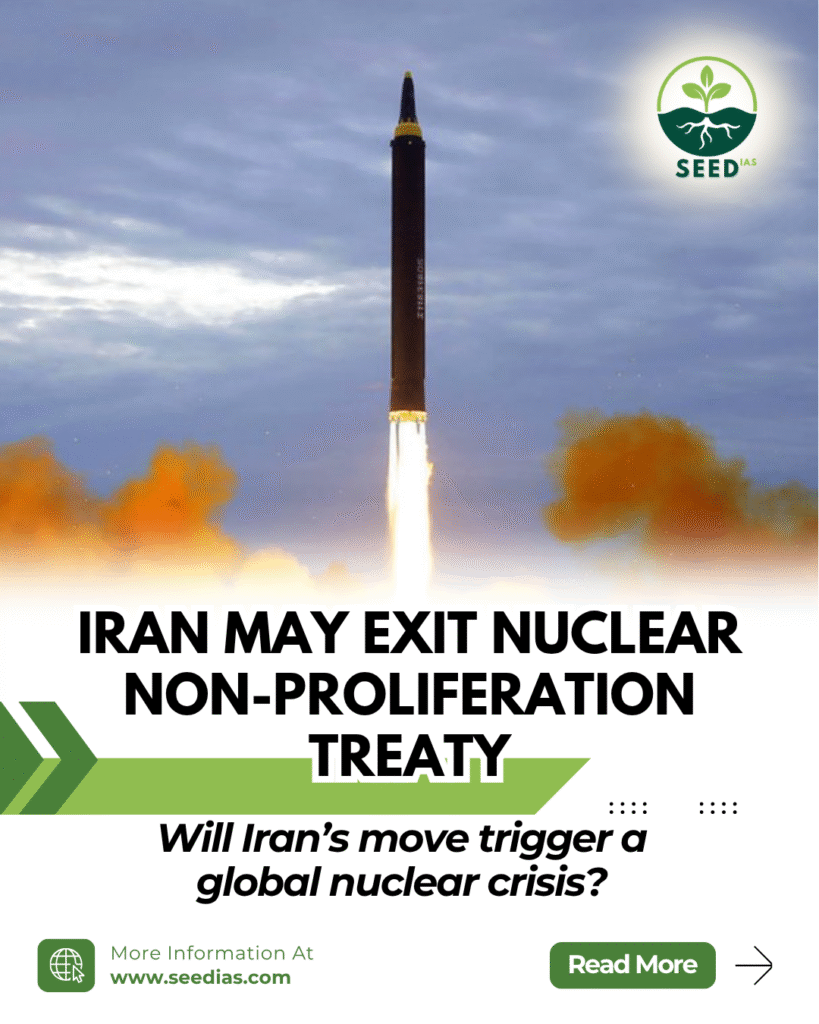
Context of the News
Iran is reviewing a possible exit from the Nuclear Non-Proliferation Treaty (NPT) after alleging that:
- US and Israel strikes on nuclear sites like Isfahan
- Violated its right to peaceful nuclear energy
A withdrawal could:
- End IAEA inspections
- Weaken the global non-proliferation regime
- Set a dangerous precedent globally
Background
- The NPT was signed in 1968 and came into force in 1970
- It is the cornerstone of global nuclear governance
- Currently has 191 member countries
Exception countries:
- India, Pakistan, Israel, South Sudan
- North Korea withdrew in 2003
News Breakdown
1. What is the NPT?
Definition:
The Nuclear Non-Proliferation Treaty (NPT) is an international treaty to:
- Prevent spread of nuclear weapons
- Promote peaceful nuclear use
- Achieve nuclear disarmament
2. Core Pillars of NPT
(A) Non-Proliferation
Definition:
Preventing spread of nuclear weapons to more countries.
- Nuclear Weapon States (NWS):
- Countries that tested nuclear weapons before 1 January 1967
- USA, Russia, UK, France, China
- Non-Nuclear Weapon States (NNWS):
- Agree not to acquire nuclear weapons
(B) Disarmament
- All countries must:
- Work towards reducing nuclear arsenals
- End arms race
(C) Peaceful Use of Nuclear Energy
- Countries have inalienable right to:
- Use nuclear energy for:
- Electricity generation
- Medical purposes
- Use nuclear energy for:
- Condition:
- Must follow non-proliferation rules
(D) Verification Mechanism
Definition:
IAEA (International Atomic Energy Agency) ensures compliance.
- Conducts:
- Inspections
- Monitoring of nuclear facilities
3. Withdrawal Clause
Definition:
Article X allows exit from NPT.
- Requires:
- 3 months’ notice
- Justification:
- Threat to “supreme national interests”
4. Why is Iran Considering Exit?
Key Reasons
- Claims:
- Attacks on nuclear facilities violate:
- Sovereignty
- Peaceful nuclear rights
- Attacks on nuclear facilities violate:
- Concerns:
- Loss of strategic autonomy
- Increasing external pressure
5. Possible Global Implications
(A) Weakening of NPT Regime
- Undermines:
- Trust in international treaties
- Other nations may:
- Follow similar path
(B) End of IAEA Oversight
- Iran may:
- Deny inspections
- Raises risk of:
- Secret nuclear weapon development
(C) Nuclear Arms Race
- Middle East may see:
- Increased nuclear ambitions
- Countries may:
- Develop deterrence capabilities
(D) Strategic Instability
- Increased:
- Geopolitical tensions
- Conflict risks
6. India’s Stand on NPT
Why India is Not a Member
- Considers NPT:
- Discriminatory treaty
Key Arguments
- Creates division:
- “Nuclear Haves” vs “Have-Nots”
- Legitimizes:
- Nuclear weapons of P5 nations
- Restricts:
- Others from developing capabilities
India’s Position
- Supports:
- Universal, non-discriminatory disarmament
- Maintains:
- Credible minimum deterrence
Comparison: NWS vs NNWS
| Feature | NWS | NNWS |
|---|---|---|
| Nuclear Weapons | Allowed | Not allowed |
| Testing Timeline | Before 1967 | Not permitted |
| Obligations | No transfer | No acquisition |
| Rights | Retain arsenal | Peaceful use only |
Prelims Focus
- NPT signed: 1968
- Enforced: 1970
- Members: 191
- NWS criteria: Test before 1 Jan 1967
- IAEA: Nuclear watchdog
- Article X: Withdrawal clause
- India: Not a signatory
Conclusion / Way Forward
Iran’s potential exit highlights the fragility of global nuclear governance, demanding renewed commitment to equitable disarmament and strengthening international monitoring mechanisms.
Prelims Check
Question 1
With reference to the Nuclear Non-Proliferation Treaty (NPT), consider the following statements:
- It came into force in 1970.
- Nuclear Weapon States are defined based on tests after 1967.
- It promotes peaceful use of nuclear energy.
Which of the statements given above is/are correct?
(a) 1 and 3 only
(b) 1 only
(c) 2 and 3 only
(d) 1, 2 and 3
Question 2
Consider the following countries:
- India
- Israel
- Pakistan
- North Korea
Which of the above are not current members of the NPT?
(a) 1, 2 and 3 only
(b) 1, 2, 3 and 4
(c) 2 and 4 only
(d) 1 and 3 only
Question 3
Which of the following correctly describes the role of the IAEA?
(a) Conducts military operations against nuclear threats
(b) Monitors nuclear programs for peaceful use
(c) Imposes sanctions on violating countries
(d) Controls global uranium trade
Answers with Explanation
Answer 1: (a) 1 and 3 only
- Statement 1 is correct: Enforced in 1970
- Statement 2 is incorrect: Defined before 1967
- Statement 3 is correct: Promotes peaceful nuclear use
Answer 2: (b) 1, 2, 3 and 4
- India, Israel, Pakistan → Never signed
- North Korea → Withdrew in 2003
Answer 3: (b) Monitors nuclear programs for peaceful use
- IAEA ensures:
- Compliance
- Inspections
- Does not:
- Conduct military action or impose sanctions
“Peace is not secured by power, but by trust and restraint.”