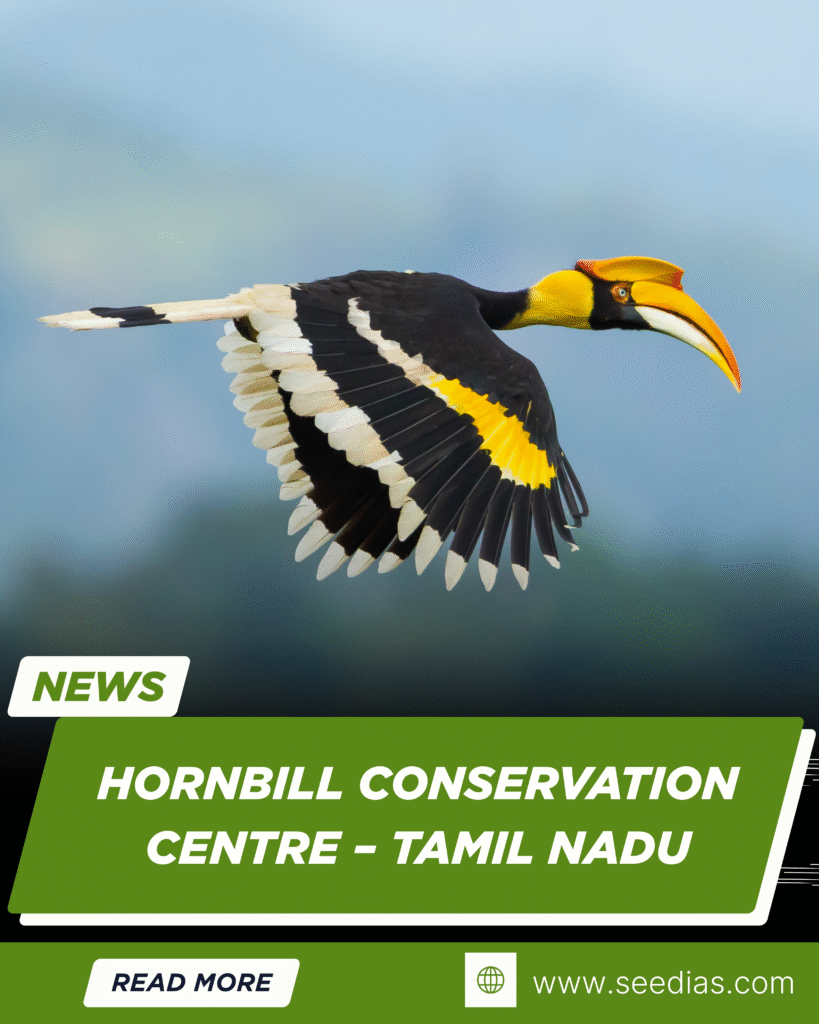
Why in News
The Government of Tamil Nadu has announced the establishment of India’s first Centre of Excellence for Hornbill Conservation at the Anamalai Tiger Reserve in the Western Ghats.
This initiative reinforces Tamil Nadu’s position as a national leader in species-specific wildlife conservation.
Location and Landscape Coverage
Core Location
- Anamalai Tiger Reserve
Extended Conservation Landscape
- Kalakkad Mundanthurai Tiger Reserve
- Sathyamangalam Tiger Reserve
- Forested regions of Kanyakumari
This landscape-level conservation approach ensures habitat connectivity, which is essential for wide-ranging forest birds like hornbills.
Focus Species of the Western Ghats
The Centre will prioritise the conservation of four hornbill species native to the Western Ghats:
- Great Hornbill
- Malabar Grey Hornbill
- Malabar Pied Hornbill
- Indian Grey Hornbill
Prelims Fact:
India has 9 species of hornbills, out of which 4 are found in the Western Ghats.
About Hornbills
Habitat
- Tropical evergreen and moist deciduous forests
- Depend on tall, old-growth trees for nesting
Diet
- Primarily frugivorous (fruit-eating), with occasional insects and small animals
Distinctive Features
- Large, curved bill topped with a casque
- Loud, resonant calls
- Heavy and noisy wing beats during flight
Unique Breeding Behaviour
During the nesting season, the female seals herself inside a tree cavity using mud and fruit pulp.
The male feeds the female and chicks through a narrow slit until the young birds are ready to fledge.
This behaviour makes hornbills highly sensitive to habitat loss and tree felling.
Ecological Importance
- Hornbills are keystone species
- Act as long-distance seed dispersers
- Essential for the regeneration of tropical forests
- Often called “Farmers of the Forest”, as many large-seeded trees depend almost entirely on hornbills for dispersal
Broader Conservation Context in Tamil Nadu
The Hornbill Conservation Centre adds to Tamil Nadu’s recent conservation-focused initiatives such as:
- Dugong Conservation Reserve
- Nilgiri Tahr Project
- Slender Loris Conservation Centre
- AI-enabled elephant monitoring systems
These efforts highlight a science-based and species-centric conservation strategy.
Important Species Clarification
The Narcondam Hornbill is endemic to Narcondam Island in the Andaman & Nicobar Islands and is not found in the Western Ghats.
Hornbill Species Overview
Great Hornbill
- IUCN Status: Vulnerable
- Wildlife Protection Act, 1972: Schedule I
- Distribution: Western Ghats and Northeast India
Malabar Pied Hornbill
- IUCN Status: Near Threatened
- Wildlife Protection Act, 1972: Schedule I
- Distribution: Western Ghats
Malabar Grey Hornbill
- IUCN Status: Near Threatened
- Wildlife Protection Act, 1972: Schedule II
- Distribution: Western Ghats (endemic)
Indian Grey Hornbill
- IUCN Status: Least Concern
- Wildlife Protection Act, 1972: Schedule II
- Distribution: Widespread across plains and foothills
Narcondam Hornbill
- IUCN Status: Vulnerable
- Wildlife Protection Act, 1972: Schedule I
- Distribution: Narcondam Island, Andaman & Nicobar Islands
| Species | IUCN Status | Wildlife Protection Act, 1972 | Distribution in India |
| Great Hornbill | Vulnerable | Schedule I | Western Ghats, Northeast India |
| Malabar Pied Hornbill | Near Threatened | Schedule I | Western Ghats |
| Malabar Grey Hornbill | Near Threatened | Schedule II | Western Ghats (endemic) |
| Indian Grey Hornbill | Least Concern | Schedule II | Widespread across plains & foothills |
| Narcondam Hornbill | Vulnerable | Schedule I | Narcondam Island (A&N Islands) |