Why in NEWS
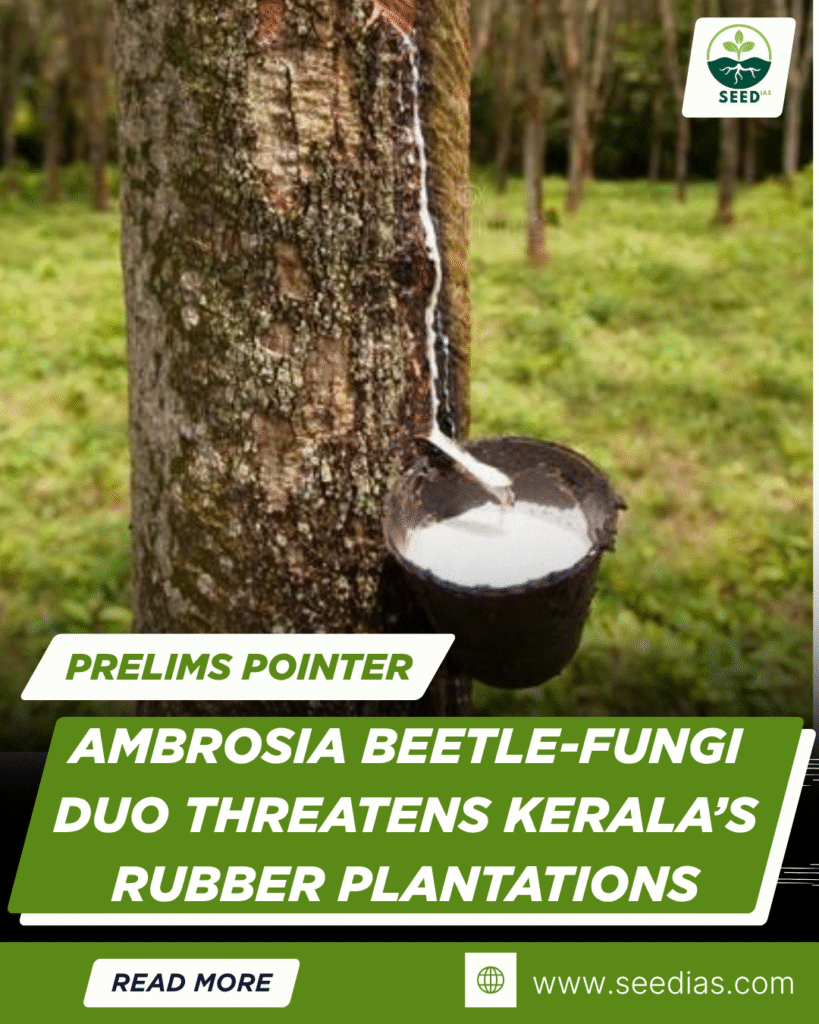
Kerala’s rubber plantations face a severe threat from the ambrosia beetle (Euplatypus parallelus) and associated Fusarium fungi, endangering tree health and latex output.
| Key Term | Explanation |
|---|---|
| Ambrosia Beetle | A type of bark beetle that bores into trees and introduces fungal pathogens. |
| Fusarium ambrosia / solani | Fungi that block xylem vessels, causing wilting, tissue damage, and tree death. |
| Latex | Milky sap harvested from rubber trees used in rubber production. |
| IEPF | Investor Education and Protection Fund—unrelated here but often confused term. |
Key Impacts and Concerns
| Aspect | Details |
|---|---|
| Pathogenesis | Beetles inject Fusarium fungi into xylem, blocking water flow, causing leaf fall, trunk drying. |
| Agricultural Impact | Reduced latex yield, slow healing of trees, tree mortality. |
| Ecological Threat | Affects over 80 species including cashew, coconut, teak, and coffee. |
| Human Health Risk | Fusarium can infect immunocompromised individuals. |
| Potential for Worsening | Beetles may associate with more virulent fungi, amplifying damage. |
Control & Mitigation Strategies
| Methods | Details |
|---|---|
| Beetle traps | Trap and reduce beetle population. |
| Pruning infected parts | Physical removal of diseased wood. |
| Chemical antifungals | Suppress fungal growth. |
| Biological control | Use of antagonistic fungi or microbial consortia. |
| Genetic modification | Development of GM rubber trees resistant to fungal invasion. |
Rubber in India
| Factor | Details |
|---|---|
| Top Producer | Kerala (90% of India’s rubber production) |
| Other Producer | Tripura (~9%) |
| Optimal Conditions | 20°–35°C temp, 200+ cm rainfall, loamy/laterite soil |
| Global Ranking | 3rd in production, 4th in natural rubber consumption |
In a nutshell
“Beetle + Fungus = Kerala’s Rubber Crisis”
Memory Code: BAF-RUB
(Beetle-Ambrosia-Fusarium → Rubber impact)
Prelims Practice Questions
- Consider the following statements regarding the ambrosia beetle:
- It directly consumes the latex of rubber trees.
- It introduces pathogenic fungi into the tree’s vascular system.
- It only affects rubber trees.
Which of the above statements is/are correct?
(a) 1 and 2 only
(b) 2 only
(c) 2 and 3 only
(d) 1 and 3 only
- Which of the following conditions are ideal for rubber cultivation?
- Temperature between 20°–35°C
- Annual rainfall below 100 cm
- Loamy or laterite soil
- High altitude plains
Select the correct answer:
(a) 1 and 3 only
(b) 2 and 4 only
(c) 1, 3, and 4 only
(d) 1, 2, and 3 only
- Fusarium fungi are known to affect which of the following?
- Rubber trees
- Coffee plants
- Human immune system
Choose the correct code:
(a) 1 and 2 only
(b) 2 and 3 only
(c) 1 and 3 only
(d) 1, 2 and 3
Answers Table – Prelims
| Qn | Answer | Explanation |
|---|---|---|
| 1 | (b) | The beetle does not consume latex but introduces fungi into xylem tissues. |
| 2 | (a) | Rubber needs >200 cm rainfall and loamy/laterite soil—not low rainfall. |
| 3 | (d) | Fusarium affects plants (rubber, coffee) and can infect immunocompromised humans. |