CONTEXT OF THE NEWS
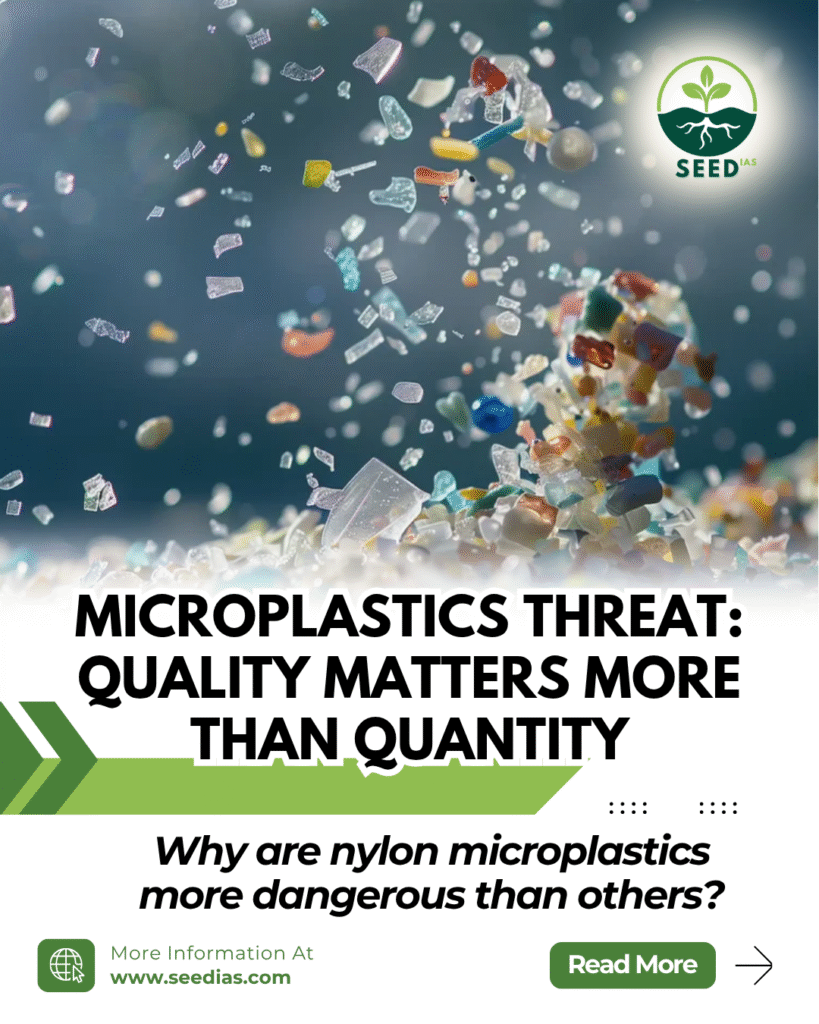
A recent study on Chennai’s beach sediments found that although overall microplastic levels are lower than global averages, the dominance of nylon fibres poses a serious ecological threat.
BACKGROUND
- Microplastics are an emerging issue in:
- GS Paper 3 (Environment & Pollution)
- Linked to:
- Marine pollution
- Human health risks
- Increasingly relevant due to:
- Plastic waste crisis
- SDG 14 (Life Below Water)
NEWS BREAKDOWN
What are Microplastics?
Microplastics: Plastic particles less than 5 mm in size.
- Can be as small as:
- Nanoplastics (<1 micrometer)
Types of Microplastics
| Type | Definition | Examples |
|---|---|---|
| Primary | Intentionally manufactured small plastics | Microbeads, Nurdles |
| Secondary | Breakdown of larger plastics | Bags, bottles, textiles |
Key Finding: Why Nylon is Dangerous
- Nylon fibres dominate Chennai sediments
- Risk depends on:
- Polymer type
- Shape
- Aging properties
- Not just quantity, but toxicity matters more
KEY CONCEPTS (IMPORTANT FOR UPSC)
1. Biomagnification
Biomagnification: Increase in concentration of toxins at higher levels of food chain.
- Microplastics:
- Absorb pollutants
- Transfer toxins to predators → Humans
2. Plastisphere
Plastisphere: Microbial ecosystem formed on plastic surfaces.
- Acts as:
- Breeding ground for bacteria
- Facilitates:
- Antimicrobial Resistance (AMR)
3. AMR (Antimicrobial Resistance)
- Bacteria develop resistance to antibiotics
- Microplastics accelerate gene exchange → “Superbugs”
KEY CHALLENGES
1. Ecological Damage
- Marine organisms:
- Mistake plastics for food
- Effects:
- Digestive blockage
- False satiety
2. Human Health Risks
- Chemicals:
- BPA, Phthalates
- Impacts:
- Hormonal imbalance
- Developmental issues
- Nanoplastics:
- Cross:
- Blood-brain barrier
- Placenta
- Cross:
3. Chemical Toxicity
- Microplastics are:
- Hydrophobic (chemically sticky)
- Absorb:
- DDT
- Heavy metals
4. Economic Impact
- Estimated loss:
- USD 75 billion annually
- Affects:
- Fisheries
- Trade
5. Detection & Removal Challenge
- Cannot be removed easily without:
- Destroying marine ecosystems
INITIATIVES TO TACKLE MICROPLASTICS
GLOBAL INITIATIVES
- UN Global Plastics Treaty (under negotiation)
- EU Ban on microplastics
- IMO marine litter strategy
- Global Plastic Action Partnership (GPAP)
INDIA’S INITIATIVES
1. Plastic Waste Management Rules
- 2024 Amendment:
- Defined microplastics (1–1000 microns)
- 2025 Amendment:
- Mandatory QR codes for plastic tracking
2. Extended Producer Responsibility (EPR 2.0)
EPR: Producers are responsible for post-consumer waste management
- Targets:
- 40% recycled content by 2026–27
- Penalty:
- Environmental Compensation
3. National Plastic Pollution Reduction Campaign (2025)
- Focus:
- Rural plastic waste
- Soil microplastics
MEASURES NEEDED
1. Product-Level Bans
- Ban:
- Microbeads in cosmetics
- Promote:
- Natural alternatives
2. Industrial Controls
- Implement:
- Zero Pellet Loss protocols
- Prevent:
- Leakage of raw plastic pellets
3. Technology & Standards
- Introduce:
- Tertiary treatment in STPs
- Efficiency:
- Removes ~99% microplastics
4. Textile & Tire Regulation
- Reduce:
- Synthetic fiber shedding
- Promote:
- Natural fibers
5. Governance Reform
- Include microplastics in:
- Air Quality Standards (NAAQS)
- Drinking Water Standards (BIS)
6. Green Innovation
- Promote:
- Biodegradable polymers
- Encourage:
- Green chemistry startups
PRELIMS FOCUS
- Microplastics size: <5 mm
- Nanoplastics: <1 micrometer
- EPR 2.0: Mandatory recycled content
- Plastisphere: Microbial layer on plastics
- Biomagnification: Toxin increase up food chain
- Nylon = high-risk polymer (as per study)
CONCLUSION
India must shift from quantity-based monitoring to risk-based regulation, targeting high-impact microplastics and strengthening upstream interventions.
PRELIMS CHECK
Question 1
Consider the following statements:
- Microplastics are plastic particles smaller than 5 mm.
- Primary microplastics are formed by breakdown of larger plastics.
- Nurdles are raw plastic pellets.
Which of the statements given above are correct?
(a) 1 and 3 only
(b) 2 and 3 only
(c) 1, 2 and 3
(d) 1 only
Question 2
With reference to microplastics, consider the following:
- Biomagnification increases toxin concentration along food chains.
- Plastisphere refers to plastic degradation process.
- Microplastics can facilitate antimicrobial resistance.
Which of the statements given above are correct?
(a) 1 and 3 only
(b) 1 and 2 only
(c) 2 and 3 only
(d) 1, 2 and 3
Question 3
Consider the following pairs:
| Term | Description |
|---|---|
| 1. EPR | Producer responsible for waste |
| 2. SAM | Severe Acute Malnutrition |
| 3. NAAQS | Water quality standards |
How many of the pairs given above are correctly matched?
(a) Only one
(b) Only two
(c) All three
(d) None
ANSWERS WITH EXPLANATION
Answer 1: (a) 1 and 3 only
- Microplastics <5 mm – Correct
- Primary are manufactured, not breakdown – Incorrect
- Nurdles are pellets – Correct
Answer 2: (a) 1 and 3 only
- Biomagnification – Correct
- Plastisphere is microbial layer, not degradation – Incorrect
- AMR linkage – Correct
Answer 3: (b) Only two
- EPR – Correct
- SAM – Correct
- NAAQS relates to air quality, not water – Incorrect
“The smallest particles can create the biggest impact—protecting nature begins with mindful choices.”