Why in News?
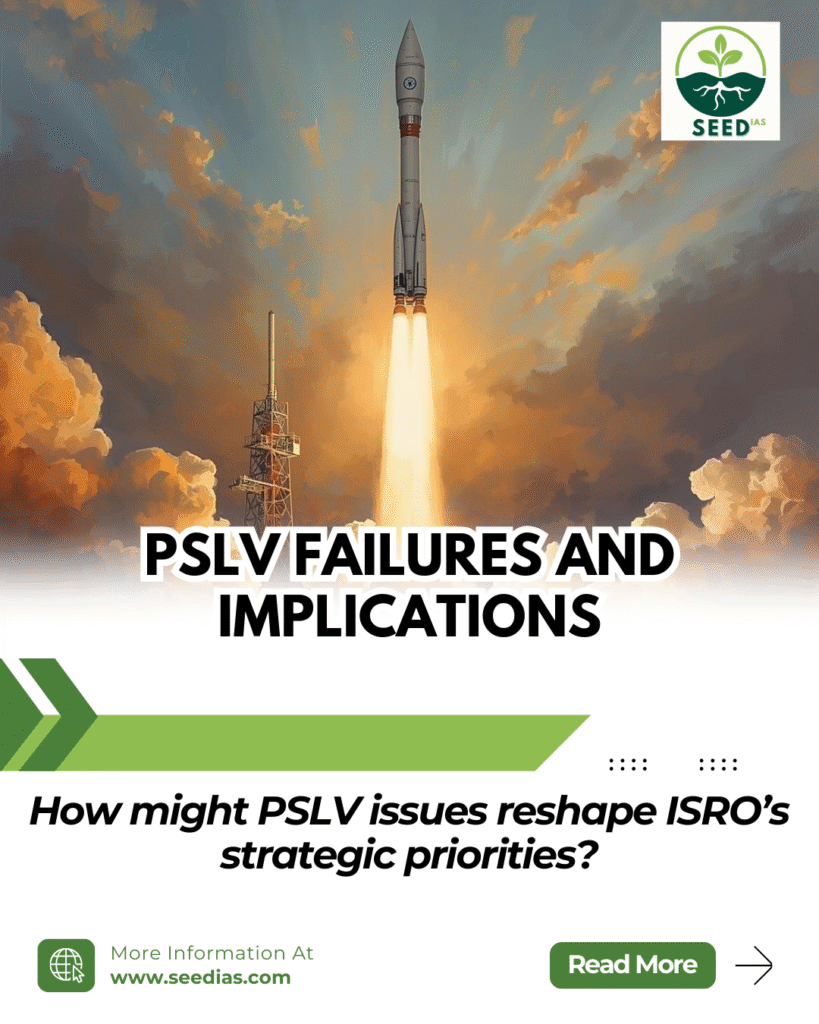
On January 12, 2026, ISRO suffered a major setback when the PSLV-C62/EOS-N1 mission failed to reach its intended orbit. While the first and second stages of the PSLV performed nominally, an anomaly in the third stage caused the mission to deviate from its trajectory. This failure is particularly concerning because the previous PSLV mission, C61 (May 2025), also failed due to a third-stage malfunction.
Since its introduction in 1993, the PSLV has completed 64 flights, with only five failures. Owing to this strong reliability record, two consecutive failures mark a significant concern for India’s otherwise dependable workhorse launcher.
Payload Loss and the Unexpected Survival of KID
The PSLV-C62 carried:
- EOS-N1, a hyperspectral Earth observation satellite
- 15 co-passenger satellites from domestic and international customers
Interestingly, one payload—the Kestrel Initial Demonstrator (KID), built by Spanish startup Orbital Paradigm—survived the failed launch.
Despite the anomaly, the 25-kg re-entry demonstrator:
- remained operational for 190 seconds,
- endured loads beyond design limits,
- returned partial telemetry,
- successfully executed separation, power, and data transmission functions.
However, because mission objectives weren’t met and customer data wasn’t delivered, the company has not declared the mission a success.
The remaining 14 satellites—including those from Dhruva Space, OrbitAID Aerospace, a Brazilian firm (AlltoSpace), and Nepal University—were all lost.
Technological Analysis: What Went Wrong?
The PSLV is a four-stage rocket that alternates between solid and liquid propulsion.
The third stage—a solid motor producing ~250 kN of thrust—burns for under two minutes and is critical for achieving near-orbital velocity.
PSLV-C61 (May 2025)
- Experienced a pressure drop in the third stage
- Likely caused by a manufacturing or material defect
- Resulted in loss of EOS-09 (RISAT-1B)
PSLV-C62 (January 2026)
- First two stages performed normally
- Disturbances detected near the end of the third-stage burn
- Vehicle deviated from the programmed inertial-guidance path
- Anomaly could stem from:
- material issues in solid propellant
- nozzle erosion
- ignition system fault
- guidance/control system degradation
ISRO has constituted a Failure Analysis Committee (FAC). However, the C61 failure report was never made public, raising concerns about transparency and whether lessons were fully implemented before PSLV-C62.
Commercial Implications
India has launched 434 satellites for 36 countries since 1999, with a previously unblemished record for foreign payloads. PSLV failures thus directly impact international customer confidence.
India’s presence in the global space market is modest—2–3% currently—with aspirations to reach 8–9%.
A growing commercial launch sector, and ISRO’s SSLV designed for small payloads, depend heavily on reliability.
The back-to-back failures raise concerns about:
- future foreign contracts
- insurance premiums
- the credibility of India’s commercial launch offerings
ISRO must quickly tighten processes and demonstrate renewed reliability.
Strategic and Security Impact
The consequences extend beyond commercial loss.
The primary payload lost—EOS-N1—was a DRDO-developed hyperspectral satellite intended for:
- real-time intelligence
- infrastructure monitoring
- border surveillance
- counterterrorism and military operations
This was India’s first dedicated hyperspectral satellite for national security.
The loss comes at a time when:
- India faces heightened tensions with China and Pakistan
- Border disputes and incursions continue
- China launched Pakistan’s HS-1 hyperspectral satellite in October 2025
- China has been providing real-time space-based support to Pakistan during periods of conflict (e.g., Operation Sindoor)
Additionally, India lost EOS-09 (RISAT-1B) in 2025, which carried a SAR (Synthetic Aperture Radar) payload capable of day-night, all-weather imaging—a key defence asset.
ISRO has experienced other strategic setbacks:
- GSLV-F10/EOS-03 failure (2021)
- GSLV-F15 (2025) partial mission (NVS-02 navigation satellite underperformed)**
These cumulative losses have direct implications for India’s ISR (Intelligence, Surveillance, Reconnaissance) capabilities.
Global Context: Space Launch Failures Are Increasing
Space ventures inherently involve risks.
Recent global incidents include:
- JAXA’s H3 launch failure (Dec 2025)
- China’s failed attempts at recovering reusable boosters
- Multiple failures in commercial start-up launch systems worldwide
Back-to-back PSLV failures may delay ISRO’s timelines but are not unprecedented in global space operations.
Conclusion
The PSLV remains one of the world’s most trusted launch vehicles, but two sequential third-stage failures expose systemic issues that demand urgent correction.
India faces technological, commercial, and strategic repercussions, especially given the loss of two defence-oriented satellites in consecutive missions.
ISRO must:
- complete transparent failure analyses
- strengthen manufacturing and QA processes
- reinforce reliability
- recover customer confidence
- safeguard national security interests
Failures are part of the space sector, but the response to failure must be swift, transparent, and rigorous for India to maintain momentum toward its space ambitions.
UPSC Civil Services Examination, Previous Year Question (PYQ)Prelims
Q. With reference to India’s satellite launch vehicles, consider the following statements: (2018)
- PSLVs launch the satellites useful for Earth resources monitoring whereas GSLVs are designed mainly to launch communication satellites.
- Satellites launched by PSLV appear to remain permanently fixed in the same position in the sky, as viewed from a particular location on Earth.
- GSLV Mk III is a four-staged launch vehicle with the first and third stages using solid rocket motors, and the second and fourth stages using liquid rocket engines.
Which of the statements given above is/are correct?
(a) 1 only
(b) 2 and 3
(c) 1 and 2
(d) 3 only
Ans: (a)
Practice Questions
Q1. Consider the following statements regarding the Sun-Synchronous Polar Orbit (SSPO):
- Satellites in SSPO maintain the same local solar time whenever they pass over a particular region of Earth.
- SSPO typically requires an orbital inclination close to 98°.
- It is mainly used for communication satellites requiring continuous coverage of a fixed region.
Which of the statements given above is/are correct?
A. 1 and 2 only
B. 2 and 3 only
C. 1 and 3 only
D. 1, 2 and 3
Answer: A (1 and 2 only)
Explanation:
- Statements 1 and 2 are correct: SSPO ensures consistent lighting → used for remote sensing.
- Statement 3 is incorrect: Communication satellites typically use GEO, not SSPO.
Q2. With reference to PSLV and its propulsion stages, consider the following pairs:
Stage — Propellant used
- PS1 — Solid (HTPB-based)
- PS2 — Hypergolic liquid (UDMH–N₂O₄)
- PS3 — Liquid cryogenic propellant
- PS4 — MMH–MON
How many of the above pairs are correctly matched?
A. Only one
B. Only two
C. Only three
D. All four
Answer: C (Only three)