Why in News?
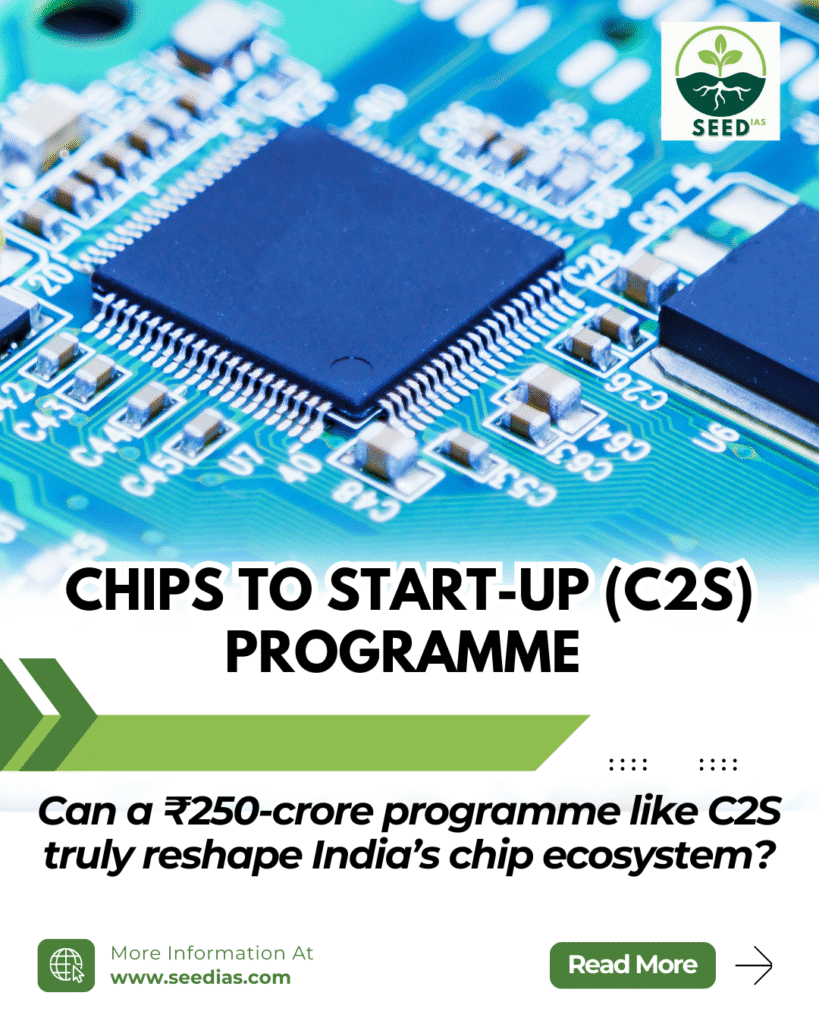
The Government of India has released performance outcomes of the Chips to Start-up (C2S) Programme, showcasing:
• High student enrolment,
• Shared wafer runs,
• Student-designed chips, and
• Patent generation under the programme.
What is the Chips to Start-up (C2S) Programme?
About
• Umbrella capacity-building initiative launched in 2022 by MeitY.
• Outlay: ₹250 crore over five years.
• Covers academic institutions across India.
Objectives / Targets
• Develop 85,000 industry-ready professionals across UG/PG/PhD levels.
• Incubate 25 start-ups.
• Enable 10 technology transfers.
• Provide SMART lab access.
• Train 1 lakh students.
• Generate 50 patents.
• Support 2,000 research publications.
Impact
• Boosts innovation & employability.
• Strengthens academia’s role in the Indian semiconductor value chain.
• Builds foundation for Aatmanirbhar Bharat in semiconductors.
• Enhances India’s global competitiveness.
Programme Approach
A hands-on, ecosystem-driven model combining:
• Academic curriculum
• Industry-led training
• Mentorship
• Multi-year semiconductor R&D projects
Institutional framework includes:
• ChipIN Centre (C-DAC Bengaluru)
• NIELIT SMART Labs
• Participating colleges/universities
Provides end-to-end exposure to:
• Chip design
• Fabrication
• Testing
Using advanced EDA tools and workflows for ASICs, SoCs, and IP cores.
Chip Fabrication Under C2S
• Student chip designs aggregated quarterly.
• Designs validated & combined into shared wafers.
• Fabricated at 180 nm node at Semi-Conductor Laboratory (SCL), Mohali.
• Chips are then packaged & delivered to students for testing and innovation.
Support Ecosystem
• ChipIN Centre provides centralised technical support.
• Over 4,855 support tickets resolved.
• Enables continuous design refinement and large-scale hands-on exposure.
UPSC Civil Services Examination, Previous Year Question (PYQ)
Prelims:
Q. Which one of the following laser types is used in a laser printer? (2008)
(a) Dye laser
(b) Gas laser
(c) Semiconductor laser
(d) Excimer laser
Ans: (c)
Q. With reference to solar power production in India, consider the following statements: (2018)
- India is the third largest in the world in the manufacture of silicon wafers used in photovoltaic units.
- The solar power tariffs are determined by the Solar Energy Corporation of India.
Which of the statements given above is/are correct?
(a) 1 only
(b) 2 only
(c) Both 1 and 2
(d) Neither 1 nor 2
Ans: (d)
UPSC Prelims Practice Questions: C2S Programme
Q. With reference to the Chips to Start-up (C2S) Programme, consider the following statements:
- It is implemented by the Ministry of Electronics and Information Technology (MeitY).
- It aims to develop more than 80,000 industry-ready semiconductor professionals.
- It focuses only on incubating semiconductor start-ups and does not include academic training.
Which of the statements given above is/are correct?
(a) 1 and 2 only
(b) 2 and 3 only
(c) 1 and 3 only
(d) 1, 2 and 3
ANS: (a) 1 and 2 only
Q. Under the C2S Programme, fabrication of student-designed chips is carried out at:
(a) Bharat Electronics Ltd., Bengaluru
(b) Semi-Conductor Laboratory (SCL), Mohali
(c) ISRO’s Vikram Sarabhai Space Centre, Thiruvananthapuram
(d) Centre for Development of Advanced Computing (C-DAC), Pune
ANS: (b) SCL, Mohali
Q. Consider the following targets of the C2S Programme:
- Incubation of 25 start-ups
- Generation of 50 patents
- Training of one lakh students
- Fabrication of chips at 65 nm node
Which of the above are correct?
(a) 1, 2 and 3 only
(b) 2 and 4 only
(c) 1 and 3 only
(d) 1, 2, 3 and 4
ANS: (a) 1, 2 and 3 only