Why in NEWS
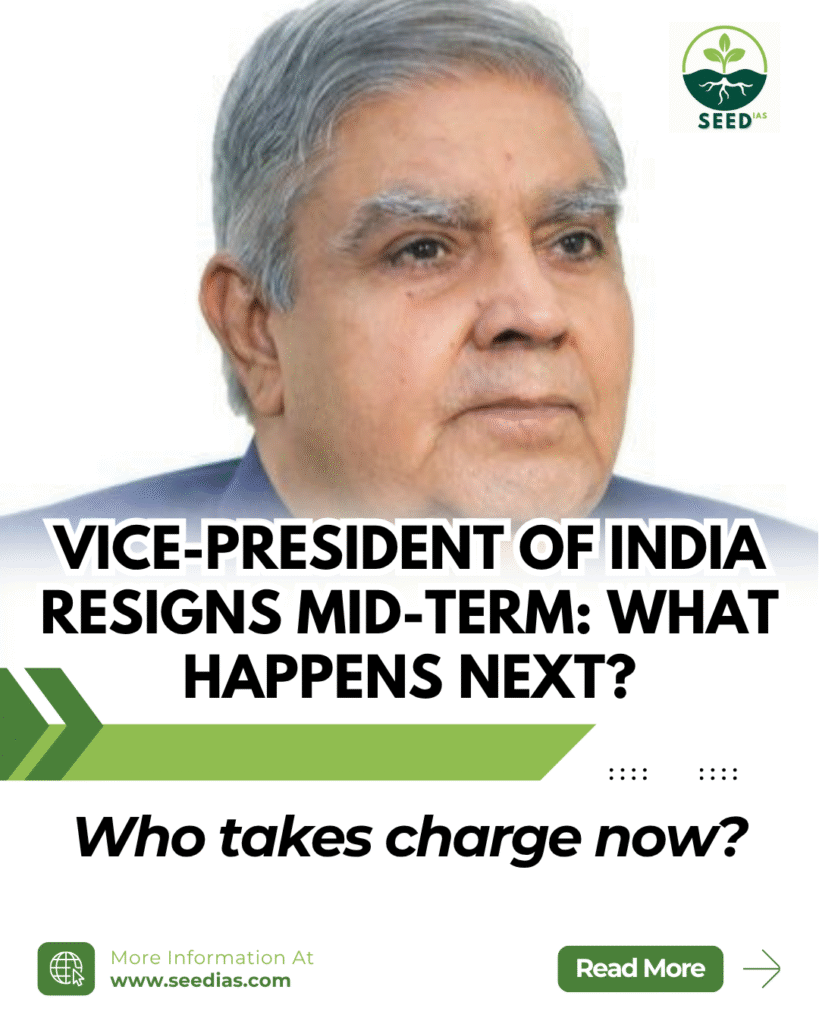
Vice-President Jagdeep Dhankhar has resigned from office under Article 67(a) of the Constitution, becoming the third Vice-President to step down before completing his term, after V.V. Giri and R. Venkataraman.
Key Terms and Concepts
| Term | Explanation |
|---|---|
| Article 63 | Mandates the office of the Vice-President in India |
| Article 64 | Vice-President to act as ex-officio Chairman of Rajya Sabha |
| Article 65 | Vice-President acts as President in the event of vacancy |
| Article 66 | Election procedure for Vice-President |
| Article 67(a) | Resignation process of Vice-President |
| Article 68 | Process for filling vacancy in the office of Vice-President |
| Article 69 | Oath or affirmation by Vice-President |
What Happens When the Vice-President Resigns Mid-Term?
| Provision | Explanation |
|---|---|
| Resignation Process | Must submit a written resignation to the President under Article 67(a) |
| Effect of Resignation | Becomes effective immediately upon submission |
| Rajya Sabha Chairmanship | Deputy Chairman presides over proceedings in absence of Vice-President |
| No Acting VP | The Constitution does not provide for an acting Vice-President |
| Election After Vacancy | Election is to be conducted “as soon as possible”; no fixed time frame unlike the Presidential vacancy (which requires filling within 6 months) |
| Election Conduct | Overseen by Election Commission under the Presidential and Vice-Presidential Elections Act, 1952 |
| Tenure of New VP | Full five-year term, even if predecessor resigned mid-term |
Vice-President of India: Key Facts
| Feature | Details |
|---|---|
| Position | Second-highest constitutional authority after the President |
| Modeled After | US Vice-President |
| Relevant Articles | Articles 63–71 |
| Electoral College | Elected by both Houses of Parliament (including nominated members); state legislatures excluded |
| Voting System | Proportional representation via single transferable vote; secret ballot |
| Eligibility | Indian citizen, ≥35 years, eligible for Rajya Sabha, no office of profit, not a member of any legislature |
| Term | Five years; continues until successor assumes office |
| Resignation | By written letter to the President |
| Removal | Rajya Sabha resolution (effective majority) + Lok Sabha approval (simple majority); 14-day notice required |
| Acts as President | In case of vacancy in President’s office; max duration: 6 months |
| Chairmanship | Ex-officio Chairman of Rajya Sabha; votes only in case of tie |
Chairman of Rajya Sabha: Roles and Powers
| Function | Explanation |
|---|---|
| Presiding Role | Conducts House proceedings; ensures discipline and order |
| Suspension Power | Can suspend members under Rule 256 for disorderly conduct |
| Neutral Arbiter | Must remain impartial; ensures equal opportunity to all members |
| Casting Vote | Has a deciding vote in case of tie (Article 100) |
| Committee Referrals | Refers bills and motions to appropriate committees |
| Limitations | Cannot preside over joint sessions or certify Money Bills |
| When Acting as President | Deputy Chairman presides over Rajya Sabha in their absence |
Vice-President: India vs United States
| Feature | India | United States |
|---|---|---|
| Presiding Role | Rajya Sabha (Upper House) | Senate (Upper House) |
| Voting Power | Only in case of tie | Only in case of tie |
| Succession Role | Acts as President temporarily (max 6 months) | Becomes President for remainder of term |
| Executive Role | Primarily ceremonial; limited function | Member of executive branch; often has policy duties |
In a Nutshell
Mnemonic: “RESIGN-CHECK”
Resignation via Article 67(a)
Election by Parliament
Secret Ballot System
Interim handled by Deputy Chairman
Gap in Chairmanship only, not governance
New VP gets full 5-year term
Constitution silent on acting VP
Heads Rajya Sabha
Effective immediately
Conducted under 1952 Act
Key articles: 63–71
Prelims Practice Questions
- Which of the following Articles deals with the resignation of the Vice-President of India?
A. Article 65
B. Article 66
C. Article 67(a)
D. Article 68 - Who presides over the Rajya Sabha in the absence of the Vice-President?
A. Speaker of Lok Sabha
B. Chief Justice of India
C. Deputy Chairman of Rajya Sabha
D. Prime Minister - In India, the election of the Vice-President is conducted by:
A. State Legislative Assemblies
B. Electoral College consisting of elected MPs only
C. Electoral College consisting of all MPs, elected and nominated
D. President and Governors
Mains Questions
- Discuss the constitutional provisions related to the resignation and vacancy of the Vice-President of India. How is the gap in parliamentary functioning managed during such a situation? (10M)
- Compare and contrast the role of the Vice-President of India with that of the Vice-President of the United States. (15M)
Answer Key with Explanations
| Qn | Answer | Explanation |
|---|---|---|
| 1 | C | Article 67(a) of the Constitution deals with resignation of the Vice-President |
| 2 | C | Deputy Chairman of the Rajya Sabha presides in the absence of the Vice-President |
| 3 | C | All members (elected and nominated) of both Houses of Parliament elect the Vice-President |