Why in News?
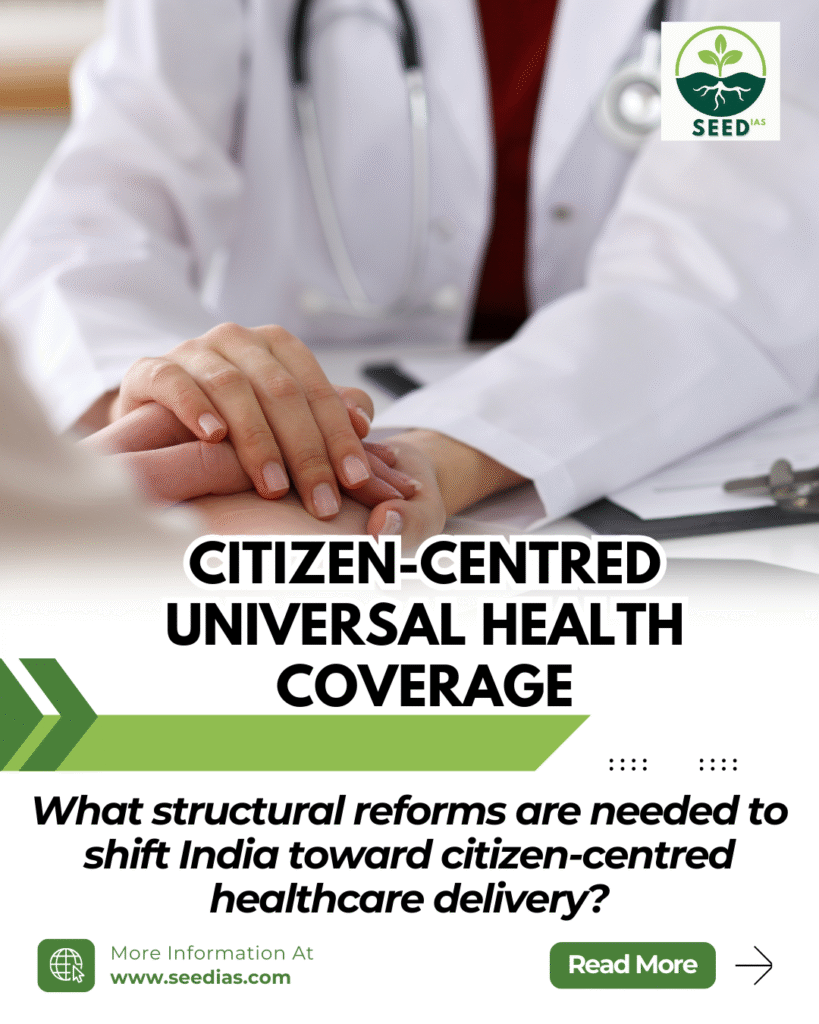
The Lancet released a report titled “A Citizen-Centred Health System for India”, presenting a roadmap for achieving citizen-centred Universal Health Coverage (UHC), in alignment with Viksit Bharat @2047.
It argues that as the WHO faces financial stress and the US retreats from global health leadership, India holds a strategic opportunity to reform domestic health delivery while emerging as a strong voice for the Global South.
Key Findings of the Lancet Report
1. Public Spending Stagnation
- Public health expenditure remains below 2% of GDP, missing the National Health Policy (2017) target of 2.5%.
2. Fragmented Health Delivery
- Health programmes function in silos (TB, malaria, maternal health etc.), causing poor care continuity and forcing patients to navigate multiple providers.
3. Input-Based Governance
- Rigid line-item budgeting (salaries, buildings, equipment) restricts local flexibility, innovation, and responsiveness to local disease burdens.
4. High Out-of-Pocket Expenditure (OOPE)
- OOPE constitutes ~50% of total health spending, among the highest globally.
5. Primary Care Deficit
- Health insurance is hospital-centric, leaving OPD and primary care—where the poor spend most—largely uncovered.
6. Paradigm Shift in Barriers
- Barriers today are not political will, infrastructure or money, but uneven quality, fragmentation, and weak governance.
7. The “Missing Middle”
- The middle class lacks financial protection, unlike the poor (government schemes) and rich (private insurance), leading to catastrophic health expenses.
8. Human Resource Gaps
- HR-policy emphasises degrees over competency, motivation, and values.
- ASHAs remain undervalued despite being critical frontline workers.
Recommendations of the Lancet Report
1. Public Financing & Provision as the Core Model
- UHC should be publicly financed and publicly delivered.
- Private sector should play a complementary, tertiary-care-focused role under strict regulation to prevent profiteering.
2. Shift to Global Budgets & Decentralisation
- Replace line-item budgets with District-level Global Budgets to enhance local autonomy and outcome-based spending.
- Empower PRIs and ULBs to manage local health systems—modelled on Kerala’s decentralised governance.
3. Strengthen Frontline Workforce
- Recognise ASHAs as formal health staff instead of volunteers.
- Expand Community Health Officers (CHOs) to handle basic OPD and reduce specialist burden.
4. Technology as an Enabler (Capital-Efficient Tech)
- Adopt a Federated Data Architecture (aligned with DPDP Act, 2023) where data stays local and is shared only through Consent Managers.
- Strengthen ABDM, and deploy AI, genomics, and point-of-care diagnostics to bring advanced care closer to rural communities.
5. Institutionalise Citizen Engagement
- Establish mechanisms like Jan Sunwais and empowered Rogi Kalyan Samitis for citizen oversight.
- Set up independent, district-level grievance redressal bodies to address corruption and service denial.
Conclusion
By adopting global budgets, digital public goods, and stronger decentralised governance, India can bridge the “missing middle”, cut OOPE, and build a truly citizen-centric health system.
This structural reform is essential for developing the healthy human capital required to realise Viksit Bharat @2047.
UPSC Civil Services Examination, Previous Year Questions (PYQs) Prelims
Q. Which of the following are the objectives of ‘National Nutrition Mission’? (2017)
- To create awareness relating to malnutrition among pregnant women and lactating mothers.
- To reduce the incidence of anaemia among young children, adolescent girls and women.
- To promote the consumption of millets, coarse cereals and unpolished rice.
- To promote the consumption of poultry eggs.
Select the correct answer using the code given below:
(a) 1 and 2 only
(b) 1, 2 and 3 only
(c) 1, 2 and 4 only
(d) 3 and 4 only
Ans: (a)
Practice Questions
Q1. With reference to the recent Lancet Report titled “A Citizen-Centred Health System for India”, consider the following statements:
- It recommends shifting from line-item budgeting to district-level global budgets to allow greater financial flexibility.
- It states that barriers to Universal Health Coverage in India are primarily due to inadequate political will and lack of infrastructure.
- It highlights that out-of-pocket expenditure (OOPE) in India is among the lowest globally due to expanded insurance coverage.
Which of the statements given above is/are correct?
(a) 1 only
(b) 1 and 2 only
(c) 2 and 3 only
(d) 1, 2 and 3
Answer: (a)
Q2. In the context of reforms suggested by the Lancet Report for India’s health system, which of the following is/are recommended?
- Adoption of a federated health data architecture aligned with the Digital Personal Data Protection Act, 2023.
- Expanding the role of Community Health Officers (CHOs) to handle basic outpatient care.
- Increasing the role of private health providers as the primary vehicle for Universal Health Coverage.
Select the correct answer using the code below:
(a) 1 and 2 only
(b) 2 and 3 only
(c) 1 and 3 only
(d) 1, 2 and 3
Answer: (a)