1.What Are Tribunals?
- Tribunals are quasi-judicial bodies created to adjudicate specialised disputes (taxation, service matters, environment, company law, etc.).
- Constitutional backing:
- Articles 323-A – Administrative Tribunals.
- Article 323-B – Tribunals for other matters (tax, industrial disputes, land reforms, elections etc.).
- Purpose: Reduce burden on High Courts, ensure technical expertise, provide speedier justice.
2. Why Tribunals Need Reform
a) Excessive Executive Control
- Government often controlled appointments, tenure, service conditions and removal of tribunal members.
- Undermines independence and impartiality.
b) Short and Uncertain Tenure
- Frequent changes in tenure provisions reduce institutional stability.
c) Lack of Uniformity
- Each tribunal functions differently:
- Different rules
- Different appointment structures
- Varying autonomy
d) Vacancies & Delays
- Chronic vacancies lead to major pendency (e.g., NCLT, NGT, ITAT).
e) Absence of a Dedicated Oversight Body
- Repeated Supreme Court judgments (Madras Bar Association cases) demanded a National Tribunals Commission (NTC), but it was never established.
f) Poor Infrastructure & Administrative Support
- Many tribunals lack proper staff, case management systems, and standardised processes.
3. What the Tribunal Reforms Act, 2021 Attempted to Do
The 2021 Act (and earlier 2021 Ordinance) attempted to restructure tribunal governance, but it drew criticism for increasing government control.
Key Provisions of the 2021 Act
- Reduced Tenure of Members
- Fixed tenure of 4 years, criticised as too short.
- Age Ceiling
- Max age 50 for appointment for some posts (seen as exclusionary).
- Central Government’s Role in Appointment
- Government could choose from a shortlist recommended by the Search–cum–Selection Committee.
- Government Control Over Service Conditions
- Salaries, allowances, and terms of service determined by executive rules.
- Abolished Several Tribunals
- Transferred functions to existing judicial bodies.
Why Controversial?
- Ignored earlier Supreme Court guidelines.
- Increased executive dominance.
- Considered a “backdoor reintroduction” of struck-down provisions.
4. Supreme Court’s 2025 Verdict: What Happened?
The Supreme Court struck down key provisions of the Tribunal Reforms Act, 2021.
Core Observations by CJI B.R. Gavai
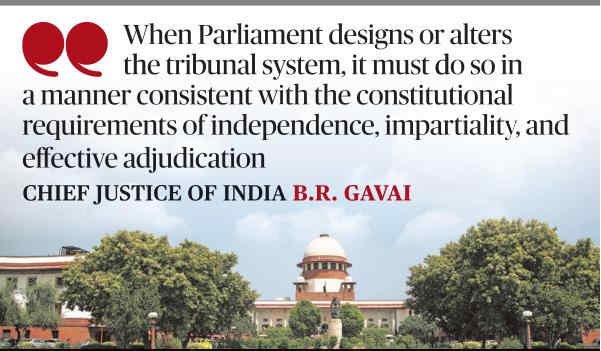
- Tribunal Independence is a Constitutional Requirement
- Independence, impartiality, and effective adjudication form part of the Basic Structure.
- Parliament Cannot Override Supreme Court Judgments
- Judicial review is a basic feature.
- Parliament cannot re-enact laws already struck down in earlier judgments.
- The 2021 Act Was “Repackaged” Ordinance
- The Court said the Act simply copied the invalidated Ordinance.
- Excessive Executive Control Violates Judicial Independence
- Ignoring Court Directions Weakens the Constitutional Scheme
Major Direction: Establish National Tribunal Commission (NTC)
- Deadline: 4 months
- Purpose:
- Oversee appointments
- Regulate administration
- Ensure autonomy
- Maintain uniformity across tribunals
- Provide infrastructure and financial independence
The Court called the NTC an “essential structural safeguard.”
5. What Reforms Do Tribunals Need
a) Structural Independence
- Appointment process free from executive control.
- Security of tenure.
- Financial and administrative autonomy.
b) Uniformity Across Tribunals
- Common rules for appointments, salaries, and functioning.
c) Efficient Staffing and Timely Appointments
- Transparent selection mechanism.
- Zero vacancy policy.
d) Establishment of the National Tribunal Commission
- Acts as an independent regulator, like the UPSC for tribunals.
e) Infrastructure Modernisation
- Standardised courtrooms, IT systems, e-filing, digital hearing platforms.
f) Clear Appellate Structure
- Streamlined appeals to reduce litigation piling up in High Courts & Supreme Court.
g) Strengthening Judicial Oversight
- Compliance with SC judgments (Madras Bar Association cases 2010, 2014, 2020, 2021).