Why in NEWS
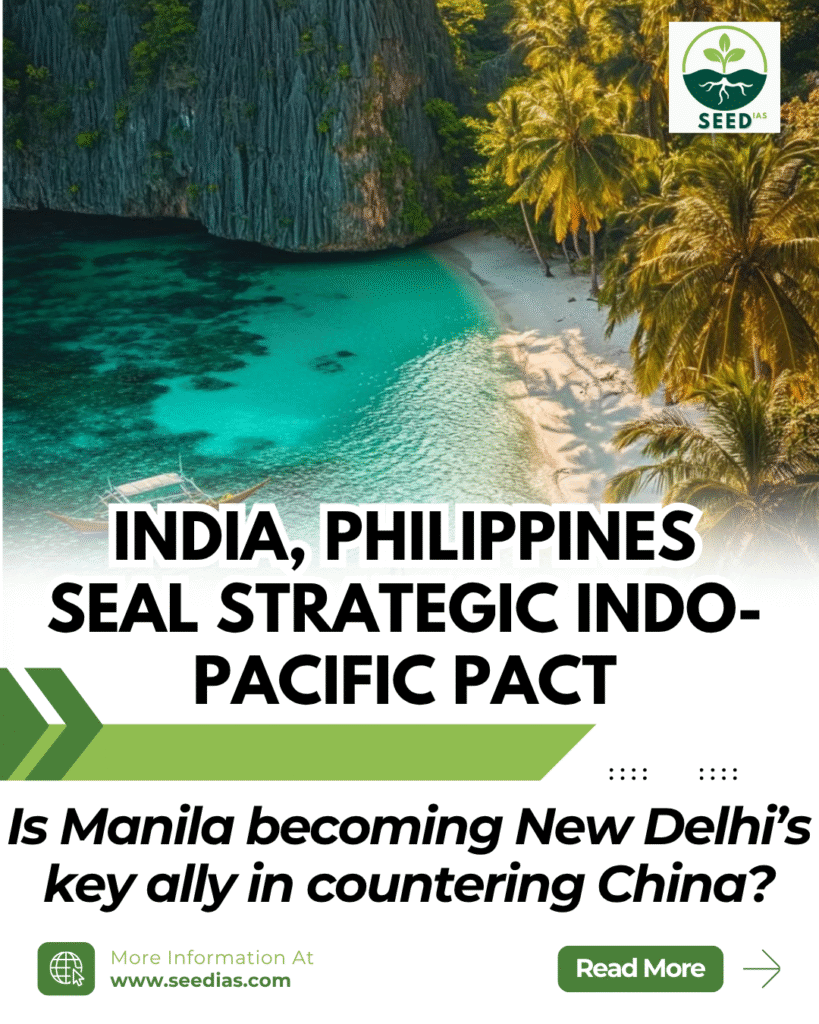
In 2025, India and the Philippines elevated their bilateral relationship to a Strategic Partnership during the Philippine President’s state visit to India. This move marks a major step in India’s Act East Policy and maritime security outreach in Southeast Asia.
Key Concepts and Terms
| Term | Explanation |
|---|---|
| Strategic Partnership | A formal agreement to strengthen cooperation in key sectors like defense, trade, and diplomacy. |
| Mutual Legal Assistance Treaty (MLAT) | A treaty for international cooperation in criminal investigations and legal proceedings. |
| IFC-IOR | Information Fusion Centre–Indian Ocean Region, promoting maritime domain awareness among partner countries. |
| Sovereign Data Cloud | A national digital infrastructure enabling secure data storage and digital autonomy. |
| Act East Policy | India’s strategy to deepen ties with Southeast Asian nations for economic and strategic cooperation. |
News Summary
India and the Philippines reaffirmed their 1952 Treaty of Friendship and signed a Strategic Partnership pact aimed at deeper cooperation in defense, trade, maritime security, and digital infrastructure. The nations adopted a Plan of Action (2025–2029), finalized legal treaties, and agreed on infrastructure collaboration. Both sides also extended visa benefits and digital cooperation, with India helping the Philippines build a sovereign data cloud and inviting them to the IFC-IOR platform. This engagement is rooted in shared concerns over the Indo-Pacific and China’s growing assertiveness in the South China Sea.
Key Outcomes of the Visit
| Domain | Developments |
|---|---|
| Diplomacy | Formal declaration of Strategic Partnership; reaffirmed 1952 Treaty of Friendship. |
| Defense | India to assist Philippines in naval asset development; BrahMos missile export already in place. |
| Legal Cooperation | Finalized MLAT and Treaty on Transfer of Sentenced Persons. |
| Digital Infrastructure | India to support a Sovereign Data Cloud for the Philippines. |
| Visa Policy | Mutual visa benefits for tourists and e-tourist visa concessions. |
| Connectivity & Investment | India invited to join large-scale infrastructure projects and share Gati Shakti framework. |
How India–Philippines Relations Evolved
| Area | Growth Trajectory |
|---|---|
| Diplomatic Ties | Started in 1949; elevated in 2025; Philippines is ASEAN Dialogue Coordinator (2024–27). |
| Trade & Economy | Trade rose from $2.03B (2020–21) to $3.53B (2023–24); India enjoys trade surplus. |
| Pharmaceuticals | India supplies 12% of Philippines’ pharma imports. |
| Defense | 2006 MoU led to Joint Defense Committee; BrahMos deal signed in 2022; naval drills in 2025. |
| Strategic Forums | Mutual support at UN and ASEAN; India backs Philippines’ South China Sea claims under UNCLOS. |
Significance of India–Philippines Ties
| Domain | Importance |
|---|---|
| Geopolitics | Strengthens Indo-Pacific strategy; checks China’s maritime aggression. |
| Act East Policy | Philippines is a key ASEAN partner; aligns with India’s regional strategy. |
| Economic Potential | Offers untapped markets in semiconductors, seaweed tech, IT, and pharmaceuticals. |
| Digital Diplomacy | India’s cloud infrastructure support enhances Philippines’ cyber sovereignty. |
Challenges in the Relationship
| Challenge | Details |
|---|---|
| China’s Reaction | China sees India’s naval and defense outreach as interference in the South China Sea. |
| Trade Gaps | Limited trade integration; PTA negotiations are slow. |
| Implementation Delays | Capacity constraints and shifting political priorities delay progress on agreements. |
What Can Be Done to Strengthen Ties
| Strategy | Suggestions |
|---|---|
| Defence Engagement | Deepen naval cooperation; co-develop maritime assets and conduct regular joint drills. |
| Faster PTA Negotiations | Focus on key sectors like digital, pharma, and processed food to unlock economic depth. |
| People-to-People Ties | Increase academic scholarships, cultural exchanges, and tourism promotion. |
| Tech & Climate Collaboration | Build joint green energy and climate resilience projects, leveraging India’s solar and bioenergy tech. |
In a Nutshell
Mnemonic: S.P.A.R.K.
- Strategic partnership boosts Indo-Pacific diplomacy
- Pharma, digital, and defence ties gain momentum
- Act East Policy finds a reliable ally in Manila
- Resilient engagement despite Chinese pressures
- Key challenges remain: trade depth and delivery pace
Prelims Practice Questions
- Which of the following Indian exports to the Philippines is the most significant by value?
a) Rice
b) Pharmaceuticals
c) Software services
d) Tea - The BrahMos missile exported to the Philippines is a joint venture between India and which country?
a) Israel
b) Russia
c) USA
d) Japan - Which body facilitates maritime information sharing among Indian Ocean Region countries?
a) IORA
b) BIMSTEC
c) IFC-IOR
d) SAARC
Mains Questions
- Discuss the strategic significance of the India–Philippines Strategic Partnership in the evolving Indo-Pacific landscape. 10 Marks
- How does India’s outreach to Southeast Asia via Act East Policy reflect its geopolitical interests? Illustrate with examples. 10 Marks
Prelims Answers and Explanations
| Q No. | Answer | Explanation |
|---|---|---|
| 1 | b | India is a key pharma supplier, covering 12% of the Philippines’ imports. |
| 2 | b | BrahMos is a joint project between India and Russia. |
| 3 | c | IFC-IOR is an Indian initiative to enhance maritime domain awareness. |