Context of the News
The closure of the Strait of Hormuz following conflict involving Iran, U.S., and Israel has disrupted global oil flows, causing sharp rise in oil prices (above $110/barrel) and geopolitical realignments.
Background
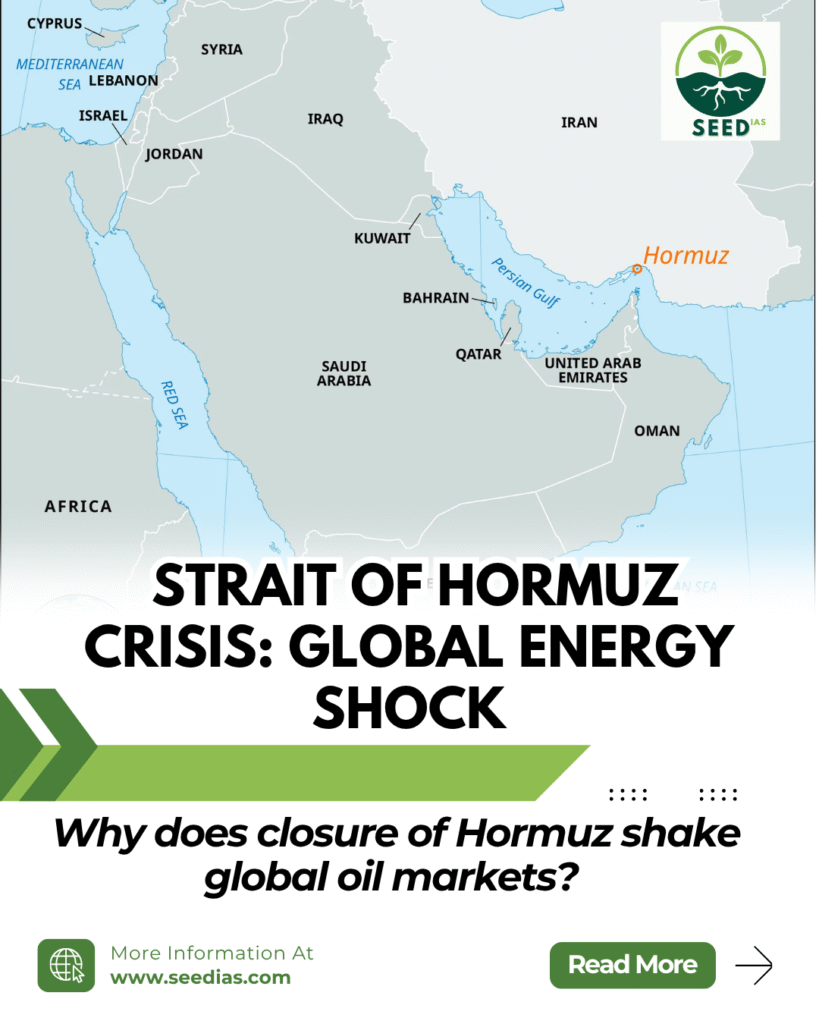
The Strait of Hormuz is a critical maritime chokepoint connecting the Persian Gulf to the Arabian Sea. Nearly 20% of global oil trade passes through it. Relevant for GS Paper I (Geography) and GS Paper III (Economy, Energy Security).
News Breakdown
What is the Strait of Hormuz?
• A narrow waterway:
o Width: ~33 km at narrowest
• Connects:
o Persian Gulf → Arabian Sea
• One of the world’s most important:
o Oil transit chokepoints
•
Why is it Important?
• Carries:
o ~1/5th of global oil trade
• Key suppliers:
o Saudi Arabia, UAE, Iran
• Key consumers:
o India, China, Japan
Global Energy Dynamics
• Oil + Gas:
o Account for over 50% of global energy supply
• Energy imbalance:
o Production concentrated in:
West Asia
o Consumption concentrated in:
Asia (India, China, Japan)
Geopolitics of Oil
• Key players:
o U.S., Russia, West Asian countries
U.S. Strategy
• Increased:
o Shale oil production
• Strategic interventions:
o Gulf War (1990-91)
o Iraq War (2003)
o Recent actions in Iran, Venezuela
Russia’s Role
• Becomes key supplier when:
o West Asian supply disrupted
• After Ukraine war sanctions:
o Russia faced reduced exports
• Now:
o Gains importance as alternative oil source
Impact on India
• India:
o 2nd largest oil importer
o 3rd largest consumer
• Effects:
o Rising oil prices → inflation
o Increased import bill
India-Russia Oil Dynamics
• Russian oil share:
o 2.5% (2021) → 39% (2023)
• India benefits:
o Discounted crude oil
• Refines and exports:
o Petrol, diesel, petrochemicals
Impact on Europe
• Reduced Russian imports due to sanctions
• Shift towards:
o West Asian oil
• Now faces:
o Supply constraints due to Hormuz crisis
Key Outcome
• Global oil markets:
o Highly interconnected
• Even small disruptions:
o Cause global ripple effects
Conclusion / Way Forward
India must diversify energy sources, strengthen strategic reserves, and accelerate renewable transition to reduce vulnerability to global oil shocks.
Prelims Check
Question 1
With reference to the Strait of Hormuz, consider the following statements:
- It connects the Persian Gulf with the Arabian Sea.
- It handles more than 50% of global oil trade.
- It is one of the world’s key energy chokepoints.
Which of the statements given above is/are correct?
(a) 1 and 3 only
(b) 2 only
(c) 1 and 2 only
(d) 1, 2 and 3
Question 2
Consider the following statements:
- India is the largest oil exporter in the world.
- Russia is a major oil supplier outside West Asia.
- Oil price rise directly affects inflation in India. Which of the statements given above is/are correct?
(a) 2 and 3 only
(b) 1 and 2 only
(c) 1 and 3 only
(d) 2 only
Question 3
Consider the following statements:
Statement-I: Closure of the Strait of Hormuz disrupts global oil supply.
Statement-II: Oil markets are globally interconnected.
Which one of the following is correct?
(a) Both Statement-I and Statement-II are correct and Statement-II explains Statement-I
(b) Both Statement-I and Statement-II are correct but Statement-II does not explain Statement-I
(c) Statement-I is correct, but Statement-II is incorrect
(d) Statement-I is incorrect, but Statement-II is correct
Answers with Explanation
Q1: (a) 1 and 3 only
• Correct connection → True
• Only ~20% trade → Statement 2 incorrect
• Key chokepoint → Correct
Q2: (a) 2 and 3 only
• India is importer → Statement 1 incorrect
• Russia major supplier → Correct
• Oil prices affect inflation → Correct
Q3: (a) Both correct, Statement-II explains Statement-I
• Interconnected markets amplify disruption
“In a globalised world, a narrow strait can shape the destiny of nations.”