Why in News?
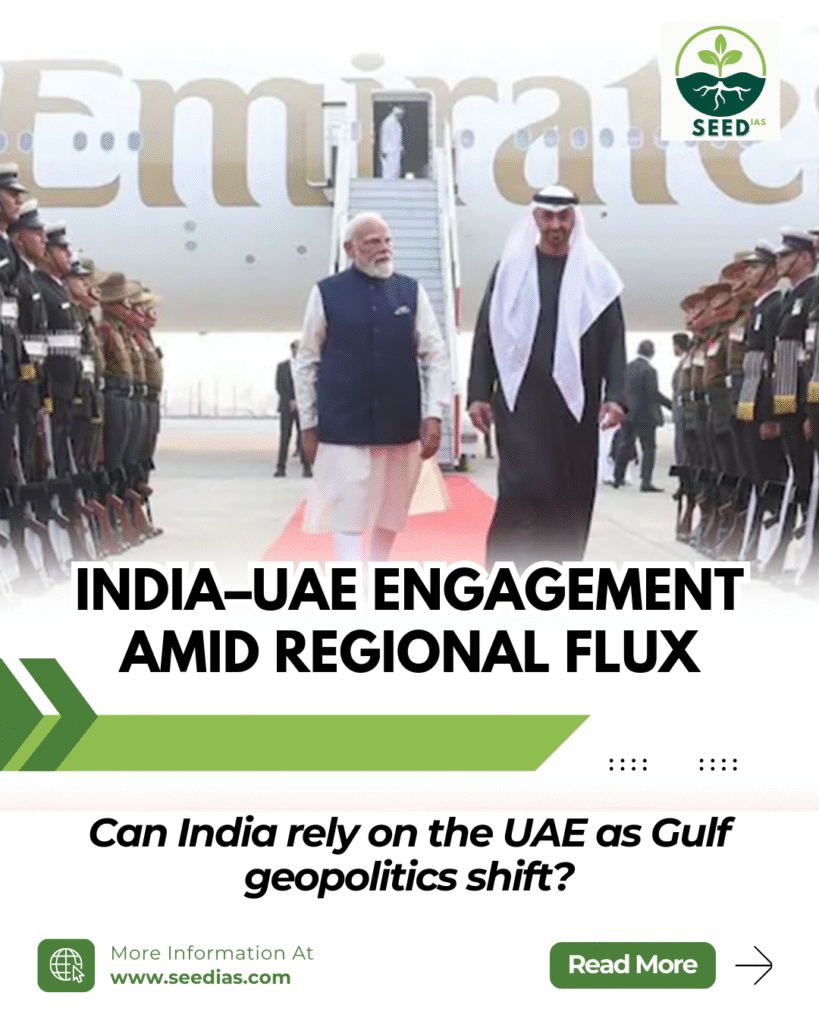
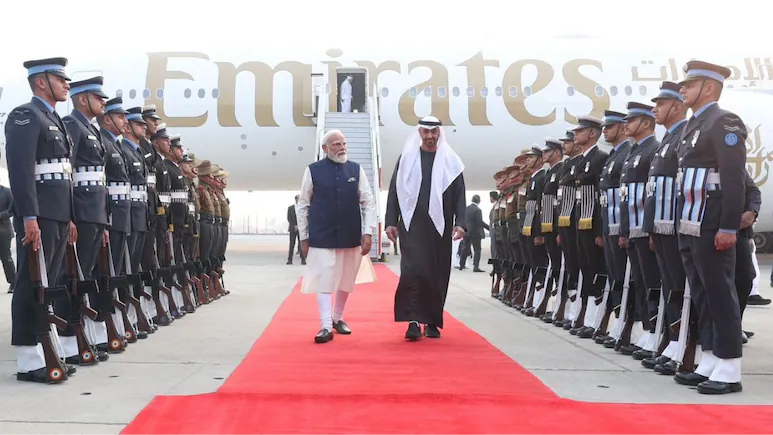
The President of the UAE paid an official visit to India amid shifting Gulf geopolitics. The visit produced wide-ranging agreements in trade, defence, technology, energy, nuclear cooperation, and digital infrastructure—strengthening India’s ties with an increasingly influential Middle Eastern power.
Key Outcomes of the Visit
1. Trade & Economic Engagement
- Building on the 2022 Comprehensive Economic Partnership Agreement (CEPA), bilateral trade touched USD 100 billion in FY 2024–25.
- A new target was set: USD 200 billion by 2032.
- Initiatives fast-tracked:
- Bharat Mart (Dubai)
- Virtual Trade Corridor
- Bharat–Africa Setu
- India invited UAE sovereign wealth funds to invest in the NIIF.
- Discussed UAE partnership in Dholera Special Investment Region (Gujarat)—airport, port, township, and MRO ecosystem.
2. Energy & Nuclear Cooperation
- Signed a 10-year LNG supply agreement (from 2028).
- Agreed to cooperate on advanced nuclear technologies including Small Modular Reactors (SMRs) under India’s SHANTI Act, 2025.
3. Technology, Digital Infrastructure & AI
- Cooperation expanded to AI, supercomputing, and data centres.
- Agreed to explore establishing Data Embassies—critical sovereign data stored on foreign soil under diplomatic protection.
- Strengthening digital public infrastructure linkages (UPI–Aani, Digilocker–UAE platforms).
4. Defence & Security
- Defence flagged as a core pillar.
- Welcomed increased joint military engagements (e.g., Zayed Talwar naval exercise).
- Signed a Letter of Intent for a Strategic Defence Partnership.
- Reaffirmed joint action against terrorism and terror financing under FATF.
5. Cultural, Education & Mobility
- Decision to establish a House of India in Abu Dhabi.
- Encouraged greater university collaborations and student exchanges.
- Work ongoing to interlink national payment platforms for cross-border payments.
Data Embassy – Key Concept (UPSC Important)
- An offshore data centre storing a nation’s critical digital information under diplomatic protection.
- Legal Status:
- Physical facility: Host country jurisdiction
- Data: Home country-exclusive jurisdiction (inviolable)
- First in the world: Estonia’s 2017 Data Embassy (Luxembourg).
- India–UAE agreement establishes India’s first data embassy.
Geopolitical Context Behind the Visit
1. UAE–Saudi Tensions
- Divergence in Yemen, Sudan, and Somalia.
- UAE backs the Southern Transitional Council; Saudi backs the internationally recognised government.
2. Emerging Saudi–Pakistan–Turkey Axis
- Saudi–Pakistan defence cooperation and Turkey’s role contrast with India’s minilaterals like I2U2 and IMEC with UAE and Israel.
3. US–Iran Hostilities
- Heightened risks in the Gulf.
- UAE helps India diversify energy and maintain communication channels.
4. Board of Peace (Gaza)
- India and UAE invited; partnership aids coordinated influence in post-conflict Gaza reconstruction.
India–UAE Bilateral Relations: Current Assessment
Economic
- UAE is India’s 3rd largest trading partner and 2nd largest export destination.
- UAE investments in India: USD 20–21 billion, plus a USD 75 billion infrastructure commitment.
Energy
- UAE is India’s 4th largest crude oil supplier and a key LNG/LPG source.
- Petroleum accounts for over 41% of bilateral trade.
Financial Integration
- RuPay and UPI adoption in UAE.
- 2023 Local Currency Settlement (LCS) enables INR-AED trade (gold, crude, food).
Defence
- Growing UAE interest in Indian platforms: BrahMos, Akash, Tejas.
- Joint exercises: Desert Cyclone, Zayed Talwar.
People-to-People Relations
- Indian diaspora: 3.5 million (≈35% of UAE population).
- BAPS Mandir in Abu Dhabi marks a cultural milestone.
Regional & Multilateral Engagement
- UAE crucial in Abraham Accords, IMEC, I2U2.
- Stability in the Gulf directly impacts India’s energy security.
Challenges in India–UAE Relations
1. Regional Rivalries
- Managing UAE–Saudi frictions, Iran–Arab tensions while balancing India’s ties with all.
2. UAE–China Deepening Ties
- China’s investments, defence supplies (e.g., L-15 jets) challenge India’s strategic space.
3. UAE–Pakistan Relations
- UAE’s financial support to Pakistan raises concerns given Pakistan’s terror links.
4. Structural Trade Issues
- Limited diversification in trade post-CEPA.
- NTBs like Halal certification, SPS/TBT standards restrict Indian exports.
5. Emerging Climate–Energy Contradictions
- Different net-zero timelines (UAE 2050; India 2070).
- India’s push for renewables vs. UAE’s hydrocarbon export dependence.
What Should India Do? – Policy Recommendations
1. Build a Joint Green Energy Corridor
- Joint investments in:
- Green hydrogen
- Solar and wind
- Desalination technologies
- Establish an India–UAE Climate Research Centre.
2. Use UAE as a Gateway to GCC & Africa
- Expand CEPA-type agreements with GCC/GAFTA nations.
- Leverage UAE’s re-export capability for Indian textiles, pharmaceuticals, handicrafts.
3. Accelerate Investment Flows
- Fast-track UAE investments in:
- GIFT City
- Smart cities & logistics
- Renewable energy
- Create a Bilateral Investment Fast-Track Mechanism.
4. Institutionalise Strategic Dialogue
- Strengthen the Joint Commission with fixed timelines.
- Advocate for Kafala reforms for Indian migrant welfare (on Qatar’s model).
Conclusion
The visit reflects a maturing India–UAE Comprehensive Strategic Partnership, marked by expanded cooperation in trade, defence, digital integration, energy, and geopolitics.
However, to realise the full potential of CEPA and new-age collaborations, India must carefully navigate:
- Gulf rivalries
- China’s presence in the region
- Energy transition challenges
- Structural trade barriers
Strategic, economic, and digital convergence make the India–UAE partnership a key pillar of India’s West Asia policy and Indo-Pacific outreach.
PSC Civil Services Examination Previous Year Questions (PYQs) Prelims
Q. Which of the following is not a member of ‘Gulf Cooperation Council’? (2016)
(a) Iran
(b) Saudi Arabia
(c) Oman
(d) Kuwait
Ans: (a)
Q.Consider the following statements: (2008)
- Ajman is one of the seven Emirates of the UAE.
- Ras al-Khaimah was the last Sheikhdom to join the UAE.
Which of the statements given above is/are correct?
(a) 1 only
(b) 2 only
(c) Both 1 and 2
(d) Neither 1 nor 2
Ans: (c)
Practice Questions
Q1. With reference to Data Embassies, consider the following statements:
- A Data Embassy functions under the complete jurisdiction of the host country, including legal access to the stored data.
- India’s first Data Embassy is being set up in the United Arab Emirates.
- Estonia established the world’s first Data Embassy in Luxembourg.
Which of the statements given above is/are correct?
A. 1 and 2 only
B. 2 only
C. 2 and 3 only
D. 1, 2 and 3
Answer: C
Q2. India’s strategic engagement with the UAE has recently expanded due to which of the following developments?
- Rising tensions between Saudi Arabia and the UAE in Yemen and other regions.
- Formation of a Saudi–Pakistan–Turkey security axis.
- Increased risks of a U.S.–Iran confrontation in the Gulf region.
- Establishment of the Board of Peace for Gaza, to which both India and the UAE have been invited.
Select the correct answer using the code below:
A. 1, 2 and 3 only
B. 1, 3 and 4 only
C. 2 and 4 only
D. 1, 2, 3 and 4
Answer: D