Background: India’s Oil Import Profile
- India imports 85% of its crude oil demand, making energy security a strategic priority.
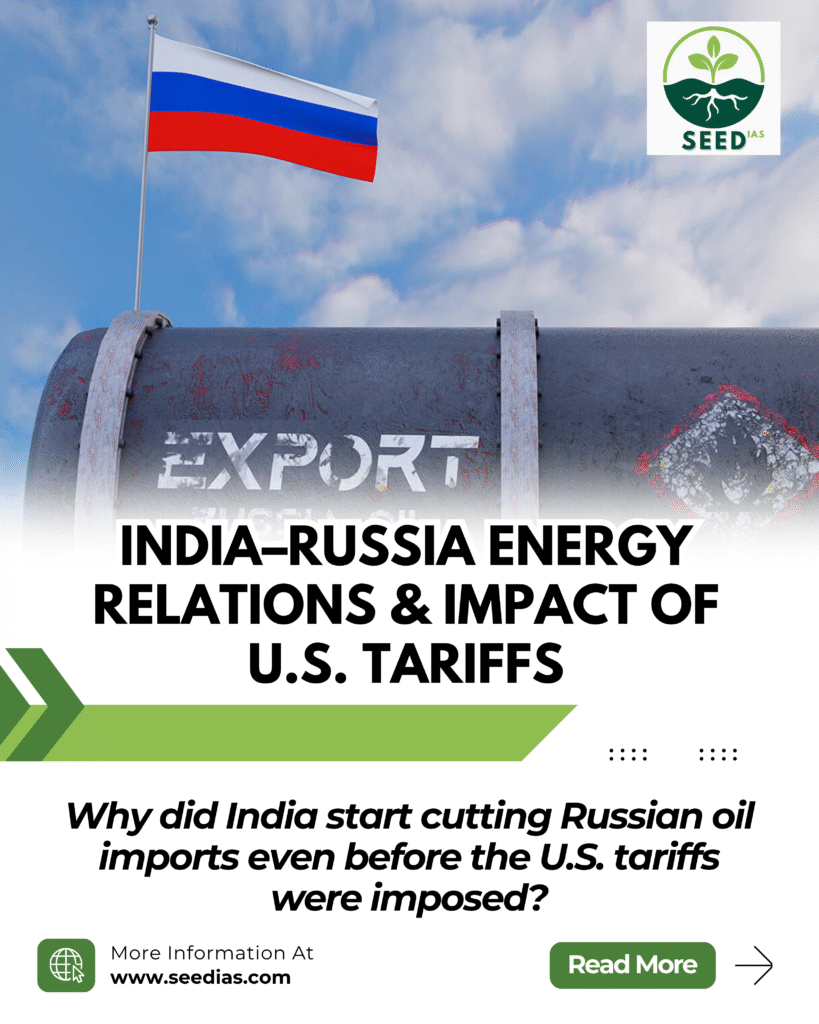
- Since 2022, India saw a major shift toward discounted Russian oil following the Ukraine conflict and Western sanctions on Russia.
- The U.S. recently imposed 25% and 50% additional tariffs on certain Indian exports, partly linked to India’s Russian oil purchases.
Evidence of a Long-Term Diversification Plan
- India reduced Russian imports in 8 out of 10 months before U.S. tariffs took effect.
- In Feb, May, June, July, September 2025, cuts exceeded 20% each.
- Indicates strategic diversification, not reactive policy.
Interpretation:
India is restoring balance by re-engaging with traditional suppliers (U.S., UAE, Saudi Arabia) and reducing overdependence on Russia.
Why India is Cutting Russian Oil Imports
- Supply Risk Diversification:
Overdependence on a single supplier exposes India to geopolitical shocks. - Refinery Compatibility & Long-Term Contracts:
Indian refineries use a mix of Middle Eastern, U.S. and Russian oil. - Payment and Shipping Challenges:
Sanctions complicate payment channels, insurance, shipping availability. - Price Volatility & Discounts Shrinking:
Russian discounts have reduced compared to 2022–23 levels. - Improving Energy Security:
India wants flexible sourcing to avoid disruptions due to volatile geopolitics.
India–Russia Energy Relationship: Strategic Dimensions
Positive Aspects
- Russia became India’s largest crude supplier in 2022–2024.
- Discounts helped India manage inflation, fiscal pressure, and fuel prices.
- Energy cooperation supplements ties in defence, nuclear energy, and space.
Emerging Challenges
- Western secondary sanctions increase transaction risks.
- Overreliance reduces negotiating power with Gulf suppliers.
- U.S. scrutiny impacts broader India–U.S. trade relations.
Balancing Strategy
India maintains a multi-alignment approach:
- Buy energy where it suits national interest.
- Avoid overdependence on any one region.
- Keep space for cooperation with both Russia and the U.S.
Impact of U.S. Tariffs on India: What the News Shows
Tariffs Introduced
- 25% additional tariff directly linked to Indian purchases of Russian oil
- 50% tariff on select Indian imports (from 27 August 2025)
Impact Assessment
- Not the Main Reason for Reducing Russian Oil:
Cuts began months before tariffs; driven by India’s domestic strategy. - Trade Negotiations Restarted:
India–U.S. formal trade talks resumed; BTA tranche-1 expected “soon”. - Political Signalling, but Limited Strategic Impact:
India continues to assert energy independence.
Ministers (EAM, Commerce, Finance) stated decisions are not under duress. - Possible Increase in Import Costs:
Tariffs may affect selective export sectors but not crude imports directly. - Geoeconomic Dynamics:
U.S. may be using tariffs as leverage, but India’s policy remains interest-based.
UPSC-Relevant Analytical Themes
- Energy Security & Strategic Autonomy
India prioritises affordability, accessibility, and supply diversification. - Geopolitics of Oil
Ukraine war changed global oil flows; Asia became a major market for Russian crude. - Balancing Great Power Relations
India navigates India-U.S. strategic partnership and India-Russia traditional ties simultaneously. - Trade & Foreign Policy Linkages
Tariffs show how energy choices intersect with global trade negotiations. - Shifts in Global Energy Markets
Russia’s pivot to Asia may be temporary depending on geopolitics and sanctions.
Mains Questions
Q1. Discuss the geopolitical and economic implications of India’s shifting oil import basket since 2022. (10/15 marks)
Prelims Pointers
- India imports ~85% of its crude oil demand.
- Russia became India’s largest oil supplier between 2022–2024.
- U.S. imposed 25% tariff specifically linked to Indian Russian oil purchases.
- Russia’s share peaked at 35.1% in 2024–25, then fell to 32.3% in 2025–26 (Apr–Sep).
- In September 2025:
- 29% drop (value),
- 17% drop (volume) compared to Sep 2024.