Why in NEWS
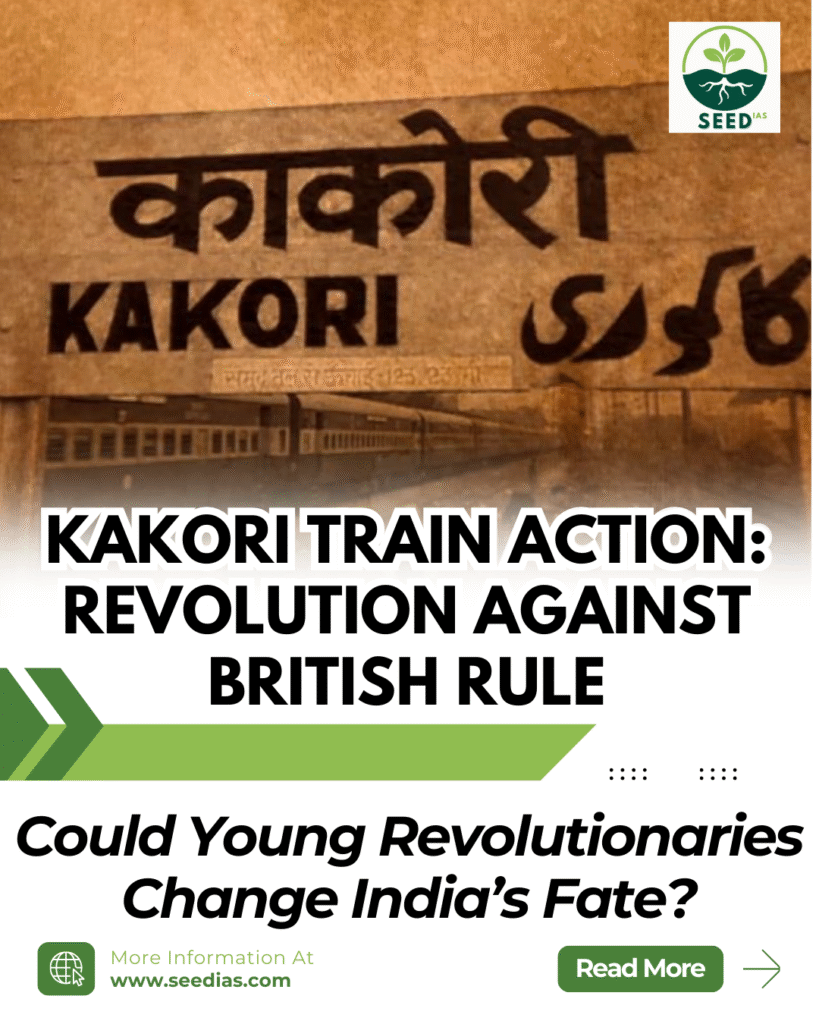
The Kakori Train Action, carried out in August 1925 near Kakori village close to Lucknow, remains a significant milestone in India’s fight against British colonial rule.
Key Terms / Concepts
| Term | Definition |
|---|---|
| Kakori Train Action | A revolutionary act on 9th August 1925 where Indian revolutionaries looted government treasury on the Number 8 Down train from Shahjahanpur to Lucknow to fund freedom struggle activities. |
| Hindustan Republican Association (HRA) | Revolutionary organization founded in 1924 aiming to establish a federal Republic of India through armed struggle. |
| Hindustan Socialist Republican Association (HSRA) | Successor to HRA from 1928, adopting socialism and collective leadership, with prominent revolutionaries like Bhagat Singh and Sukhdev. |
| Krantikari Manifesto | HRA’s manifesto released on 1st January 1925, advocating revolution against British rule. |
Kakori Train Action Details
| Aspect | Details |
|---|---|
| Date & Place | 9th August 1925, near Kakori village, Lucknow. |
| Objective | Seize British government funds to support revolutionary activities. |
| Revolutionaries Involved | Ram Prasad Bismil, Ashfaqullah Khan, Rajendra Lahiri, Keshav Chakraborty, Mukundi Lal, Banwari Lal, Chandrashekhar Azad. |
| British Response | Crackdown led to arrests; 17 jailed, 4 transported for life, 4 hanged (Bismil, Ashfaqullah, Roshan Singh, Rajendra Lahiri). Chandrashekhar Azad escaped. |
| Significance | Demonstrated youth-led revolutionary nationalism and highlighted armed resistance as an alternative to non-violent struggle. |
Hindustan Republican Association (HRA)
| Aspect | Details |
|---|---|
| Foundation | Formed in October 1924 in Kanpur by Ram Prasad Bismil, Jogesh Chandra Chatterjee, Sachin Sanyal. |
| Ideology | Advocated federal republic through organized revolution; used violence only as retaliation. |
| Krantikari Manifesto | Released on 1st January 1925, outlined HRA’s revolutionary objectives. |
Transition to HSRA
| Aspect | Details |
|---|---|
| Renaming | 1928, under Chandrashekhar Azad, HRA became HSRA. |
| Leadership & Members | Included Bhagat Singh, Sukhdev, Bhagwati Charan Vohra, Bejoy Kumar Sinha, Shiv Verma, Jaidev Kapur. |
| Key Actions | Anti-Simon Commission protests (1927), assassination of JP Saunders (1928), Viceroy Irwin train bombing (1929). |
| Ideology | Adopted socialism and collective leadership. |
| Outcome | British crackdowns in the 1930s fragmented the organization. |
In a nutshell
The Kakori Train Action symbolized bold, youth-led revolutionary resistance against British colonialism. The HRA/HSRA combined nationalist fervor with socialist ideals, providing an alternative to the non-violent struggle, and inspired future generations of revolutionaries.
Prelims Questions
- Who among the following revolutionaries participated in the Kakori Train Action?
A) Bhagat Singh
B) Rajendra Lahiri
C) Subhas Chandra Bose
D) Sukhdev - The HRA was renamed as HSRA in:
A) 1925
B) 1928
C) 1930
D) 1922 - The main objective of the Kakori Train Action was to:
A) Attack British officials
B) Seize government funds for revolutionary activities
C) Protest the Simon Commission
D) Assassinate Viceroy Irwin
Mains Questions
- Examine the significance of the Kakori Train Action in India’s revolutionary movement against British rule. 10 Marks
- Analyse the evolution of the Hindustan Republican Association into the HSRA and its role in linking revolutionary nationalism with socialist ideals. 15 Marks
Prelims Answers & Explanation
| Q.No | Answer | Explanation |
|---|---|---|
| 1 | B | Rajendra Lahiri was one of the key participants in the Kakori Train Action. |
| 2 | B | HRA was renamed as HSRA in 1928 under Chandrashekhar Azad’s leadership. |
| 3 | B | The Kakori Train Action aimed to seize British treasury funds to support revolutionary activities. |