Context of the News
As India approaches the centenary (2027) of the Mahad Satyagraha (1927), there is a growing call to recognise its role in shaping the ideals of equality, dignity, and constitutional rights.
Background
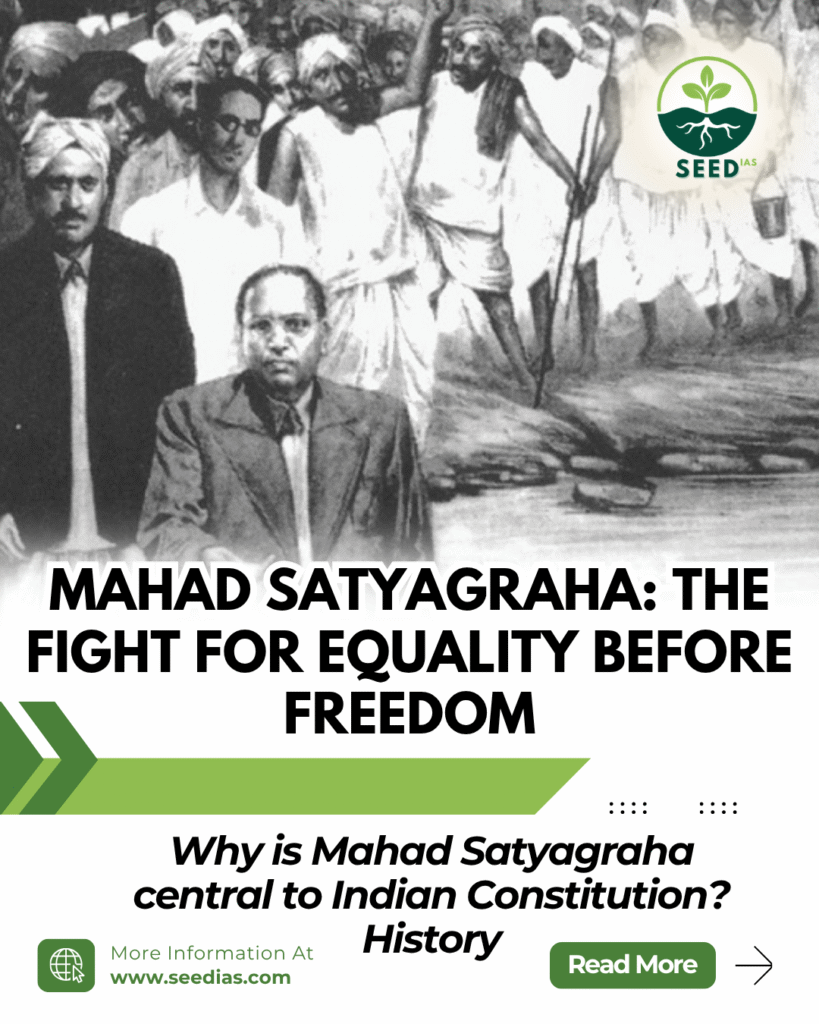
The Mahad Satyagraha, led by Dr. B.R. Ambedkar on March 20, 1927, was a landmark movement against untouchability, asserting the right of Dalits to access public water sources. Relevant for GS Paper I (Modern History) and GS Paper II (Polity – Fundamental Rights).
News Breakdown
What was the Mahad Satyagraha?
- A mass movement led by Dr. B.R. Ambedkar
- Objective:
- To assert the right of untouchables to access public water
- Location:
- Chavdar Tank, Mahad (Maharashtra)
- Trigger:
- Despite legal permission (Bole Resolution, 1923), Dalits were denied access
Key Events
- Ambedkar led thousands to:
- Drink water from a public tank
- This was:
- A symbolic assertion of human dignity and equality
- Followed by:
- Violent backlash from upper castes
- “Purification” of tank by caste Hindus
Second Phase (December 1927)
- Ambedkar returned to Mahad
- Burned:
- Manusmriti
- Significance:
- Rejection of caste-based social order
Legal Battle
- Upper castes filed case:
- To restrict access to tank
- Final verdict:
- Bombay High Court (1937) upheld:
- Tank is public property
- Dalits have equal access rights
- Bombay High Court (1937) upheld:
Why is Mahad Satyagraha Important?
1. Assertion of Civil Rights
- Not against British rule, but:
- Against social discrimination within India
2. Foundation of Constitutional Values
- Inspired:
- Article 15:
- No discrimination in access to public spaces
- Article 17:
- Abolition of untouchability
- Article 15:
3. Social Reform vs Political Freedom
- Compared to:
- Salt Satyagraha (1930)
- Key Difference:
- Mahad:
- Fight against internal social injustice
- Dandi:
- Fight against colonial rule
- Mahad:
Mahad vs Dandi: Key Insight
- Dandi → Political freedom (Swaraj)
- Mahad → Social equality (dignity)
- Mahad addressed:
- Deep-rooted caste discrimination
Continuing Relevance
- Issues persist:
- Caste discrimination
- Manual scavenging
- Social exclusion
- Raises question:
- Has constitutional equality become reality?
Prelims Focus
- Bole Resolution (1923):
- Allowed Dalits access to public places
- Article 15(2):
- Access to wells, tanks, public spaces
- Article 17:
- Abolition of untouchability
- Manusmriti:
- Ancient text associated with caste hierarchy
Conclusion / Way Forward
The Mahad centenary must inspire social reform, dignity, and equality, ensuring constitutional promises translate into lived reality for all citizens.
Prelims Check
Question 1
With reference to Mahad Satyagraha, consider the following statements:
- It was led by Mahatma Gandhi.
- It was aimed at access to public water sources.
- It took place before the Salt Satyagraha.
Which of the statements given above is/are correct?
(a) 2 and 3 only
(b) 1 and 2 only
(c) 3 only
(d) 1, 2 and 3
Question 2
Consider the following statements:
- Article 17 abolishes untouchability.
- Article 15 prohibits discrimination in public spaces.
- Manusmriti promotes equality among all castes.
Which of the statements given above is/are correct?
(a) 1 and 2 only
(b) 2 only
(c) 1 and 3 only
(d) 1, 2 and 3
Question 3
Consider the following statements:
Statement-I: Mahad Satyagraha was a movement against social discrimination.
Statement-II: It directly influenced constitutional provisions on equality.
Which one of the following is correct?
(a) Both Statement-I and Statement-II are correct and Statement-II explains Statement-I
(b) Both Statement-I and Statement-II are correct but Statement-II does not explain Statement-I
(c) Statement-I is correct, but Statement-II is incorrect
(d) Statement-I is incorrect, but Statement-II is correct
Answers with Explanation
Q1: (a) 2 and 3 only
- Led by Ambedkar → Statement 1 incorrect
- Water access → Correct
- Before Dandi → Correct
Q2: (a) 1 and 2 only - Article 17 → Correct
- Article 15 → Correct
- Manusmriti supports hierarchy → Statement 3 incorrect
Q3: (a) Both correct, Statement-II explains Statement-I - Movement shaped equality provisions
“True freedom is not just freedom from rulers, but freedom from discrimination.”