Why in NEWS
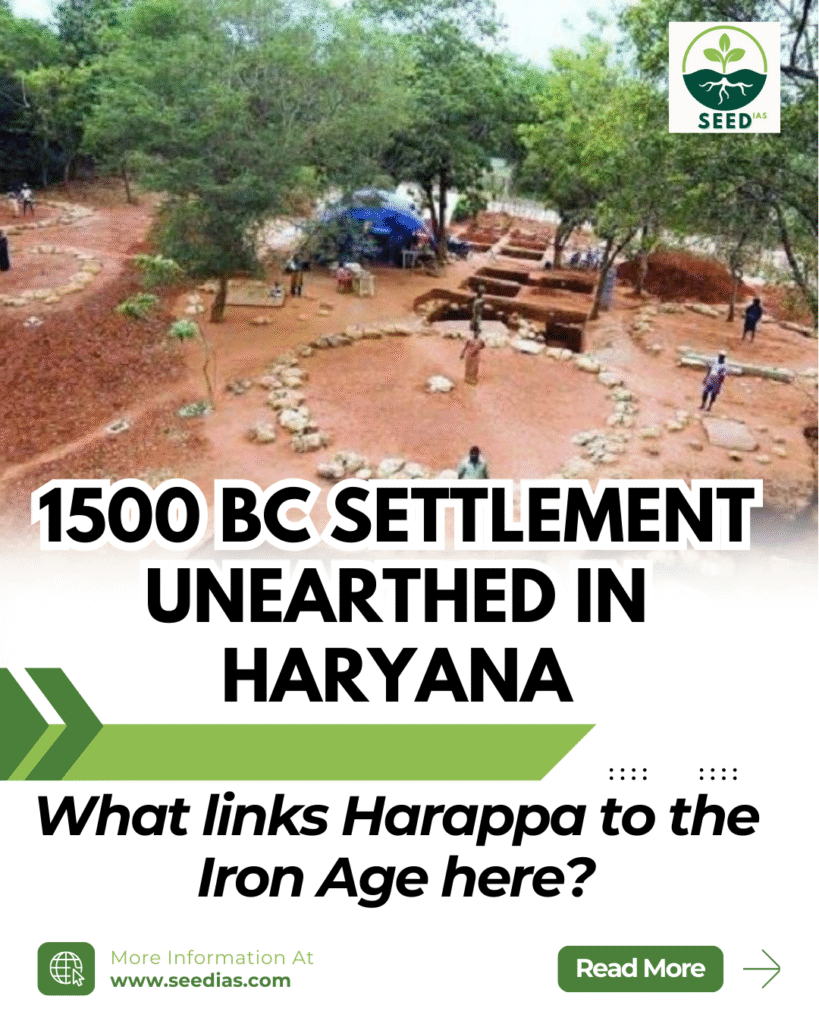
Evidence of human settlements dating back to around 1500 BC has been found at Topra Kalan village, Haryana, marking the transitional phase from the Indus Valley Civilization (Bronze Age: 3300–1300 BC) to the Iron Age in India (1500–600 BC).
Key Terms and Concepts
| Term | Explanation |
|---|---|
| Painted Grey Ware (PGW) | Grey pottery with black geometric designs, linked to early Iron Age North India. |
| Black-and-Red Ware (BRW) | Pottery with black interiors and red exteriors, produced using inverted firing techniques. |
| Northern Black Polished Ware (NBPW) | Fine, wheel-made, glossy black pottery, associated with the Second Urbanization (700–100 BC). |
| Second Urbanization | A phase marked by the growth of states and towns in the Ganga valley, coinciding with Mauryan rule and Buddhism’s spread. |
Key Archaeological Evidences at Topra Kalan
| Evidence | Details |
|---|---|
| Historical Link | Original site of Delhi-Topra Ashokan pillar, linked to Buddhist activity recorded by Sir Alexander Cunningham and Hiuen Tsang. |
| Artifacts | PGW, BRW, stamped pottery, moulded bricks, beads, and other late Bronze Age–early Iron Age items. |
| Structures | Walls, platforms, room-like enclosures, and a dome-like structure believed to be a Buddhist stupa found at 4–5 m depth. |
Key Features of the Iron Age in India
| Feature | Details |
|---|---|
| Period | Followed the Bronze Age, marked by the widespread use of iron for tools and weapons. |
| Technology | Involved ore collection, smelting, and forging. |
| Literary References | Rigveda’s “ayas” referred to copper/alloys; Atharvaveda’s “ayas/karshnyas” indicated iron; later Buddhist texts and Arthashastra show expanded iron use. |

Associated Cultures
| Region | Culture | Characteristics |
|---|---|---|
| North India | BRW | Black interior, red exterior pottery; found in Harappan, Pre-PGW, and southern Megalithic contexts. |
| North India | PGW | Grey pottery with black geometric designs; iron artifacts found in Ganga valley sites. |
| North India | NBPW | Highly polished black pottery, linked to urban growth and state formation in 700–100 BC. |
| South India | Megalithic | Sites like Naikund (iron-smelting furnaces) and Paiyampalli (iron slag); Sivagalai shows possible iron use from 4th millennium BCE. |
| Central India | Malwa | Sites like Nagda, Eran, Ahar (750–500 BCE). |
| Middle & Lower Ganga Valley | Post-Chalcolithic | Sites like Pandu Rajar Dhibi, Mahisdal, Chirand, Sonpur (750–700 BCE). |
In a Nutshell
Memory Code – “TPG-BIN”
Topra
PGW
Ganga valley
BRW
Iron
NBPW
Prelims Practice Questions
- Which culture is associated with highly polished black pottery in ancient India?
a) Painted Grey Ware
b) Black-and-Red Ware
c) Northern Black Polished Ware
d) Ochre Coloured Pottery - Topra Kalan is historically significant because:
a) It was a major Harappan trade hub
b) It housed the original site of the Ashokan pillar relocated by Firoz Shah Tughlaq
c) It was a Mauryan capital
d) It was a Megalithic burial site - The BRW pottery style is characterized by:
a) Red interiors and black exteriors
b) Grey surfaces with black designs
c) Black interiors and red exteriors
d) Ochre colouring and painted motifs
Mains Practice Questions
- Discuss the significance of the Topra Kalan archaeological findings in understanding the transition from the Bronze Age to the Iron Age in India. 10 Marks
- Examine the role of pottery traditions like BRW, PGW, and NBPW in tracing cultural and technological developments in ancient India. 10 Marks
Prelims Answers & Explanations
| Q No. | Answer | Explanation |
|---|---|---|
| 1 | c | NBPW is known for its fine, wheel-made, highly polished black pottery. |
| 2 | b | Topra Kalan was the original site of the Delhi-Topra Ashokan pillar. |
| 3 | c | BRW pottery is made with black interiors and red exteriors using inverted firing. |