CONTEXT OF THE NEWS
The India Meteorological Department (IMD) has released its Summer Forecast (April–June 2026), predicting a rise in heatwave days and higher night temperatures across India.
BACKGROUND
- India has witnessed increasing frequency and intensity of heatwaves in recent years.
- Climate variability, especially El Niño, plays a key role in shaping summer and monsoon patterns.
- Heatwaves are becoming a major public health and economic concern, though they are not officially classified as disasters under the Disaster Management Act, 2005.
NEWS BREAKDOWN
A heatwave is a period of abnormally high temperatures compared to normal climatic conditions.
Key Highlights of IMD Forecast 2026
- Heatwave Trend
- India likely to witness above-normal heatwave days
- Most affected regions:
- East India
- Central India
- Northwest India
- Southeast Peninsula
- Temperature Pattern
- Above-normal temperatures expected in:
- East & Northeast India
- Eastern Central India
- Adjoining Peninsular regions
- Normal to below-normal temperatures in other regions
- Above-normal temperatures expected in:
- North India Exception
- Likely to experience a cooler-than-normal summer
- Indicates regional variation in climate patterns
- Heatwave-Prone Areas (April Focus)
- Odisha, West Bengal, Tamil Nadu, Puducherry
- Parts of:
- Andhra Pradesh
- Gujarat
- Maharashtra
- Karnataka
- Western Disturbances
- Expected 12% above-normal rainfall in April
- Due to higher frequency of western disturbances
- Leads to:
- Moderated temperatures
- Increased rainfall
- El Niño Concern
- Possible development by July 2026
- Impacts:
- Weakens monsoon winds
- Reduces rainfall
- May delay or weaken monsoon onset
WHAT ARE HEAT WAVES?
- A heat wave is a prolonged period of unusually high temperatures.
- Occurs mainly between March and June (peak in May).
- Not classified as a natural disaster under Indian law.
IMD CRITERIA FOR DECLARING HEAT WAVES
Based on Temperature Thresholds
| Region | Heat Wave Criteria |
| Plains | ≥ 40°C |
| Hilly Areas | ≥ 30°C |
| Coastal Areas | Departure ≥ 4.5°C & temp ≥ 37°C |
Based on Departure from Normal
- Heat Wave: 4.5°C to 6.4°C above normal
- Severe Heat Wave: > 6.4°C above normal
Based on Absolute Temperature
- Heat Wave: ≥ 45°C
- Severe Heat Wave: ≥ 47°C
Spatial Condition
- Must occur in at least 2 stations
- For 2 consecutive days
FACTORS CAUSING HEAT WAVES
Geographical Factors
- Latitude Effect
- Areas near Tropic of Cancer receive intense solar radiation
- Terrain & Soil
- Rocky surfaces & black soils retain heat longer
- Distance from Water
- Landlocked regions face higher heat due to lack of cooling
- Urban Heat Island Effect
- Cities trap heat due to:
- Concrete structures
- Less vegetation
- Cities trap heat due to:
Climatic Factors
- Low Moisture & Cloud Cover
- Reduces cooling and increases solar heating
- Wind & Pressure Systems
- High-pressure systems trap heat
- Weak winds prevent heat dispersion
- Global Phenomena
- El Niño
- Reduces rainfall
- Increases heatwave probability
- El Niño
- Regional Winds
- Loo: Hot, dry wind increasing temperatures in North India
IMPACTS OF HEATWAVES
- Public Health Crisis
- Heatstroke, dehydration, cardiovascular stress
- 733 deaths reported (Heat Watch 2024)
- Agricultural Stress
- Reduced yield of Rabi crops (e.g., wheat)
- Affects Punjab & Haryana
- Water Scarcity
- Increased evaporation
- Depletion of groundwater & reservoirs
- Economic Loss
- Reduced labor productivity
- Increased power demand
- Environmental Impact
- Over 36% forest cover prone to fires
- Increased forest fire incidents
INDIA’S INITIATIVES TO TACKLE HEAT WAVES
- Heat Action Plans (HAPs)
- State-level strategies for heat mitigation
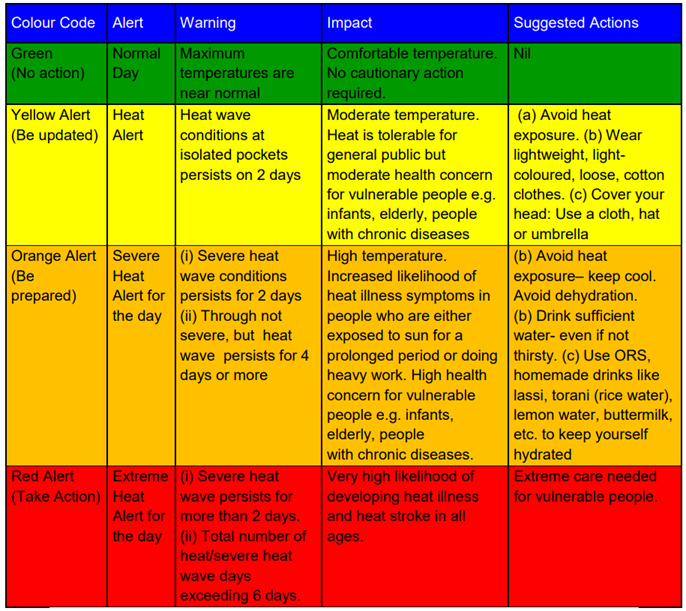
- IMD Warning System
- Colour-coded alerts for early warning
- Jal Shakti Abhiyan
- Focus on water conservation
- Smart Cities Mission
- Promotes green spaces & climate resilience
- Cool Roof Initiatives
- Reflective materials reduce indoor heat
PRELIMS FOCUS
- Heatwaves are not included under the Disaster Management Act, 2005
- El Niño leads to:
- Reduced rainfall
- Increased temperatures
- Western Disturbances bring:
- Winter & pre-monsoon rainfall in North India
- Loo winds are:
- Hot, dry winds blowing over Northwest India
- Heatwave declaration requires:
- 2 stations + 2 consecutive days
CONCLUSION / WAY FORWARD
India must strengthen early warning systems, urban planning, and climate adaptation strategies to reduce heatwave risks and protect vulnerable populations.
PRELIMS CHECK
Question 1
Consider the following statements regarding heatwaves in India:
- Heatwaves are classified as natural disasters under the Disaster Management Act, 2005.
- Heatwave declaration requires conditions to be met at least in two stations for two consecutive days.
Which of the statements given above is/are correct?
(a) 1 only
(b) 2 only
(c) Both 1 and 2
(d) Neither 1 nor 2
Question 2
With reference to El Niño, consider the following statements:
- It leads to increased rainfall over India.
- It weakens monsoon winds.
Which of the statements given above is/are correct?
(a) 1 only
(b) 2 only
(c) Both 1 and 2
(d) Neither 1 nor 2
Question 3
Consider the following factors contributing to heatwaves:
- Urban heat island effect
- High-pressure systems
- Increased cloud cover
How many of the above are correct?
(a) Only one
(b) Only two
(c) All three
(d) None
ANSWERS WITH EXPLANATION
Answer 1: (b) 2 only
- Heatwaves are not classified as disasters.
- IMD requires 2 stations + 2 days criteria.
Answer 2: (b) 2 only
- El Niño reduces rainfall, not increases.
- It weakens monsoon winds.
Answer 3: (b) Only two
- Urban heat island and high-pressure systems increase heat.
- Increased cloud cover actually reduces heat.
“Prepared minds see opportunity even in rising heat—adapt, learn, and stay ahead.”