Why in News?
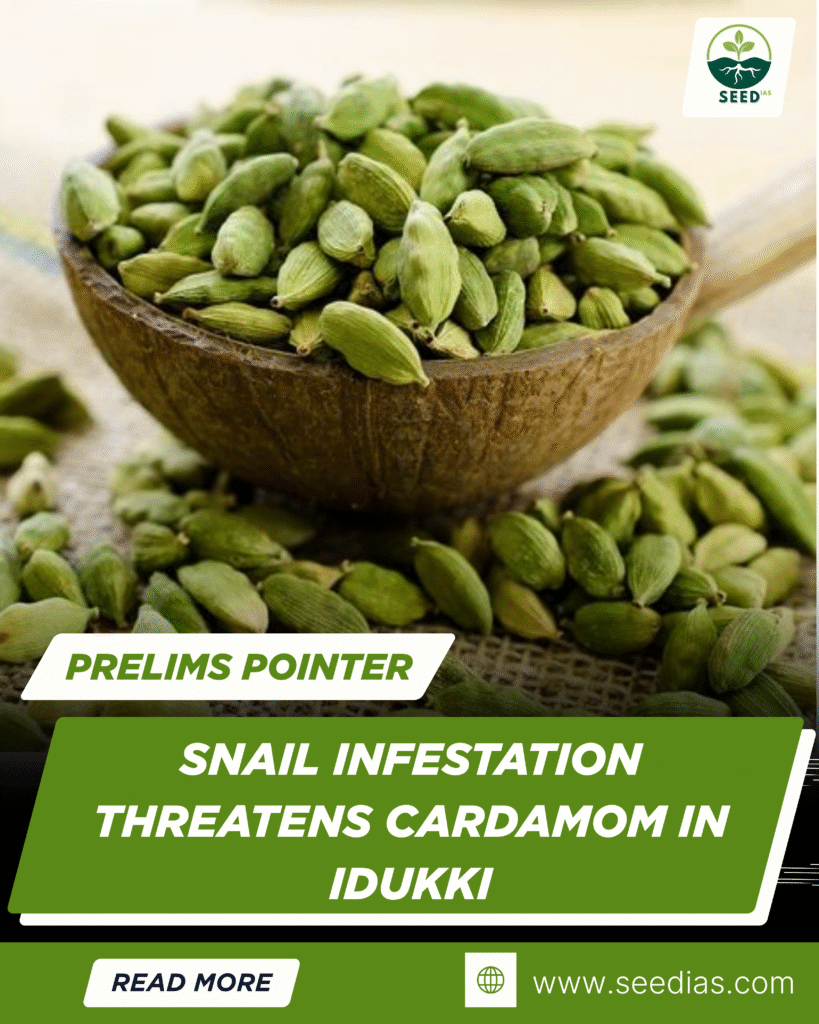
Heavy summer rains in Idukki, Kerala, have triggered snail infestations in cardamom plantations, threatening crop health, yield, and quality.
Key Concepts & Definitions
| Term | Definition |
|---|---|
| Cardamom (Elettaria cardamomum) | A premium spice known as the “Queen of Spices,” native to the Western Ghats and part of the ginger family. |
| Metaldehyde | A molluscicide (chemical pesticide) used to control snail populations, often applied as a last resort. |
| Panicles | Branching flower clusters in plants like cardamom, critical for seed/spice development. |
Cardamom & the Snail Threat: What’s Happening?
| Aspect | Details |
|---|---|
| Issue | Post-rainy season, snail populations have surged in Idukki, feeding on tender plant parts like panicles, flowers, and capsules. |
| Impact | Crop damage, yield reduction, and decline in spice quality—especially severe in smallholder farms. |
| Response | Farmers apply chemical molluscicides like metaldehyde, though concerns remain over soil and residue safety. |
Cardamom: Geography, Growth, and Varieties
| Parameter | Details |
|---|---|
| Climatic Needs | Rainfall: 1500–4000 mm; Temperature: 10–35°C; Altitude: 600–1500 m. |
| Soil | Humus-rich, acidic loamy soils (pH 5.0–6.5). |
| Top Producer | Kerala (58%), mainly Idukki district. Also grown in Karnataka (Kodagu, Chikmagalur) and Tamil Nadu (Nilgiris). |
| New Varieties | Elettaria facifera (Periyar, Idukki) and Elettaria tulipifera (Agasthyamalai & Munnar). |
India’s Spices Market at a Glance
| Aspect | Details |
|---|---|
| Total Output (2022–23) | 11.14 million tonnes of spices across 75 out of 109 ISO-classified varieties. |
| Top Crops | Chilli, cumin, turmeric, ginger, coriander (76% of total). |
| Top Producing States | MP, Rajasthan, Gujarat, Andhra Pradesh. |
| Exports (2023–24) | ~14 lakh tonnes; Chilli was 31% of total exports. |
| Top Export Markets | China, Bangladesh, West Asia, USA. |
In a Nutshell (Mnemonic)
“C.A.R.D.A.M.O.M.”
- C – Climatic needs (rain, cool temps)
- A – Affected by snails post-rains
- R – Rich soils with acidic pH
- D – District of Idukki leads production
- A – Aromatic spice in ginger family
- M – Metaldehyde used for pest control
- O – Output high in Kerala, Karnataka
- M – Market includes new rare varieties
Prelims Practice Questions
- Which district is the leading producer of cardamom in India?
A) Nilgiris
B) Idukki
C) Kodagu
D) Chikmagalur - Which of the following is not a climatic requirement for cardamom cultivation?
A) Rainfall of 1500–4000 mm
B) Altitude below 100 m
C) Temperature between 10°C to 35°C
D) Acidic loamy soil - What is metaldehyde used for in agriculture?
A) Fungicide
B) Fertilizer
C) Molluscicide
D) Herbicide
Prelims Answers & Explanations
| Qn | Answer | Explanation |
|---|---|---|
| 1 | B | Idukki in Kerala contributes the most to cardamom production. |
| 2 | B | Cardamom is a high-altitude crop (600–1500 m). Below 100 m is unsuitable. |
| 3 | C | Metaldehyde is a molluscicide used to kill snails/slugs. |