CONTEXT OF THE NEWS
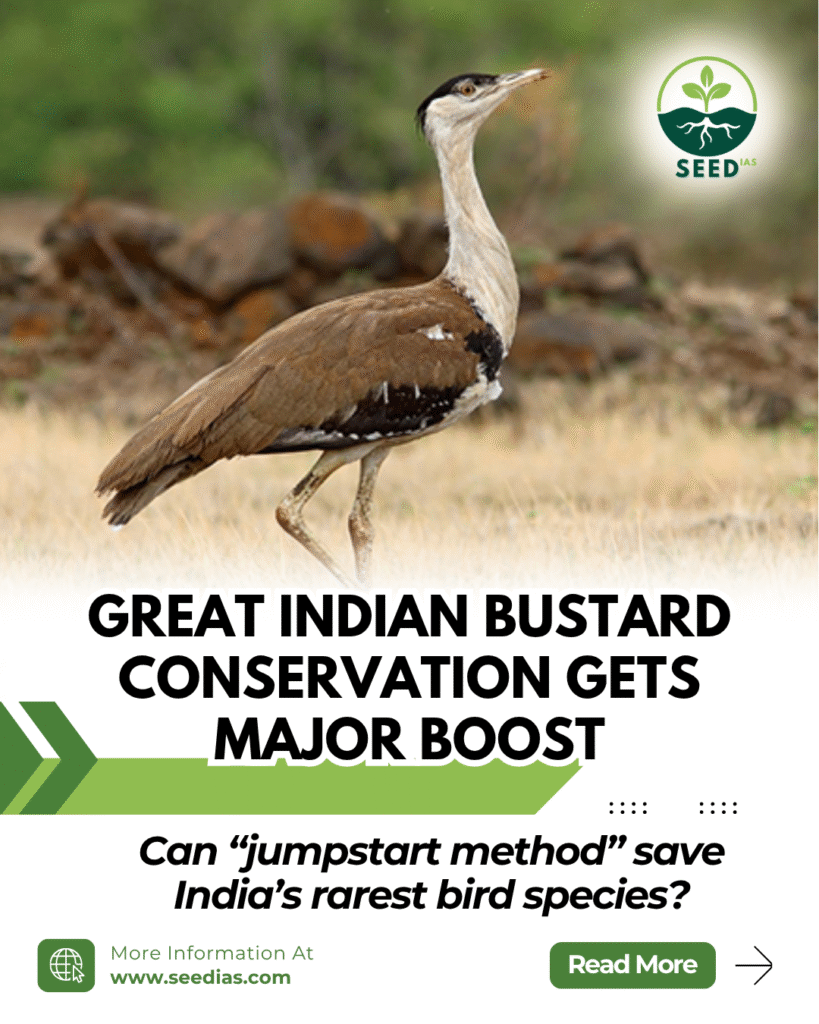
A Great Indian Bustard (GIB) chick was successfully hatched in Gujarat’s Kutch using the innovative “jumpstart approach”, marking a first-of-its-kind conservation milestone in India.
BACKGROUND
- GIB is among the most critically endangered birds in India
- Conservation linked to:
- GS Paper 3 (Environment & Biodiversity)
- Efforts under:
- Project Great Indian Bustard (2016)
NEWS BREAKDOWN
What is the “Jumpstart Approach”?
Jumpstart Approach: A conservation technique where a fertile egg from a captive breeding center is placed in a wild bird’s nest for natural incubation.
Key Features of the Approach
- Combines:
- Captive breeding + wild nurturing
- Ensures:
- Higher survival rates
- Better adaptation to natural habitat
- First inter-state collaboration:
- Rajasthan + Gujarat + Wildlife Institute of India
ABOUT GREAT INDIAN BUSTARD (GIB)
Basic Facts
- Scientific Nature: Large terrestrial bird
- One of the heaviest flying birds in the world
- State Bird of Rajasthan
Distribution
- Mainly found in:
- Thar Desert (Rajasthan)
- Also present in:
- Gujarat
- Maharashtra
- Karnataka
- Andhra Pradesh
Bustard Species in India (COMPARISON)
| Species | Region |
|---|---|
| Great Indian Bustard | Rajasthan (Thar Desert) |
| Lesser Florican | Grasslands of western India |
| Bengal Florican | Terai grasslands |
| Macqueen’s Bustard | Migratory (NW India) |
Ecological Role
Indicator Species: Species whose presence reflects the health of an ecosystem.
- GIB indicates:
- Healthy grassland ecosystems
- Decline signals:
- Grassland degradation
PROTECTION STATUS
| Convention / Law | Status |
|---|---|
| IUCN Red List | Critically Endangered |
| CITES | Appendix I |
| CMS | Appendix I |
| Wildlife Protection Act, 1972 | Schedule I |
KEY THREATS
1. Habitat Loss
- Due to:
- Agriculture expansion
- Mining
- Infrastructure development
2. Power Line Collisions (MOST CRITICAL)
- Cause:
- Poor frontal vision
- Leads to:
- High adult mortality
3. Human Disturbance
- Encroachment into:
- Grasslands
CONSERVATION EFFORTS
1. Project Great Indian Bustard (2016)
- Aim:
- Increase population
- Protect habitats
- Measures:
- Breeding enclosures
- Habitat restoration
2. Integrated Development of Wildlife Habitats
- Focus:
- Financial and technical support
3. Technological & Policy Measures
- Undergrounding:
- Power lines in GIB habitats
- Monitoring:
- Satellite tracking
SIGNIFICANCE OF THE DEVELOPMENT
- First successful:
- Wild-assisted hatching through jumpstart method
- Demonstrates:
- Innovative conservation strategy
- Strengthens:
- Inter-state cooperation
PRELIMS FOCUS
- GIB = Critically Endangered
- Habitat = Grasslands (Thar Desert)
- Major threat = Power line collision
- Project GIB = 2016
- Indicator species = Ecosystem health marker
- Bustard species in India = 4
CONCLUSION
Innovative methods like the jumpstart approach, combined with habitat protection and policy support, are crucial for reviving the Great Indian Bustard population.
PRELIMS CHECK
Question 1
Consider the following statements:
- Great Indian Bustard is a critically endangered species.
- It is primarily found in forest ecosystems.
- Power line collisions are a major cause of its mortality.
Which of the statements given above are correct?
(a) 1 and 3 only
(b) 2 and 3 only
(c) 1 and 2 only
(d) 1, 2 and 3
Question 2
With reference to bustard species in India, consider the following:
- Lesser Florican
- Bengal Florican
- Macqueen’s Bustard
- Great Indian Bustard
How many of the above are found in India?
(a) Only two
(b) Only three
(c) All four
(d) None
Question 3
Consider the following pairs:
| Term | Description |
|---|---|
| 1. Indicator Species | Reflect ecosystem health |
| 2. CITES Appendix I | Trade allowed without restriction |
| 3. CMS Appendix I | Species requiring strict protection |
How many of the pairs given above are correctly matched?
(a) Only one
(b) Only two
(c) All three
(d) None
ANSWERS WITH EXPLANATION
Answer 1: (a) 1 and 3 only
- Critically endangered – Correct
- Found in grasslands, not forests – Incorrect
- Power lines major threat – Correct
Answer 2: (c) All four
- All four bustard species are found in India – Correct
Answer 3: (b) Only two
- Indicator species – Correct
- CITES Appendix I = strictly restricted trade – Incorrect
- CMS Appendix I – Strict protection – Correct
“Saving one species is not just conservation—it is preserving the balance of life itself.”