Context of the News
India is witnessing growing concerns over the sale of nicotine pouches, with the Tamil Nadu Directorate of Drugs Control (DDC) issuing alerts against their illegal online sale and consumption.
Background
Nicotine pouches are a new tobacco-free nicotine product gaining popularity worldwide. Health experts warn that despite being marketed as alternatives to tobacco, they can cause strong nicotine addiction and health risks.
From a UPSC perspective, this issue relates to:
- Public Health Policy
- Regulation of Drugs and Addictive Substances
- Tobacco Control Frameworks in India
NEWS BREAKDOWN
What are Nicotine Pouches?
Nicotine Pouches are small oral packets containing nicotine and flavouring agents that are placed between the gum and lip.
Standard Definition
Nicotine:
A highly addictive chemical compound naturally found in tobacco plants that stimulates the central nervous system and can cause dependency.
How Nicotine Pouches Work
- Small microfiber pouches containing:
- Nicotine
- Flavouring agents
- Other chemical additives
- Users place them between lip and gum
- Nicotine is absorbed through the mouth lining (buccal absorption)
Buccal Absorption:
Absorption of substances directly into the bloodstream through tissues inside the mouth.
Why Are Nicotine Pouches in News?
The Tamil Nadu Directorate of Drugs Control (DDC) recently issued a public alert.
Key actions taken:
- Issued show-cause notices to dealers
- Warned against online sale and distribution
- Directed businesses not to manufacture or stock these products
Authorities Directed the Following Entities:
- Manufacturers
- Retailers
- Distributors
- Hospitals
- Pharmacies
- Online marketplaces
to avoid selling or stocking nicotine pouches.
Key Concerns Raised by Experts
Health experts and anti-tobacco activists warn that nicotine pouches pose serious health risks.
Major Concerns
- Highly addictive due to nicotine content
- Easily accessible online
- Attractive flavours target youth
- Unregulated nicotine dosage
Health Risks
- Cardiovascular problems
- Gum diseases
- Nicotine poisoning in extreme cases
Experts emphasise that:
“Tobacco-free does not mean risk-free.”
High Nicotine Levels
A major concern is the nicotine concentration in these products.
| Product Type | Typical Nicotine Content |
|---|---|
| Nicotine replacement patches/tablets | ~2 mg |
| Some nicotine pouches | Up to 50 mg |
Higher nicotine content significantly increases addiction potential and health risks.
Global Regulatory Status
According to the US Centers for Disease Control (CDC)
- Nicotine pouches contain nicotine and flavouring chemicals
- They do not require spitting
- Absorbed through the gums and oral lining
According to the US Food and Drug Administration (FDA)
- Nicotine pouches are NOT approved as smoking cessation aids
Why Activists Demand a Ban
Anti-tobacco groups argue that nicotine pouches may create a new generation of nicotine addiction.
Key Reasons
- Appealing flavours attract youth
- Easy online availability
- Synthetic nicotine may bypass tobacco laws
- Could replace:
- Cigarettes
- Chewing tobacco
- E-cigarettes
Activists suggest:
- State-level bans
- Amendments to Public Health Acts
- Cyber monitoring of online platforms
PRELIMS FOCUS
Key Facts for UPSC
- Nicotine is a psychoactive stimulant.
- It affects the central nervous system and causes addiction.
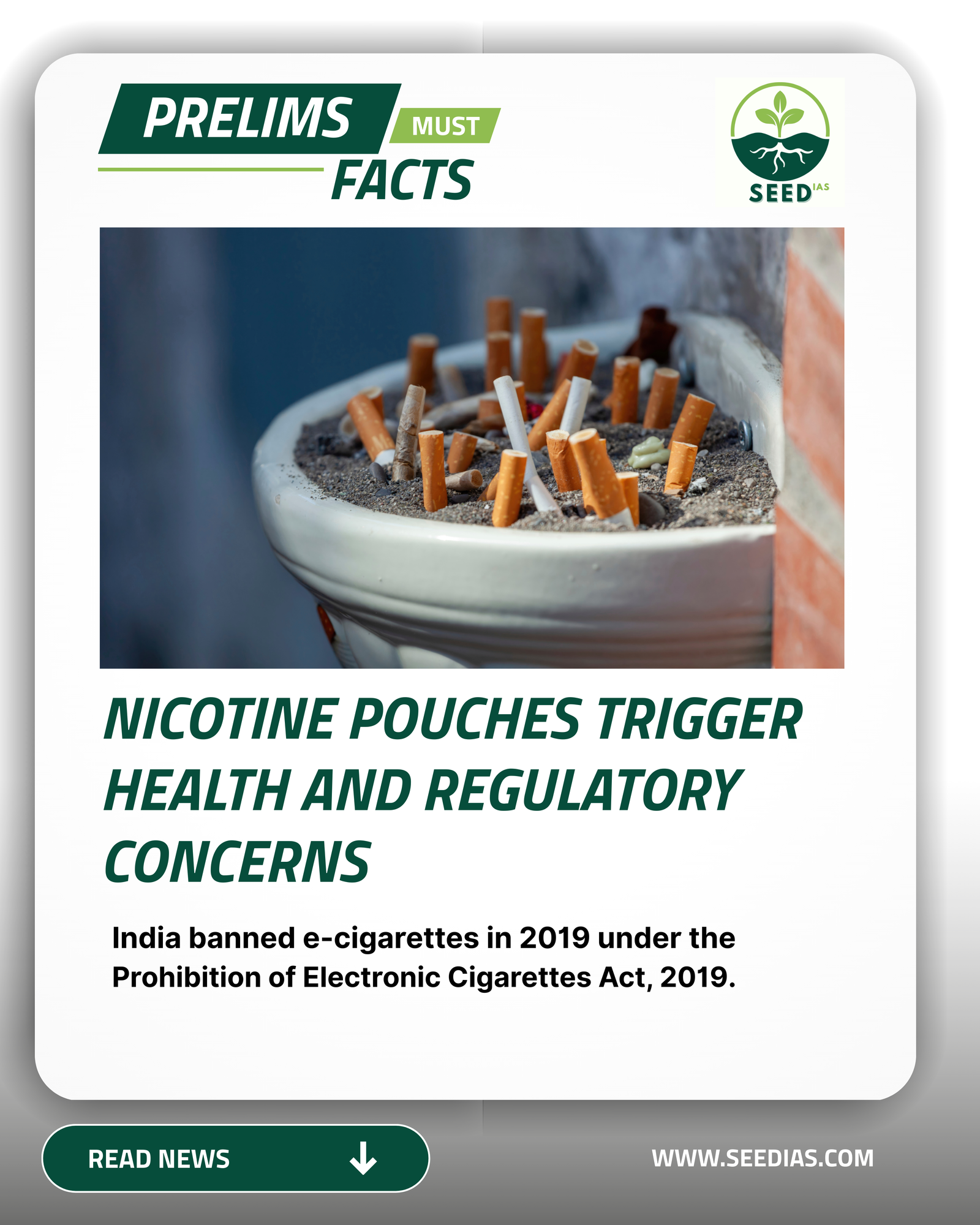
- India banned e-cigarettes in 2019 under the
Prohibition of Electronic Cigarettes Act, 2019. - Nicotine Replacement Therapy (NRT) products like patches and gums are allowed in regulated doses.
- Synthetic nicotine can be produced without tobacco plants, complicating regulation.
CONCLUSION / WAY FORWARD
India must strengthen regulatory frameworks, cyber monitoring and public awareness to prevent emerging nicotine products from triggering a new addiction epidemic.
PRELIMS CHECK
Question 1
With reference to Nicotine, consider the following statements:
- Nicotine is a naturally occurring compound found in tobacco plants.
- It stimulates the central nervous system and can cause addiction.
- Nicotine replacement therapies are completely banned in India.
Which of the statements given above are correct?
(a) 1 and 2 only
(b) 2 and 3 only
(c) 1 and 3 only
(d) 1, 2 and 3
Question 2
Which of the following statements regarding Nicotine Pouches is/are correct?
- They contain powdered nicotine and flavouring substances.
- They are approved globally as smoking cessation aids.
- Nicotine is absorbed through the lining of the mouth.
Select the correct answer using the code below:
(a) 1 and 2 only
(b) 1 and 3 only
(c) 2 and 3 only
(d) 1, 2 and 3
Question 3
Consider the following statements:
Statement I: India has banned electronic cigarettes under a specific legislation.
Statement II: The ban aims to prevent new nicotine addiction pathways, especially among youth.
Which one of the following is correct?
(a) Both Statement I and Statement II are correct and Statement II explains Statement I
(b) Both Statement I and Statement II are correct but Statement II does not explain Statement I
(c) Statement I is correct but Statement II is incorrect
(d) Statement I is incorrect but Statement II is correct
ANSWERS
1. Answer: (a) 1 and 2 only
Explanation:
- Nicotine is naturally present in tobacco plants.
- It stimulates the central nervous system and causes addiction.
- Nicotine replacement therapy such as patches and gums are allowed, not banned.
2. Answer: (b) 1 and 3 only
Explanation:
- Nicotine pouches contain nicotine powder and flavouring chemicals.
- They are not approved globally as smoking cessation aids.
- Nicotine is absorbed through the oral lining and gums.
3. Answer: (a)
Explanation:
- India banned e-cigarettes through the Prohibition of Electronic Cigarettes Act, 2019.
- The law aims to prevent youth addiction and emerging nicotine delivery systems.
- Hence Statement II correctly explains Statement I.
“Success in the UPSC exam is not about speed, but about consistent understanding of issues that shape society.”