Context of the News
India and Nepal have signed a Memorandum of Understanding (MoU) to strengthen cooperation in forests, wildlife, biodiversity conservation, and climate change, as announced by PIB.
Background
India and Nepal share the ecologically sensitive Terai Arc Landscape, home to many migratory and endangered species.
News Breakdown
Key Definitions
Memorandum of Understanding (MoU):
A formal agreement between two or more parties expressing intent to cooperate on specified areas.
Transboundary Conservation:
Conservation of ecosystems and wildlife that extend across international borders through coordinated management.
Landscape-Level Conservation:
An approach that manages biodiversity across large ecological regions rather than isolated protected areas.
What the India–Nepal MoU Provides
The agreement aims to deepen bilateral cooperation in environmental sectors.
Major focus areas:
- Forests management
- Wildlife protection
- Biodiversity conservation
- Climate change cooperation
Landscape-Level Biodiversity Conservation
The MoU emphasises protecting species that move across borders.
Priority species identified:
- Asian Elephant
- Gangetic Dolphin
- One-horned Rhinoceros
- Snow Leopard
- Tiger
- Vultures
Why this matters:
Focus on Transboundary Ecosystems
Both countries agreed to strengthen coordination in shared ecological regions.
Key actions:
- Restore wildlife corridors
- Interlink protected areas
- Improve habitat connectivity
- Joint monitoring mechanisms
Important India–Nepal Wildlife Linkages
| Corridor/Linkage | Connects | Location Significance |
|---|---|---|
| Khata Corridor | Bardia National Park (Nepal) – Katarniaghat Wildlife Sanctuary (India) | Part of Terai Arc Landscape |
| Valmiki–Chitwan Linkage | Valmiki Tiger Reserve (India) – Chitwan National Park & Parsa Wildlife Reserve (Nepal) | Critical tiger habitat |
Exam Tip: Terai Arc Landscape is a favourite UPSC mapping area.
Combating Wildlife Crime
A major pillar of the MoU is tackling illegal wildlife trade.
Measures proposed:
- Capacity building of frontline forest staff
- Intelligence sharing
- Coordinated enforcement
- Joint training programmes
Major poaching threats mentioned:
- Rhino horn trade
- Tiger body parts trafficking
- Elephant ivory (tusks) trade
Commitment to Multilateral Environmental Agreements
India and Nepal reaffirmed cooperation under global frameworks.
Both countries are parties to:
- International Big Cat Alliance (IBCA)
- Convention on Biological Diversity (CBD), 1992
- Convention on International Trade in Endangered Species (CITES), 1973
Prelims Focus
High-Value Facts
- The MoU is between India’s MoEFCC and Nepal’s Ministry of Forests and Environment.
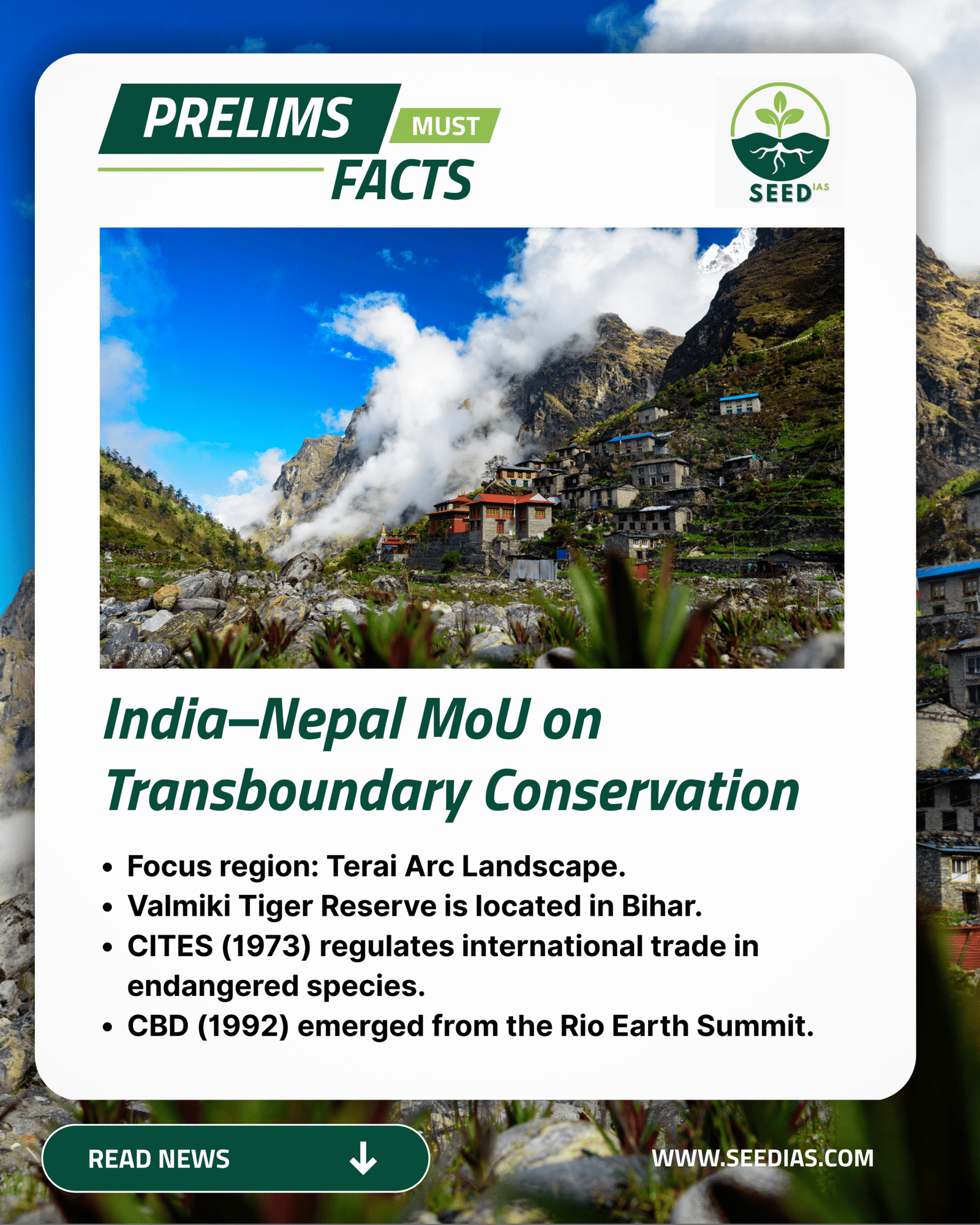
- Focus region: Terai Arc Landscape.
- Khata Corridor links Bardia NP (Nepal) with Katarniaghat WLS (India).
- Valmiki Tiger Reserve is located in Bihar.
- CITES (1973) regulates international trade in endangered species.
- CBD (1992) emerged from the Rio Earth Summit.
Conclusion / Way Forward
Strengthening India–Nepal transboundary conservation can secure migratory species, curb wildlife crime, and enhance regional ecological resilience through sustained institutional coordination.
Prelims Check
Question 1
With reference to the India–Nepal conservation cooperation, consider the following statements:
- The Khata Corridor connects Bardia National Park and Katarniaghat Wildlife Sanctuary.
- Valmiki Tiger Reserve is located in Uttar Pradesh.
- The MoU emphasises landscape-level biodiversity conservation.
Which of the statements given above is/are correct?
(a) 1 and 3 only
(b) 2 and 3 only
(c) 1 only
(d) 1, 2 and 3
Question 2
Which of the following species were specifically highlighted under the India–Nepal MoU?
- Snow Leopard
- Gangetic Dolphin
- Great Indian Bustard
- One-horned Rhinoceros
Select the correct answer using the code below:
(a) 1 and 2 only
(b) 1, 2 and 4 only
(c) 2 and 3 only
(d) 1, 3 and 4 only
Question 3
With reference to international environmental agreements, consider the following:
- CITES regulates international trade in endangered species.
- CBD was adopted during the Rio Earth Summit.
- International Big Cat Alliance is a legally binding UN treaty.
Which of the statements given above are correct?
(a) 1 and 2 only
(b) 2 and 3 only
(c) 1 only
(d) 1, 2 and 3
Answers with Explanation
Answer 1: (a) 1 and 3 only
- Statement 1 is correct: Khata Corridor links Bardia NP and Katarniaghat WLS.
- Statement 2 is incorrect: Valmiki Tiger Reserve is in Bihar, not Uttar Pradesh.
- Statement 3 is correct: Landscape-level conservation is a core focus.
Answer 2: (b) 1, 2 and 4 only
- Snow Leopard — included.
- Gangetic Dolphin — included.
- Great Indian Bustard — not mentioned in the MoU.
- One-horned Rhinoceros — included.
Answer 3: (a) 1 and 2 only
- Statement 1 is correct: CITES regulates wildlife trade.
- Statement 2 is correct: CBD emerged from the 1992 Rio Earth Summit.
- Statement 3 is incorrect: IBCA is an initiative, not a legally binding UN treaty.
“Conservation across borders is the only way to secure nature’s future.”