Why in News?
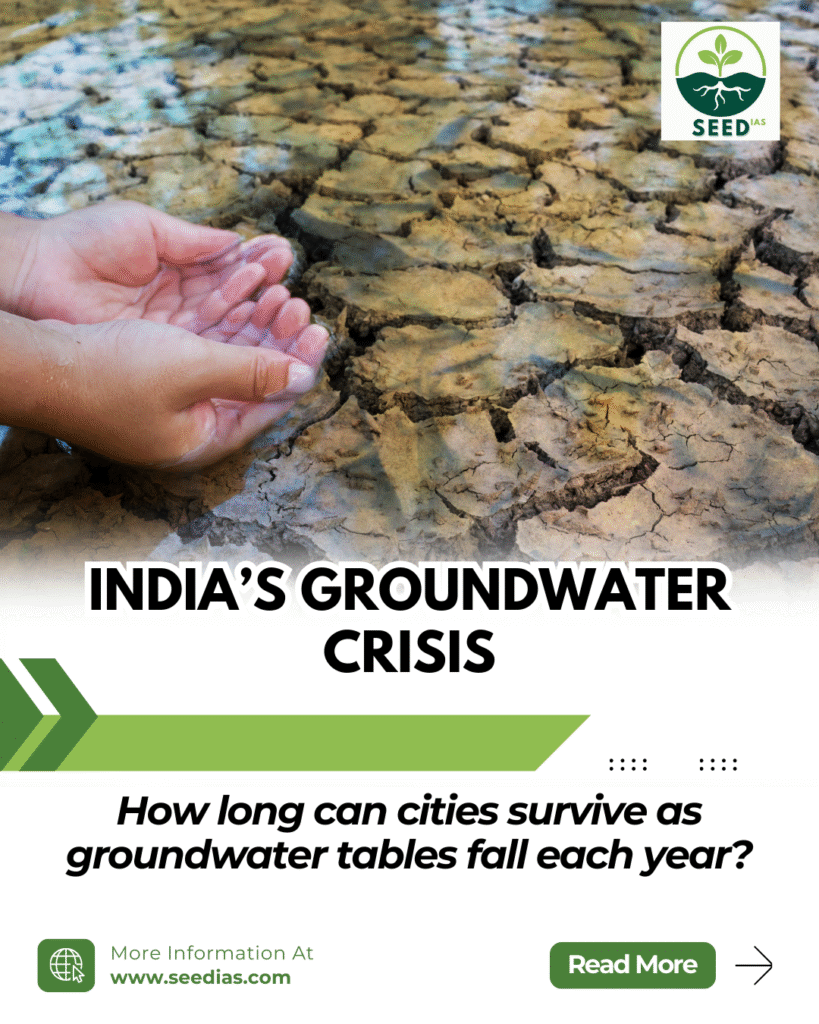
Groundwater remains the backbone of India’s water security, supporting agricultural production and drinking water needs. However, unsustainable extraction, declining quality, and climate-induced stresses have pushed aquifers to a critical stage, necessitating integrated, sustainable management.
Summary
- Groundwater provides 62% of irrigation, 85% of rural, and 50% of urban water needs.
- Over-extraction and contamination are worsening due to distorted incentives, urbanisation, climate change, and outdated laws.
- Government interventions include: Model Groundwater Bill, JSA: Catch the Rain, JSJB, NAQUIM 2.0, Atal Bhujal Yojana, Mission Amrit Sarovar, and enhanced monitoring networks.
Key Facts Regarding Groundwater in India
About Groundwater
- Groundwater refers to freshwater stored in aquifers, accounting for ~99% of Earth’s liquid freshwater (excluding ice).
- It enters through infiltration, is stored in geological formations, and is extracted via wells or emerges as springs.
Groundwater Dependency in India
- India is the world’s largest user of groundwater.
- Supports:
- 62% of irrigation
- 85% of rural drinking water
- 50% of urban water supply
Status of India’s Groundwater
- Annual extraction: 245.64 BCM
- Extraction rate: 60.47% — within replenishable limits but highly skewed by regions.
- Annual recharge: 446.90 BCM — steadily rising due to recharge structures and conservation.
Governance
- Water is a State subject, while the Centre provides technical and financial support.
- Integrated groundwater governance is vital to achieving SDGs 6, 11, and 12.
UNESCO’s 4 Priorities for Effective Groundwater Management
- Enhance knowledge & mapping of aquifers
- Strengthen governance and institutions
- Promote sustainable and inclusive utilisation
- Build resilience against climate change
Drivers of Groundwater Depletion in India
1. Distorted Economic & Policy Incentives
- Free electricity for agriculture → unregulated pumping
- MSP bias towards paddy & sugarcane → cropping patterns misaligned with hydrogeology
2. Demographic & Urban Pressures
- Expansion of impermeable surfaces in cities → suppressed natural recharge
- Industrial pumping → cones of depression; examples:
- Delhi & Chennai facing land subsidence
3. Climate Change
- Variable monsoon affects recharge (~60% recharge from SW monsoon)
- Higher temperatures → greater evapotranspiration → more water demand
4. Contamination
- Nitrate pollution from fertilisers
- Heavy metals from industries (e.g., Kanpur tanneries)
- Fluoride, arsenic in many regions
- Coastal areas face saline intrusion (e.g., 28/33 districts in coastal Gujarat)
5. Archaic Legal Framework
- Easements Act, 1882 treats groundwater as private property, hindering collective management.
6. Institutional Fragmentation
- CGWB, CPCB, SPCBs, Jal Shakti Ministry work in silos;
- Water Act (1974) barely addresses groundwater; enforcement is weak.
Government Initiatives and Achievements
1. Regulatory Framework
- Model Groundwater Bill (2017) – adopted by 21 States/UTs
- Coordination via National Interdepartmental Steering Committee (NISC)
2. Conservation Campaigns
- Jal Shakti Abhiyan – Catch the Rain
- Focus on rainwater harvesting, borewell rejuvenation, waterbody mapping
- Jal Sanchay Jan Bhagidari (JSJB)
- 39.6 lakh artificial recharge structures completed (as of Jan 2026)
3. Scientific Assessment
- NAQUIM & NAQUIM 2.0 – Panchayat-level aquifer maps + management plans
- Master Plan 2020 – 1.42 crore structures to add 185 BCM of recharge
4. Community-based Schemes
- Atal Bhujal Yojana – demand-side management in 7 stressed states
- Mission Amrit Sarovar – 1-acre ponds for recharge and storage
5. Monitoring & Surveillance
- 43,228 groundwater monitoring stations across India
Strategies for Effective Groundwater Management
1. Water-Smart Agriculture
- Drip/micro-irrigation, zero tillage, precision irrigation
- Convergence of PMKSY + Atal Bhujal Yojana for high-impact outcomes
2. Institutional Re-engineering
- Shift to aquifer-based governance (hydrogeological boundaries)
- Adopt Public Trust Doctrine
- Establish Aquifer Management Committees (AMCs) with regulatory powers
3. Digital Water Command System
- National IoT sensor grid for real-time:
- extraction
- levels
- quality
- Central AI platform “Bhu-Neer” for predictive analytics & enforcement
4. Financial Restructuring
- Replace free power with DBT-linked electricity subsidies + smart meters
- Groundwater Security Cess on industries
- Create Aquifer Recharge Fund for community incentives
5. Nature-based & Advanced Recharge Solutions
- Managed Aquifer Recharge (MAR) customised to terrain
- Solar desalination + MAR in coastal zones
- Biochar-based filters for agricultural runoff
- Mandatory RWH and wastewater recycling in urban areas
6. Building Climate Resilience
- Hydrogeology literacy at community level
- Simple Water Budgeting Tools for Gram Panchayats
- Promote millets and pulses through procurement reforms
- Link MGNREGS with aquifer recharge projects
Conclusion
Ensuring groundwater sustainability demands a three-pillar integrated approach:
- Policy Reforms – subsidy rationalisation, legal overhaul, aquifer-based regulation
- Technological Innovation – AI, IoT, real-time monitoring, digital command systems
- Community-led Action – participatory planning, local recharge structures, crop diversification
Together with climate-resilient strategies and strong intergovernmental coordination, India can transition from groundwater exploitation to groundwater security.
UPSC Civil Services Examination, Previous Year Question: Prelims
Q. Which one of the following ancient towns is well known for its elaborate system of water harvesting and management by building a series of dams and channelizing water into connected reservoirs? (2021)
(a) Dholavira
(b) Kalibangan
(c) Rakhigarhi
(d) Ropar
Ans: (a)
Q. With reference to ‘Water Credit’, consider the following statements: (2021)
- It puts microfinance tools to work in the water and sanitation sector.
- It is a global initiative launched under the aegis of the World Health Organization and the World Bank.
- It aims to enable the poor people to meet their water needs without depending on subsidies.
Which of the statements given above are correct?
(a) 1 and 2 only
(b) 2 and 3 only
(c) 1 and 3 only
(d) 1, 2 and 3
Ans: (c)
Q. Which of the following can be found as pollutants in the drinking water in some parts of India? (2013)
- Arsenic
- Sorbitol
- Fluoride
- Formaldehyde
- Uranium
Select the correct answer using the codes given below.
(a) 1 and 3 only
(b) 2, 4 and 5 only
(c) 1, 3 and 5 only
(d) 1, 2, 3, 4 and 5
Ans: (c)
Practice Questions
Q1. Consider the following statements regarding groundwater governance in India:
- Water is placed in the Concurrent List of the Constitution, enabling both the Centre and States to regulate groundwater extraction.
- The Easements Act, 1882 treats groundwater as a private property right attached to land ownership.
- The Model Groundwater Bill, 2017 is legally binding on all States once notified by the Central Government.
- The Centre supports groundwater management through technical schemes such as NAQUIM and Atal Bhujal Yojana.
How many of the above statements are correct?
(a) Only one
(b) Only two
(c) Only three
(d) All four
Answer: (c) Only three
Q2. Which of the following factors contribute to groundwater depletion in India?
- Free electricity for agriculture
- Expansion of impervious urban surfaces
- Increased variability of the Southwest Monsoon
- Saline water intrusion in coastal regions
- Public Trust Doctrine embedded in the Easements Act, 1882
Select the correct answer using the code below:
(a) 1, 2 and 3 only
(b) 1, 2, 3 and 4 only
(c) 2, 3, 4 and 5 only
(d) 1, 3 and 5 only
Answer: (b) 1, 2, 3 and 4 only