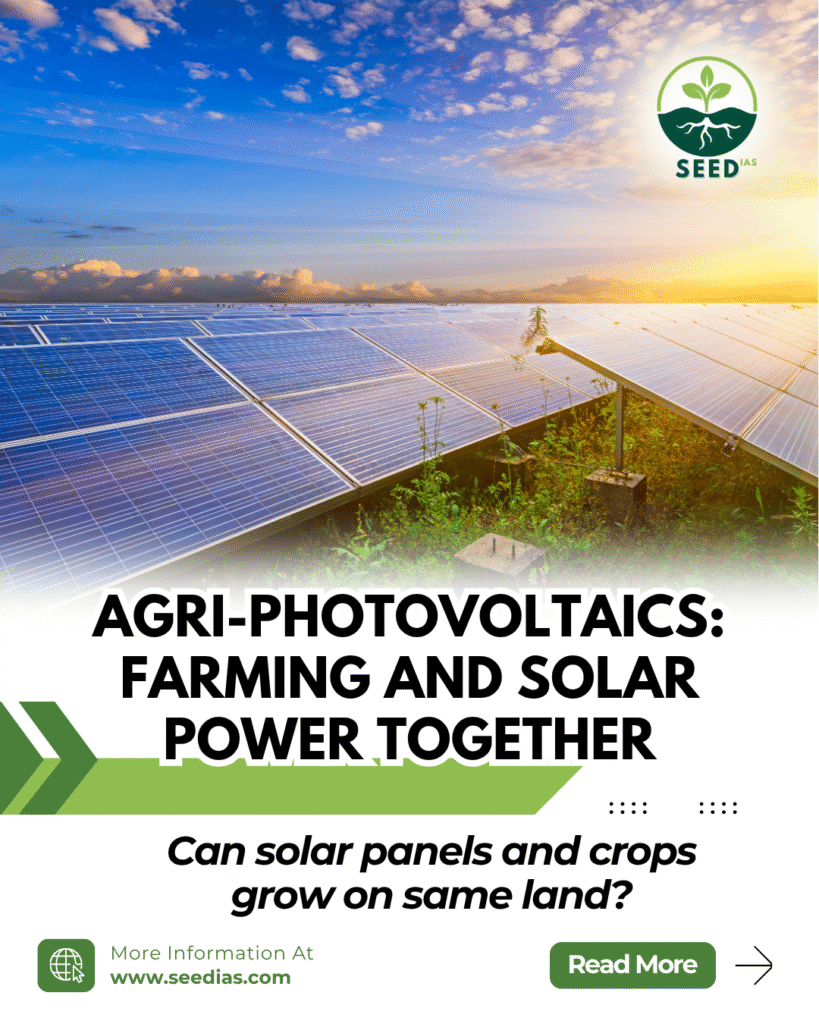
Agri-Photovoltaics | PM-KUSUM | Renewable Energy & Agriculture
CONTEXT OF THE NEWS
The Union Budget 2026-27 nearly doubled allocation to PM-KUSUM scheme to ₹5,000 crore, signalling a major push for solarisation of agriculture.
In this context, Agri-Photovoltaics (AgriPV) is gaining attention as a solution to balance food security and renewable energy expansion.
BACKGROUND
India is targeting:
- 300 GW Solar Capacity by 2030
- Net-Zero Emissions by 2070
- Doubling Farmers’ Income
However, large solar parks require huge land areas, creating a Food vs Fuel dilemma:
- Solar parks need agricultural land
- Agriculture is essential for food security
Agri-Photovoltaics (AgriPV) emerges as a dual-use solution to this challenge.
NEWS BREAKDOWN
What is Agri-Photovoltaics (AgriPV)?
Agri-Photovoltaics (AgriPV) refers to simultaneous use of land for agriculture and solar power generation.
Instead of clearing farmland for solar parks:
- Solar panels are installed above crops
- Or placed between crop rows
- Both energy and crops produced together
This creates a dual-use land model.
How Agri-Photovoltaics Works
Solar panels:
- Provide partial shade
- Reduce heat stress
- Reduce water loss
Plants:
- Release moisture (transpiration)
- Cool solar panels
- Improve solar efficiency
This creates a mutually beneficial micro-climate.
Types of Agri-Photovoltaic Systems
| Type | Features | Best Use |
|---|---|---|
| Elevated Systems | Panels mounted high above crops | Mechanised farming |
| Row-Based Systems | Panels in rows | Sun-loving crops |
| Vertical Systems | Panels upright like fences | Limited land areas |
| Greenhouse Systems | Panels integrated into greenhouses | Controlled farming |
Crops Suitable for AgriPV
Crop selection depends on shade tolerance and regional climate.
Example Crops
Madhya Pradesh
- Tomato
- Onion
- Turmeric
- Tulsi
Karnataka & Maharashtra
- Ragi
- Jowar
- Grapes
- Banana
- Brinjal
Region-specific planning is essential.
Benefits of Agri-Photovoltaics
1. Income Diversification
Farmers can:
- Use solar power for irrigation
- Replace diesel pumps
- Sell surplus power to DISCOMs (Distribution Companies)
Creates secondary income source.
2. Water Conservation
Solar panel shade:
- Reduces evapotranspiration
- Retains soil moisture
- Improves water-use efficiency
Useful in Rajasthan and Gujarat.
3. Weather Protection
Solar panels protect crops from:
- Heat waves
- Heavy rainfall
- Hailstorms
4. Strengthening Rural Economy
Solar energy can support:
- Cold storage
- Food processing
- Small agro industries
- Rural micro enterprises
Business Models
AgriPV can operate through:
- Farmer ownership model
- Farmers Producer Organisation (FPO) model
- Private leasing model
- Public sector development model
Current Status in India
- Around 50 pilot AgriPV projects in India
- Example: ICAR-CAZRI (Indian Council of Agricultural Research – Central Arid Zone Research Institute), Jodhpur
- Large-scale commercial adoption yet to begin
- Proposal for National Agri-Photovoltaics Mission
- Proposed 10 GW AgriPV component under PM-KUSUM 2.0
Importance for India
Food vs Fuel Dilemma
India has:
- 50% land under agriculture
- Growing energy demand
AgriPV avoids:
- Land acquisition conflicts
- Food production loss
Strengthening Agrarian Economy
- Farmers become energy producers
- Decentralised energy generation
- Reduced dependence on fossil fuels
Alignment with National Missions
AgriPV supports:
- PM-KUSUM Scheme
- Net Zero 2070 target
- Renewable energy expansion
- Doubling farmers income
Barriers to Adoption
High Capital Cost
- Elevated mounting structures expensive
- Steel structure costs high
Yield Risks
Wrong panel-crop combination may:
- Reduce crop yield
- Affect crop quality
Regulatory Challenges
Lack of clarity on:
- Land classification
- Tariffs
- Grid connectivity
Ownership Issues
Possible disputes:
- Land rights
- Revenue sharing
- Long-term agreements
Data Scarcity
Only 50 pilot projects
Limited:
- Crop performance data
- Climate-specific data
Maintenance Challenges
- Solar panel cleaning needs water
- Runoff may affect soil health
Measures for Large-Scale Adoption
Targeted Research
Institutions:
- ICAR
- NISE (National Institute of Solar Energy)
Should:
- Identify crop-panel combinations
- Map agro-climatic suitability
Financial Support
Government should provide:
- Subsidies
- Viability Gap Funding (VGF)
- Soft loans
Policy Framework
Need:
- National Agrivoltaics Policy
- Technical standards
- Grid connectivity rules
Capacity Building
Role of Krishi Vigyan Kendras (KVKs)
- Train farmers
- Demonstration projects
- Modern irrigation techniques
State Level Support
States should:
- Identify clusters
- Simplify approvals
- Provide guidelines
PRELIMS FOCUS
Key Facts:
- PM-KUSUM Scheme — Solarisation of agriculture
- Agri-Photovoltaics — Dual land use
- 300 GW Solar Target — 2030
- Net-Zero Target — 2070
- ICAR-CAZRI — Pilot AgriPV in Jodhpur
- NISE — National Institute of Solar Energy
- DISCOM — Distribution Company
CONCLUSION / WAY FORWARD
Agri-Photovoltaics can transform farms into energy hubs, balancing food security, renewable energy, and farmer incomes sustainably.
PRELIMS CHECK
Question 1
With reference to Agri-Photovoltaics, consider the following statements:
- It involves simultaneous use of land for solar power and agriculture
- It increases evapotranspiration from soil
- It can help reduce farmer dependence on diesel pumps
Which of the statements are correct?
A. 1 and 3 only
B. 2 and 3 only
C. 1 and 2 only
D. 1, 2 and 3
Question 2
Consider the following institutions:
- ICAR
- NISE
- Krishi Vigyan Kendras
Which of the above are relevant for Agri-Photovoltaics adoption?
A. 1 only
B. 1 and 2 only
C. 2 and 3 only
D. 1, 2 and 3
Question 3
Agri-Photovoltaics primarily helps address:
- Food vs Fuel dilemma
- Renewable energy expansion
- Farmer income diversification
Select the correct answer:
A. 1 only
B. 1 and 2 only
C. 2 and 3 only
D. 1, 2 and 3
ANSWERS AND EXPLANATION
Answers:
1 — A
2 — D
3 — D
Explanation:
Question 1
- AgriPV reduces evapotranspiration, not increases
- Helps reduce diesel pump dependence
- Enables dual land use
Question 2
- ICAR — Research
- NISE — Solar technology
- KVKs — Farmer training
All relevant.
Question 3
- AgriPV addresses food vs fuel
- Expands renewable energy
- Diversifies farmer income
All correct.
“Great nations solve future challenges by integrating innovation with tradition — Agri-Photovoltaics is one such step toward India’s sustainable future.”