CONTEXT OF THE NEWS
India’s logistics costs have declined to 7.97% of GDP.
This improvement is strongly linked to the expansion of Gati Shakti Cargo Terminals (GCTs) under the PM Gati Shakti National Master Plan, which focuses on integrated and multimodal infrastructure planning.
BACKGROUND
India has traditionally faced high logistics costs due to fragmented transport systems and over-dependence on roads.
The push for rail-based, multimodal logistics directly links to GS Paper III (Infrastructure, Logistics, Economic Development) and Prelims (Government Schemes & Transport Infrastructure).
NEWS BREAKDOWN
What are Gati Shakti Cargo Terminals (GCTs)?
GCTs are modern multimodal railway cargo hubs developed under the Gati Shakti Multi-Modal Cargo Terminal Policy by the Ministry of Railways.
Key features
- Integrate RAIL + ROAD + PORTS + AIRPORTS
- Function as single-window cargo handling points
- Reduce logistics delays and handling costs
Why were GCTs needed?
Earlier freight movement in India was:
- Fragmented across modes
- Poorly connected
- Time-consuming and expensive
This resulted in:
- High logistics costs
- Longer turnaround times
- Traffic congestion
- Higher carbon emissions
GCTs solve this by
- Acting as strategic logistics nodes
- Enabling seamless multimodal movement
- Cutting handling time and fuel use
Operational Features of GCTs
Engine-on-Load (EOL) System
- Trains depart immediately after loading/unloading
- Reduces idle time of wagons
Modern Infrastructure
- Mechanised loading systems
- Silos and automated cargo handling
- Better utilisation of railway assets
Sustainability and Cost Efficiency
Rail transport advantages
- Less than half the cost of road transport
- Nearly 90% lower carbon emissions
Official data (since 2014)
- 2,672 million tonnes freight shifted to rail
- 143.3 million tonnes of CO₂ emissions saved
This supports India’s climate and decarbonisation goals.
Key GCTs Driving Logistics Growth
- Manesar GCT (Haryana)
- India’s largest automobile cargo terminal
- Capacity: 4.5 lakh vehicles per year
- Linked via Haryana Orbital Rail Corridor
- Moinarband & Cinnamara GCTs (Assam)
- Strengthen North-East regional trade
- Handle petroleum, fertilisers, food grains, containers
- New Sanjali GCT (Gujarat)
- Built on private land
- Located on Western Dedicated Freight Corridor
- Promotes high-speed, green logistics
Progress Under GCT Programme
- 306 GCTs approved by Indian Railways
- 118 GCTs commissioned
- Total capacity: 192 million tonnes per annum
- Freight revenue:
- 4× increase between 2022–23 and 2024–25
- Reached ₹12,608 crore
GATI SHAKTI MULTI-MODAL CARGO TERMINAL POLICY, 2021
Objective
- Faster cargo terminal development
- Increased private sector participation
- Demand-driven infrastructure growth
Key incentives
- Cost exemptions
- Freight rebates
- Railway-supported infrastructure
- Commercial use of surplus land via Rail Land Development Authority (RLDA)
Goal
- Position India as a global logistics hub
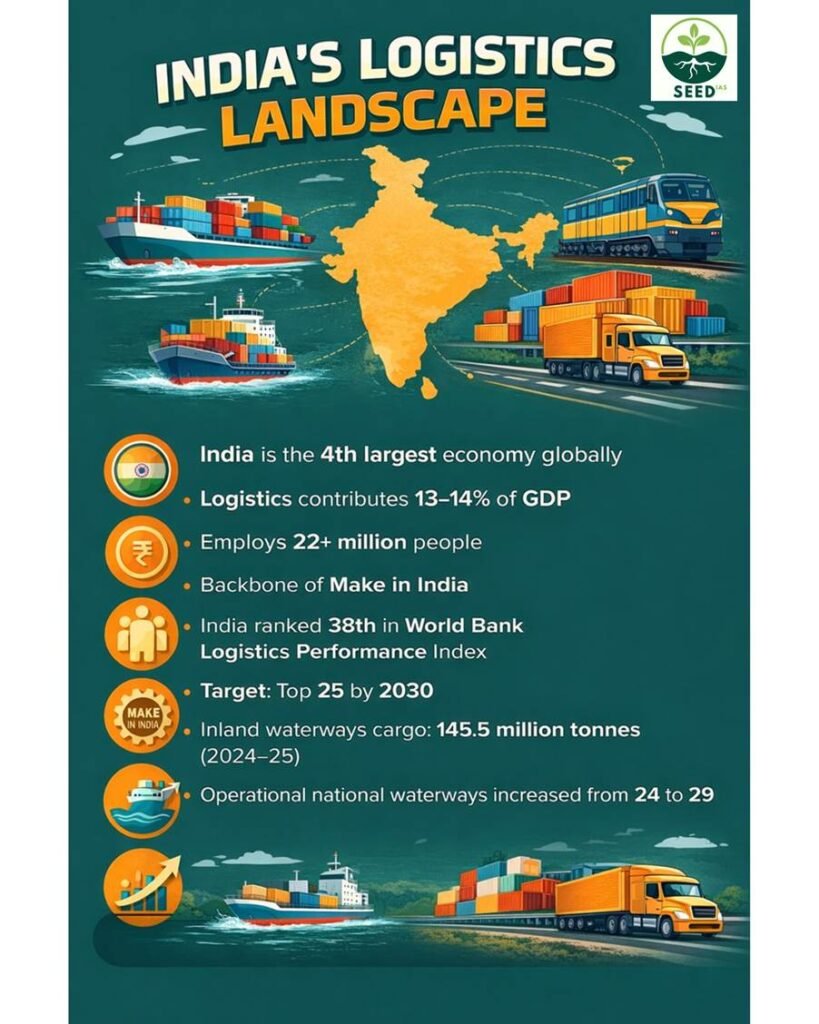
KEY GOVERNMENT INITIATIVES IN LOGISTICS
- National Logistics Policy
- PM GatiShakti National Master Plan
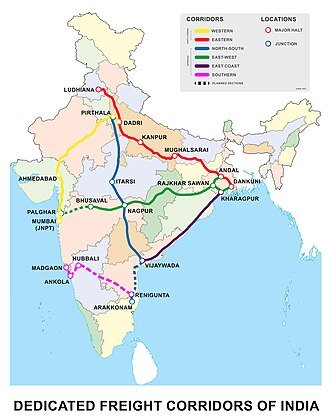
- Dedicated Freight Corridors
- Eastern DFC: Ludhiana–Sonnagar (1337 km)
- Western DFC: JNPT–Dadri (1506 km)
- Multi-Modal Logistics Parks under Bharatmala Pariyojana
- Logistics Data Bank (LDB) – 75 million+ EXIM containers tracked
- Unified Logistics Interface Platform (ULIP)
- e-Way Bill System
- Gati Shakti Vishwavidyalaya
- LEADS Index
KEY CHALLENGES IN INDIA’S LOGISTICS SECTOR
- Logistics cost still high at 7.97% of GDP
- Road dominance: 60–65% freight by road
- Rail capacity constraints and weak last-mile links
- Port inefficiencies: draft depth, evacuation delays
- Compliance burdens despite GST
- Highly fragmented sector
- Uneven digital adoption
- Road transport causes 12% of India’s energy-related CO₂ emissions
MEASURES TO STRENGTHEN INDIA’S LOGISTICS SECTOR
- Fast-track DFCs and multimodal projects
- Improve last-mile connectivity
- Nationwide single-window clearances
- Promote AI, IoT, blockchain adoption
- Upgrade warehousing and cold storage
- Expand logistics skill development
- Promote green logistics corridors and carbon credits
PRELIMS FOCUS
- Logistics cost (2023–24): 7.97% of GDP
- GCT Policy launched: 2021
- Approved GCTs: 306
- Commissioned GCTs: 118
- DFC lengths: EDFC 1337 km, WDFC 1506 km
- LDB tracked containers: 75 million+
CONCLUSION / WAY FORWARD
Strengthening GCTs, multimodal connectivity, and green logistics can sustainably reduce costs, boost exports, and enhance India’s global supply-chain competitiveness.
PRELIMS CHECK
Q1. With reference to Gati Shakti Cargo Terminals, consider the following statements:
- They are developed under a policy notified in 2021.
- They integrate rail, road, ports, and airports.
- They are exclusively developed on government-owned land.
Which of the statements given above are correct?
(a) 1 and 2 only
(b) 2 and 3 only
(c) 1 and 3 only
(d) 1, 2 and 3
Q2. Consider the following pairs:
| Corridor | Terminal Location |
| Western DFC | New Sanjali |
| Haryana Orbital Rail Corridor | Manesar |
| Eastern DFC | Cinnamara |
Which of the pairs given above are correctly matched?
(a) Only one
(b) Only two
(c) All three
(d) None
Q3. Consider the following statements:
- Rail freight has nearly 90% lower carbon emissions than road freight.
- Road transport accounts for about 12% of India’s energy-related CO₂ emissions.
Which of the statements given above is/are correct?
(a) 1 only
(b) 2 only
(c) Both 1 and 2
(d) Neither 1 nor 2
Answers with Explanation
Q1 – (a)
- GCT Policy notified in 2021.
- GCTs enable multimodal integration.
- They can also be built on private land.
Q2 – (b)
- New Sanjali → Western DFC ✔
- Manesar → Haryana Orbital Rail Corridor ✔
- Cinnamara is not on Eastern DFC ✘
Q3 – (c)
- Rail freight emits ~90% less CO₂.
- Road transport contributes ~12% energy-related emissions.
“Infrastructure builds nations, but efficient logistics make them competitive.”