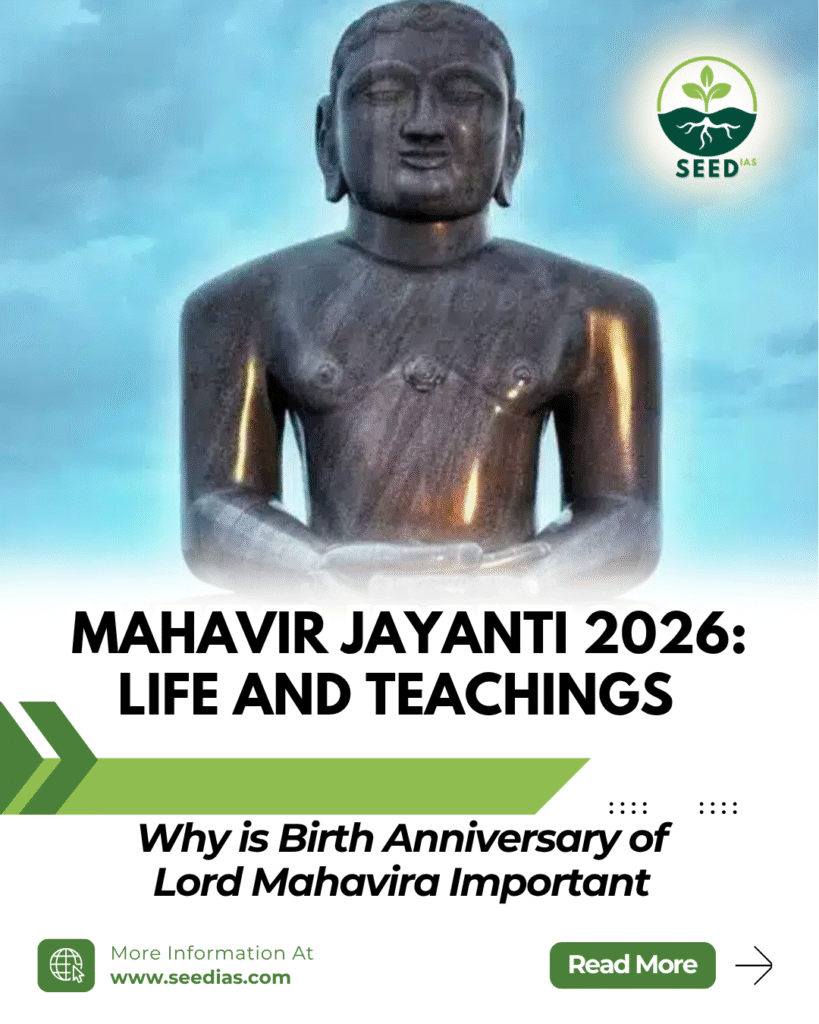
Context of the News
The President of India extended greetings on Mahavir Jayanti (Mahaveer Janma Kalyanak), celebrating the birth of Lord Vardhamana Mahavira, the 24th Tirthankara of Jainism.
- In 2026, it is observed on 31st March
- Falls on:
- Trayodashi tithi
- Shukla Paksha (waxing phase)
- Month of Chaitra
Background
- Jainism is one of the ancient Indian religions
- It emphasizes:
- Non-violence
- Self-discipline
- Spiritual liberation
- Before Mahavira:
- Parshvanatha (23rd Tirthankara) propagated 4 vows
- Mahavira systematized and expanded Jain philosophy
News Breakdown
1. Who was Lord Mahavira?
Early Life
- Born in 599 BCE
- Birthplace: Kundalagrama (near Vaishali, Bihar)
- Dynasty: Ikshvaku
- Parents:
- King Siddhartha
- Queen Trishala
Spiritual Journey
- Renounced worldly life at age 30
- Practiced severe asceticism
- Attained:
Definition:
Kevala Jnana = Supreme infinite knowledge (omniscience)
- Achieved under a Sal tree
- Near Rijupalika river
Titles and Meaning
- Jina → “Conqueror of inner passions”
- Mahavira → “Great Hero”
Nirvana (Liberation)
- Attained at age 72
- Place: Pavapuri (Bihar)
Definition:
Nirvana/Moksha = Liberation from cycle of birth and death
2. Core Philosophy: Path to Liberation
Tri-Ratna (Three Jewels)
Definition:
Tri-Ratna = Path to spiritual liberation
- Samyak Darshan → Right Faith
- Samyak Gyan → Right Knowledge
- Samyak Charitra → Right Conduct
3. Five Great Vows (Maha-Vratas)
| Vow | Meaning |
|---|---|
| Ahimsa | Non-violence (supreme principle) |
| Satya | Truthfulness |
| Asteya | Non-stealing |
| Aparigraha | Non-possessiveness |
| Brahmacharya | Celibacy/self-control |
Important Note
- Parshvanatha → Taught 4 vows
- Mahavira added → Brahmacharya
4. Key Teachings Explained
(A) Ahimsa (Non-Violence)
- Core of Jain philosophy
- Applies to:
- Physical actions
- Speech
- Thoughts
(B) Aparigraha (Non-Possessiveness)
- Encourages:
- Minimalism
- Detachment from wealth
(C) Brahmacharya (Self-Control)
- Control over:
- Desires
- Senses
5. Philosophical Contributions
(A) Anekantavada
Definition:
Doctrine that truth has multiple perspectives
- Reality is complex
- Promotes:
- Tolerance
- Intellectual humility
(B) Syadvada
Definition:
All statements are conditionally true
- Truth depends on:
- Context
- Viewpoint
6. Jain Sangha Structure
Mahavira organized followers into:
- Sadhus → Monks
- Sadhvis → Nuns
- Shravaks → Laymen
- Shravikas → Laywomen
Disciples
- 11 Ganadharas (chief disciples)
- Important:
- Indrabhuti Gautama
- Sudharman
Sacred Texts
- Agam Sutras
- Initially:
- Oral tradition
- Later:
- Written on palm leaves
Prelims Focus
- Mahavira → 24th Tirthankara
- Born: 599 BCE, Kundalagrama (Bihar)
- Nirvana: Pavapuri
- Kevala Jnana → Omniscience
- Tri-Ratna → Path to liberation
- Anekantavada → Multiple truths
- Syadvada → Conditional truth
Conclusion / Way Forward
Mahavira’s teachings of non-violence, truth, and self-restraint remain relevant for ethical living and sustainable society in the modern world.
Prelims Check
Question 1
With reference to Jainism, consider the following statements:
- Mahavira was the founder of Jainism.
- He was the 24th Tirthankara.
- He attained Nirvana at Rajgir.
Which of the statements given above is/are correct?
(a) 2 only
(b) 1 and 2 only
(c) 2 and 3 only
(d) 1, 2 and 3
Question 2
Consider the following pairs:
| Concept | Meaning |
|---|---|
| 1. Anekantavada | Absolute truth is singular |
| 2. Syadvada | Truth is conditional |
| 3. Aparigraha | Non-possession |
Which of the pairs given above are correctly matched?
(a) 2 and 3 only
(b) 1 and 2 only
(c) 1 and 3 only
(d) 1, 2 and 3
Question 3
With reference to the teachings of Mahavira, consider the following:
- Ahimsa is the highest virtue.
- Brahmacharya was added by Mahavira to earlier vows.
- Tri-Ratna includes right livelihood.
Which of the statements given above is/are correct?
(a) 1 and 2 only
(b) 2 only
(c) 1 and 3 only
(d) 1, 2 and 3
Answers with Explanation
Answer 1: (a) 2 only
- Statement 1 is incorrect: Jainism existed before Mahavira.
- Statement 2 is correct: He is the 24th Tirthankara.
- Statement 3 is incorrect: Nirvana at Pavapuri, not Rajgir.
Answer 2: (a) 2 and 3 only
- Pair 1 is incorrect: Anekantavada = multiple truths, not singular.
- Pair 2 is correct: Syadvada = conditional truth.
- Pair 3 is correct: Aparigraha = non-possession.
Answer 3: (a) 1 and 2 only
- Statement 1 is correct: Ahimsa is supreme.
- Statement 2 is correct: Brahmacharya added by Mahavira.
- Statement 3 is incorrect: Tri-Ratna does not include livelihood.
“Non-violence and truth are the highest forms of strength.”