CONTEXT OF THE NEWS
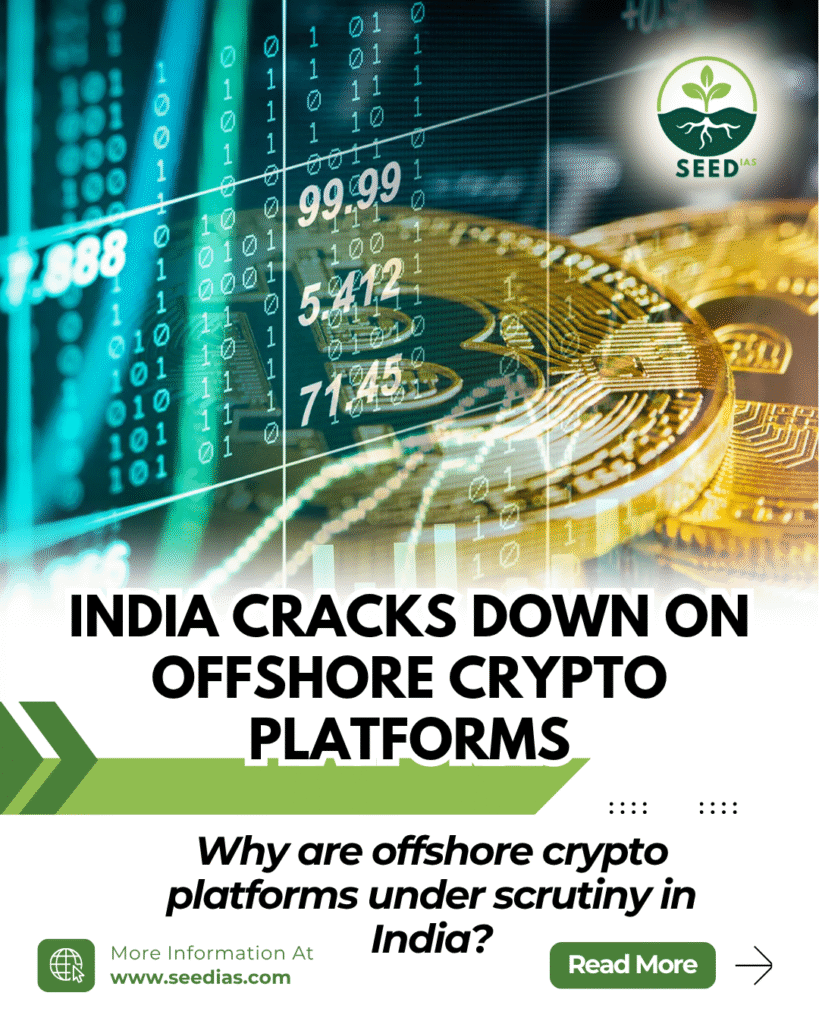
The Financial Action Task Force (FATF) in its March 2026 report highlighted India’s strong regulatory actions against Offshore Virtual Asset Service Providers (oVASPs) to curb money laundering and terror financing.
BACKGROUND
- Linked to:
- GS Paper 3 (Internal Security & Economy)
- Growing risks due to:
- Cryptocurrency misuse
- Cross-border financial crimes
- Legal framework in India:
- Prevention of Money Laundering Act (PMLA), 2002
- Finance Act, 2022 (Virtual Digital Assets)
NEWS BREAKDOWN
What are Offshore Virtual Asset Service Providers (oVASPs)?
oVASPs: Crypto-related service providers operating outside India but serving Indian users.
Core Functions of oVASPs
- Exchange:
- Crypto ↔ Crypto (e.g., Bitcoin to Ethereum)
- Fiat ↔ Crypto (e.g., INR to USDT)
- Transfer:
- Moving assets between wallets
- Safekeeping:
- Providing digital wallets
- Financial Services:
- Supporting crypto investments and offerings
What are Virtual Assets?
Virtual Assets (VA): Digital representations of value using blockchain technology.
Types of Virtual Assets
| Type | Description | Example |
|---|---|---|
| Cryptocurrency | Medium of exchange | Bitcoin, Ethereum |
| Stablecoins | Pegged to assets | USDT, USDC |
| NFTs | Unique digital ownership | Digital art |
| Governance Tokens | Voting rights in projects | DAO tokens |
KEY FATF HIGHLIGHTS ON INDIA
1. Virtual Asset Lab
- India setting up:
- Automated surveillance system
- Functions:
- Web monitoring
- Data analytics
- Detection of illegal crypto platforms
2. FIU-IND Regulations
FIU-IND: India’s financial intelligence agency monitoring suspicious transactions.
- Mandatory:
- Principal Officer (PO) in India
- Ensures:
- Legal accountability under PMLA
3. Crackdown on Scam Compounds
- Agencies involved:
- NIA, CBI, ED
- Target areas:
- Myanmar-Thailand border
- Cambodia, Laos
4. Blocking Non-Compliant Platforms
- 85 URLs blocked
- Tool used:
- Sahyog Portal
- Purpose:
- Remove illegal offshore platforms
5. Inter-Agency Coordination
- Virtual Assets Contact Sub-Group (2023)
- Role:
- Intelligence sharing
- Tracking crypto crime patterns
6. Tackling Regulatory Arbitrage
Regulatory Arbitrage: Exploiting weaker laws in other countries.
- Issue:
- Users shift to offshore platforms
- Solution:
- Mandatory local registration for oVASPs
7. Red Flag Monitoring
- FIU working with:
- Banks
- Payment gateways
- Detect:
- Suspicious crypto transactions
REGULATORY FRAMEWORK IN INDIA
Under PMLA, 2002
- oVASPs must:
- Register with FIU-IND
- Appoint Principal Officer
- Follow KYC norms
- Report Suspicious Transactions (STRs)
Under Finance Act, 2022
- 30% tax on crypto income
- 1% TDS on transactions
KEY CHALLENGES
1. Jurisdictional Issues
- Operate from:
- Low-regulation countries
2. Anonymity
- Difficult to:
- Trace transactions
3. Illicit Financial Flows
- Process:
- Convert illegal money → crypto → re-enter economy
4. Cybercrime Networks
- “Scam compounds” using:
- Forced labor
- Crypto fraud
WAY FORWARD
1. Strengthen Global Cooperation
- Support:
- FATF global standards
2. Improve Surveillance
- Expand:
- AI-based monitoring systems
3. Strict Enforcement
- Ensure:
- Universal KYC compliance
4. Reduce Regulatory Arbitrage
- Mandate:
- Local compliance for all platforms
5. Public Awareness
- Educate users about:
- Risks of offshore platforms
PRELIMS FOCUS
- FATF: Global anti-money laundering body
- oVASPs: Offshore crypto platforms
- PMLA, 2002: Anti-money laundering law
- 30% tax + 1% TDS on crypto (India)
- FIU-IND: Financial intelligence agency
- Regulatory Arbitrage: Exploiting legal gaps
CONCLUSION
India’s proactive regulation of offshore crypto platforms strengthens financial security, but sustained global coordination is essential to effectively combat evolving digital financial crimes.
PRELIMS CHECK
Question 1
Consider the following statements:
- Offshore VASPs operate outside a country but can serve its users.
- Regulatory arbitrage refers to strict compliance with multiple jurisdictions.
- FATF sets global standards to combat money laundering.
Which of the statements given above are correct?
(a) 1 and 3 only
(b) 2 and 3 only
(c) 1 and 2 only
(d) 1, 2 and 3
Question 2
With reference to Virtual Digital Assets (VDAs) in India, consider the following:
- Income from VDAs is taxed at 30%.
- TDS of 1% is applicable on transactions.
- VDAs are not covered under PMLA.
Which of the statements given above are correct?
(a) 1 and 2 only
(b) 2 and 3 only
(c) 1 and 3 only
(d) 1, 2 and 3
Question 3
Consider the following pairs:
| Term | Description |
|---|---|
| 1. FIU-IND | Financial intelligence unit |
| 2. STR | Suspicious Transaction Report |
| 3. NFT | Fungible digital asset |
How many of the pairs given above are correctly matched?
(a) Only one
(b) Only two
(c) All three
(d) None
ANSWERS WITH EXPLANATION
Answer 1: (a) 1 and 3 only
- oVASPs serve users across borders – Correct
- Regulatory arbitrage = exploiting weak laws, not strict compliance – Incorrect
- FATF sets AML standards – Correct
Answer 2: (a) 1 and 2 only
- 30% tax – Correct
- 1% TDS – Correct
- Covered under PMLA since 2023 – Statement 3 incorrect
Answer 3: (b) Only two
- FIU-IND – Correct
- STR – Correct
- NFT is non-fungible, not fungible – Incorrect
“Strong regulation today builds a secure digital economy for tomorrow.”