CONTEXT OF THE NEWS
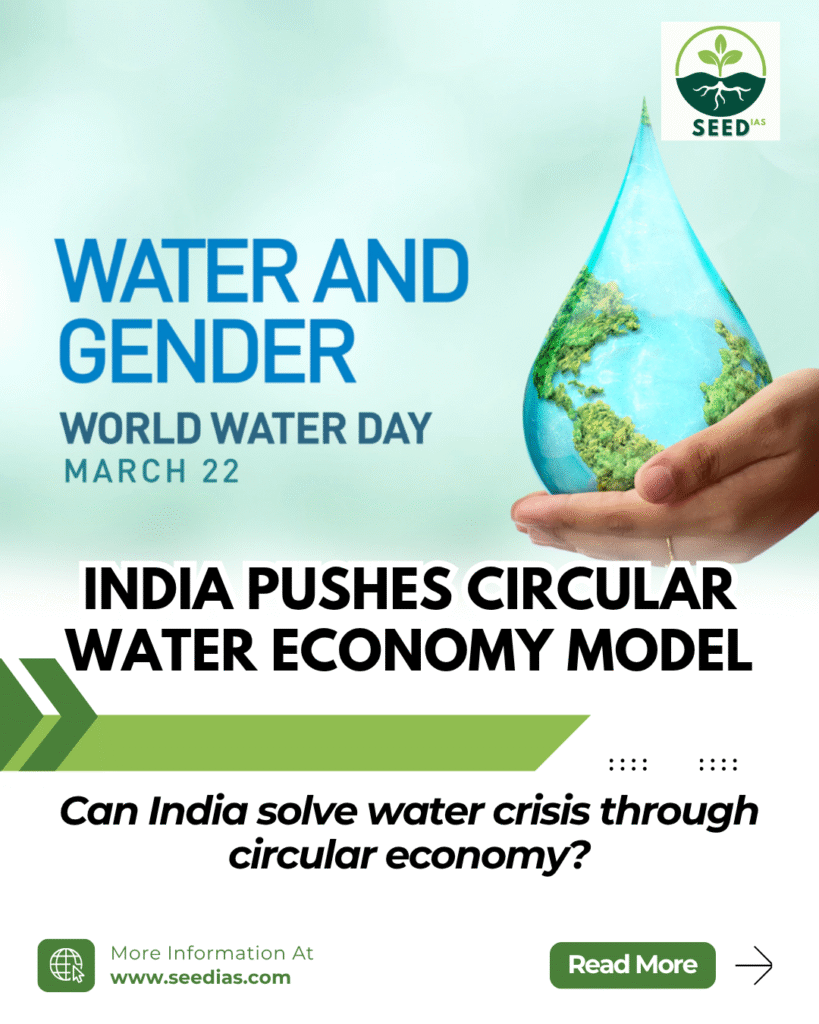
India, through the Ministry of Jal Shakti, organized the World Water Day Conclave 2026, signaling a strategic shift toward a circular water economy and data-driven water governance.
BACKGROUND
- World Water Day (22 March) is observed by the United Nations to highlight freshwater conservation.
- Directly linked to SDG 6: Clean Water and Sanitation.
- Increasing water stress in India makes it a critical topic for:
- GS Paper 1 (Geography – Water Resources)
- GS Paper 3 (Environment & Sustainable Development)
NEWS BREAKDOWN
What is Circular Water Economy?
Circular Water Economy: A restorative model where water is reused, recycled, and conserved, replacing the linear “take-use-discard” approach.
- Focuses on:
- Reduce
- Reuse
- Recycle
- Treats wastewater as a resource, not waste
Key Highlights of the Conclave
1. Focus on Circular Water Economy
- Promotes long-term sustainability
- Aims to decouple water use from economic growth
- Builds climate resilience
2. Launch of Major Water Data Resources
- Released:
- 7th Minor Irrigation Census
- 2nd Census of Water Bodies
- 1st Census of Springs
- National Water Data Policy 2026
Significance:
- Enables data-driven policy making
- Helps track water availability and usage patterns
3. Industry Commitments (Water Governance)
Zero Liquid Discharge (ZLD): A process where no industrial wastewater is discharged into the environment.
- Industry bodies committed to:
- Water audits by 2027
- ZLD by 2030
- 50% reduction in water footprint by 2030
4. Glacier Monitoring & Himalayan Security
GLOF (Glacial Lake Outburst Flood): Sudden release of water from a glacial lake due to dam failure.
- Collaboration with NRSC-ISRO
- Use of Bhuvan platform
- Focus on Himalayan glaciers (“Third Pole”)
5. Technological Integration
- Use of:
- Artificial Intelligence (AI)
- Internet of Things (IoT)
Purpose:
- Shift from traditional management → precision water governance
WORLD WATER DAY 2026
- Observed by: United Nations
- First Observed: 1993
- Origin: 1992 Rio Earth Summit
Theme 2026: “Water and Gender”
- Campaign: “Where water flows, equality grows”
- Focus:
- Women spend 250 million hours daily collecting water
- Links water access → gender equality
WATER CONSERVATION INITIATIVES IN INDIA
Legislative Framework
- Water Act, 1974
- Environment Protection Act, 1986
Policy & Schemes
- National Water Policy 2012
- Jal Jeevan Mission 2.0
- Atal Bhujal Yojana
- PM Krishi Sinchayee Yojana
KEY WATER CHALLENGES
Global Challenges
- 2.2 billion people lack safe drinking water
- 1.4 million deaths annually due to water-related diseases
- Climate extremes:
- Droughts + Floods
- 60% freshwater flows across borders → conflicts
India-Specific Challenges
1. Groundwater Depletion
- India = largest groundwater user
- Per capita availability:
- 1950: 5200 cubic meters
- 2024: 1400–1500 cubic meters
- 2050 projection: 1191 cubic meters
2. Water Quality Issues
| Type | Cause | Impact |
| Geogenic | Arsenic, Fluoride | Affects ~90 million people |
| Industrial/Agricultural | Pesticides, sewage | 70% surface water polluted |
3. Inter-State Water Disputes
- Examples:
- Cauvery dispute
- Krishna river dispute
4. Himalayan Crisis
- Glaciers melting → Threat to:
- Ganga
- Indus
- Brahmaputra
5. Urban Water Stress
- Cities like:
- Bengaluru
- Chennai
- Facing “Day Zero” risk
STEPS FOR SUSTAINABLE WATER MANAGEMENT
1. Agricultural Reforms
- Agriculture uses ~80% of water
- Solutions:
- Drip irrigation
- Crop diversification (Millets)
2. Industrial & Urban Circularity
- Promote:
- Decentralized STPs
- Dual piping systems
3. Traditional Water Systems
- Revive:
- Ahar-Pynes (Bihar)
- Johads (Rajasthan)
- Stepwells (Baolis)
4. Governance & Public Participation
- Campaign: “Jan Bhagidari se Jal Sanchay”
- Make water conservation a people’s movement
5. Economic Tools
- Tiered water pricing
- Water Credits (like Carbon Credits)
PRELIMS FOCUS
- World Water Day: 22 March (since 1993)
- Theme 2026: Water and Gender
- ZLD: No discharge of industrial wastewater
- GLOF: Glacial Lake Outburst Flood
- India water stress threshold: <1700 cubic meters per capita
- Water scarcity threshold: <1000 cubic meters
CONCLUSION
India’s shift to a circular water economy integrates technology, industry accountability, and community participation to ensure sustainable, equitable, and climate-resilient water management.
PRELIMS CHECK
Question 1
Consider the following statements:
- Circular water economy promotes reuse and recycling of water.
- Zero Liquid Discharge allows partial discharge of treated wastewater.
- GLOF is associated with glacial lake failures.
Which of the statements given above are correct?
(a) 1 and 3 only
(b) 1 and 2 only
(c) 2 and 3 only
(d) 1, 2 and 3
Question 2
With reference to World Water Day, consider the following statements:
- It was first observed in 1993.
- It is coordinated by UNESCO.
- It supports Sustainable Development Goal 6.
Which of the statements given above are correct?
(a) 1 and 3 only
(b) 2 only
(c) 1, 2 and 3
(d) 3 only
Question 3
Consider the following pairs:
| Term | Description |
| 1. GLOF | Sudden release of glacial lake water |
| 2. ZLD | No wastewater discharge from industries |
| 3. Water Stress | Availability below 1000 cubic meters |
How many of the pairs given above are correctly matched?
(a) Only one
(b) Only two
(c) All three
(d) None
ANSWERS WITH EXPLANATION
Answer 1: (a) 1 and 3 only
- Circular economy promotes reuse – Correct
- ZLD means zero discharge, not partial – Incorrect
- GLOF relates to glacial lake bursts – Correct
Answer 2: (a) 1 and 3 only
- First observed in 1993 – Correct
- Coordinated by UN-Water, not UNESCO – Incorrect
- Linked to SDG 6 – Correct
Answer 3: (b) Only two
- GLOF – Correct
- ZLD – Correct
- Water stress threshold is <1700, not 1000 – Incorrect
“Water saved today secures generations tomorrow—every drop counts in nation building.”