CONTEXT OF THE NEWS
Every year, 24th March is observed as World Tuberculosis (TB) Day to raise awareness about the health, social, and economic burden of TB and global efforts to eliminate it.
BACKGROUND
- 24 March 1882: Discovery of Mycobacterium tuberculosis by Dr. Robert Koch.
- TB remains one of the top infectious killers globally.
- UPSC Link: Public Health, Government Schemes, Social Issues (GS Paper II & III).
NEWS BREAKDOWN
WHAT IS TUBERCULOSIS (TB)?
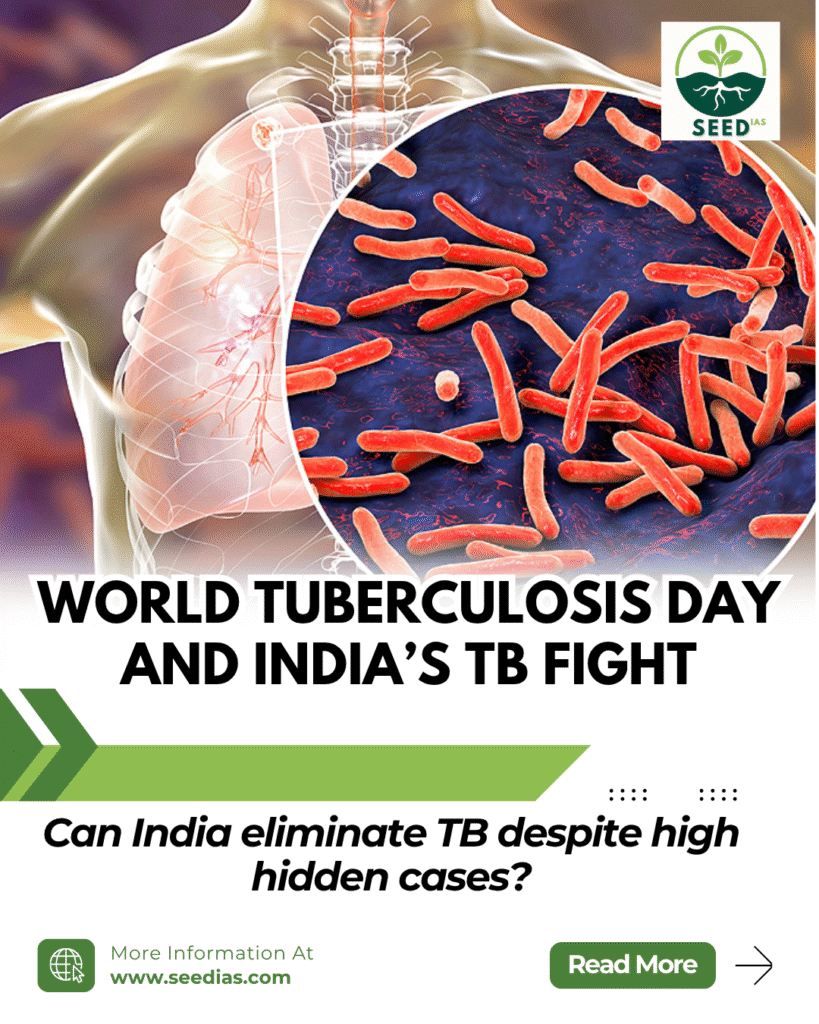
- Tuberculosis (TB): A bacterial infectious disease caused by Mycobacterium tuberculosis, mainly affecting the lungs (Pulmonary TB).
- It spreads through airborne droplets when infected persons cough or sneeze.
SIGNIFICANCE OF WORLD TB DAY 2026
- Theme 2026: “Yes! We can End TB!”
- Emphasizes:
- Localized action
- Innovation adoption
- Community participation
- Economic Insight:
- Every $1 invested → up to $43 returns in health and productivity.
INDIA’S KEY INITIATIVES (2026)
- TB Mukt Bharat Abhiyaan (100 Days)
- Mission-mode campaign for rapid detection and treatment adherence
- TB Mukt Bharat App
- Digital tracking of patients and treatment monitoring
- TB Mukt Urban Ward Initiative
- Focus on high-transmission urban areas
STATUS OF TB IN INDIA
KEY DATA (WHO Global TB Report 2025)
- India accounts for ~25% of global TB cases
- Treatment Coverage:
- 53% (2015) → 92% (2024)
- Mortality Rate:
- 28 per lakh (2015) → 21 per lakh (2024)
- Treatment Success Rate:
- 90% (India) vs 88% (Global average)
- Concerns:
- 28% of global TB deaths
- ~1 lakh “missing cases” (undiagnosed)
- 8.8% global detection gap
INDIA’S TB ELIMINATION TARGET
| Parameter | India Target | Global Target (WHO) |
| Elimination Year | 2025 | 2030 |
| Definition | <1 case per million/year | Same |
| Strategy | DTPB (Detect–Treat–Prevent–Build) | End TB Strategy |
- Progress:
- 21% decline in incidence (2015–2024)
- 28% reduction in deaths
INDIA’S ADVANCEMENTS
1. Early Detection
- World’s largest TB lab network
- 92% patients tested for Rifampicin resistance
2. Shorter Treatment
- BPaLM Regimen:
- Reduces duration from 18–24 months → 6 months
3. Decentralised Care
- 1.78 lakh Ayushman Arogya Mandirs
- Community support via Ni-kshay Mitras
4. Nutrition Support
- Ni-Kshay Poshan Yojana:
- ₹1000/month financial aid
- Total ₹3000–₹6000 per patient
MAJOR CHALLENGES
1. Drug-Resistant TB (MDR/XDR-TB)
- Definition:
- MDR-TB: Resistant to at least Isoniazid & Rifampicin
- India accounts for 32% of global MDR-TB cases
- Treatment success:
- Drug-sensitive TB → ~90%
- MDR-TB → ~77%
2. Malnutrition & Co-morbidities
- 35% TB cases linked to malnutrition
- Associated diseases:
- Diabetes (3.2 lakh TB cases)
- HIV
- High burden states:
- Bihar, Jharkhand, Uttar Pradesh
3. Diagnostic Gaps
- Stigma leads to:
- Under-reporting
- Treatment discontinuation
- Continued use of less sensitive sputum microscopy
- Uneven access to Truenat & CBNAAT
4. Socio-Economic Factors
- TB is a disease of poverty
- Risk factors:
- Overcrowding
- Poor ventilation
- Migration disrupting treatment
5. Supply Chain Issues
- Drug stockouts in states
- Leads to:
- Missed doses
- Drug resistance
MEASURES TO STRENGTHEN TB ELIMINATION
1. Detect Silent Cases
- Nearly 50% TB cases are asymptomatic
- Solutions:
- AI-based Chest X-rays
- Non-invasive swabs
2. Control Drug Resistance
- Rapid molecular testing
- Early identification of rifampicin resistance
3. Tribal-Focused Strategy
- 50% higher TB prevalence in Scheduled Tribes
- Use District Mineral Foundation (DMF) funds
4. Digital Tracking
- TB Mukt Bharat App
- Real-time tracking
- Prevents treatment dropout
5. Nutrition Integration
- Link Ni-Kshay Poshan Yojana with PDS
- Expand Ni-kshay Mitra initiative
6. Preventive Treatment (TPT)
- Treat household contacts
- Break transmission chain early
PRELIMS FOCUS
- Causative Agent: Mycobacterium tuberculosis
- Transmission: Airborne droplets
- BCG Vaccine: Effective mainly in children
- MDR-TB: Resistance to Isoniazid & Rifampicin
- NTEP: Renamed from RNTCP in 2020
- DTPB Strategy: Detect–Treat–Prevent–Build
- WHO End TB Target:
- 80% reduction in incidence
- 90% reduction in deaths by 2030
CONCLUSION / WAY FORWARD
Eliminating TB requires integrating healthcare with nutrition, poverty reduction, and universal health access, ensuring no patient is left undiagnosed or untreated.
PRELIMS CHECK
Question 1
Consider the following statements regarding Tuberculosis:
- It is caused by a virus affecting mainly the lungs.
- MDR-TB is resistant to at least Isoniazid and Rifampicin.
- TB spreads through airborne transmission.
Which of the statements given above are correct?
(a) 1 and 2 only
(b) 2 and 3 only
(c) 1 and 3 only
(d) 1, 2 and 3
Question 2
With reference to TB elimination in India, consider the following:
- India aims to eliminate TB by 2025.
- TB elimination is defined as less than one case per lakh population.
- NTEP follows the Detect–Treat–Prevent–Build strategy.
Which of the statements given above are correct?
(a) 1 and 3 only
(b) 2 and 3 only
(c) 1 and 2 only
(d) 1, 2 and 3
Question 3
Consider the following factors contributing to TB burden:
- Malnutrition
- Diabetes
- Overcrowding
- Migration
How many of the above are correct risk factors for TB?
(a) Only one
(b) Only two
(c) Only three
(d) All four
ANSWERS WITH EXPLANATION
Answer 1: (b) 2 and 3 only
- TB is caused by a bacterium, not a virus
- MDR-TB resists Isoniazid & Rifampicin
- Spread is airborne
Answer 2: (a) 1 and 3 only
- India target: 2025
- Definition is <1 case per million, not lakh
- DTPB strategy is correct
Answer 3: (d) All four
- Malnutrition weakens immunity
- Diabetes increases susceptibility
- Overcrowding aids spread
- Migration disrupts treatment
FINAL THOUGHT
“Great nations are built not just by curing diseases, but by ensuring no one is left behind in the journey to health.”