Why in News?
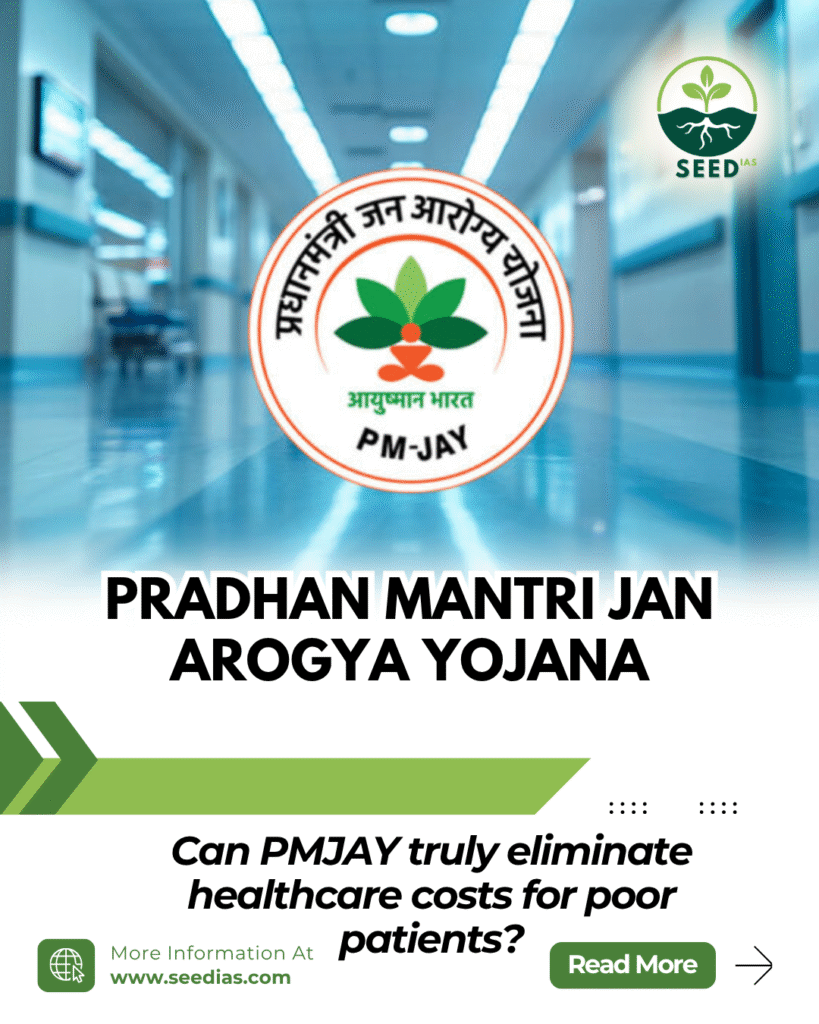
- An evaluation by NITI Aayog shows that beneficiaries under PMJAY still incur significant Out-of-Pocket Expenditure (OOPE), especially in private hospitals.
Key Findings of the Study
- High OOPE in private hospitals: ~₹53,965 per hospitalization
- Public vs Private gap:
- Government hospitals: ~₹21,827
- Private hospitals: more than double
- Limited cashless benefit:
- 65% patients incurred OOPE
- Only 35% experienced fully cashless treatment
- Major cost drivers:
- Medicines
- Diagnostics
- Transportation (not covered)
- Marginal relief vs uninsured:
- PMJAY OOPE: ₹34,790
- Uninsured: ₹38,084
About PMJAY (Pradhan Mantri Jan Arogya Yojana)
- Launched in 2018 under Ayushman Bharat
- World’s largest government-funded health assurance scheme
- Implemented by National Health Authority
Objective
- Achieve Universal Health Coverage (UHC)
- Reduce catastrophic health expenditure
Coverage & Features
- Insurance cover: ₹5 lakh per family per year
- Scope: Secondary and tertiary hospitalization
- Pre/Post hospitalization:
- 3 days pre-hospitalization
- 15 days post-hospitalization
- Pre-existing diseases: Covered from Day 1
Funding Pattern
- 60:40 → General states
- 90:10 → North-East & Himalayan states
- 100% → Union Territories (UTs) without legislature
Eligibility & Beneficiaries
- Based on Socio-Economic Caste Census (SECC) 2011
- Covers ~55 crore population initially
- No cap on family size, age, or gender
Recent Expansions
- Universal coverage for 70+ elderly (Ayushman Vay Vandana Card)
- Inclusion of Accredited Social Health Activists (ASHAs), Anganwadi Workers (AWWs), and Anganwadi Helpers (AWHs)
Key Operational Features
- Cashless & paperless treatment
- National portability across India
- Access in public + private empanelled hospitals
- Health Benefit Packages (HBP): Predefined packages covering treatment, medicines, diagnostics, and hospital charges
Achievements
- 42 crore Ayushman Cards issued
- 11 crore hospital admissions (till Dec 2025)
- Significant gender inclusion
Issues Highlighted
- High Out-of-Pocket Expenditure (OOPE) persists
- Private hospitals impose higher financial burden
- Non-coverage of transport and indirect costs
- Weak regulation and monitoring
- Gap between scheme design and implementation
Way Forward
- Strengthen regulation of private hospitals
- Expand coverage to include Outpatient Department (OPD) care and transport
- Improve package pricing and monitoring
- Increase public healthcare capacity
- Ensure truly cashless implementation
Conclusion
- PMJAY is a major step toward Universal Health Coverage (UHC)
- However, reducing Out-of-Pocket Expenditure (OOPE) is crucial to achieve real financial protection
PRACTICE QUESTIONS
Q1. With reference to the Pradhan Mantri Jan Arogya Yojana (PMJAY), consider the following statements:
- It provides health insurance cover of ₹5 lakh per individual per year.
- It covers pre-existing diseases from the first day of enrolment.
- It includes coverage for outpatient (OPD) treatment.
Which of the statements given above is/are correct?
(a) 2 only
(b) 1 and 2 only
(c) 2 and 3 only
(d) 1, 2 and 3
Q2. Consider the following statements regarding PMJAY:
- Beneficiaries are identified based on the Socio-Economic Caste Census (SECC) 2011.
- The scheme is implemented at the national level by the National Health Authority.
- The scheme provides completely free and cashless treatment in all cases without any out-of-pocket expenditure.
Which of the statements given above is/are correct?
(a) 1 and 2 only
(b) 2 and 3 only
(c) 1 only
(d) 1, 2 and 3
Q3. With reference to health financing in India, consider the following statements:
- Out-of-Pocket Expenditure (OOPE) is higher in private hospitals compared to public hospitals under PMJAY.
- Transportation costs are fully covered under PMJAY.
- PMJAY aims to reduce catastrophic health expenditure and promote Universal Health Coverage (UHC).
Which of the statements given above is/are correct?
(a) 1 and 3 only
(b) 1 only
(c) 2 and 3 only
(d) 1, 2 and 3
Answer Key
- Q1: (a) 2 only
- Q2: (a) 1 and 2 only
- Q3: (a) 1 and 3 only